

































Fishing today is no longer simply about going to sea; it involves running a business under pressure, with shrinking margins and increasing administrative requirements. Young people are increasingly reluctant to enter the profession due to harsh working conditions, economic uncertainty, rising costs, complex regulations and limited access to finance.
At the recent Small-Scale Fishers’ Forum (SSF Forum), titled “Empowering the next generation: youth engagement in SSF” and organised in Athens, Greece, by the General Fisheries Commission for the Mediterranean (GFCM) of the Food and Agriculture Organization (FAO), with support from WWF Greece and WWF Mediterranean, participants examined the challenges facing the sector.
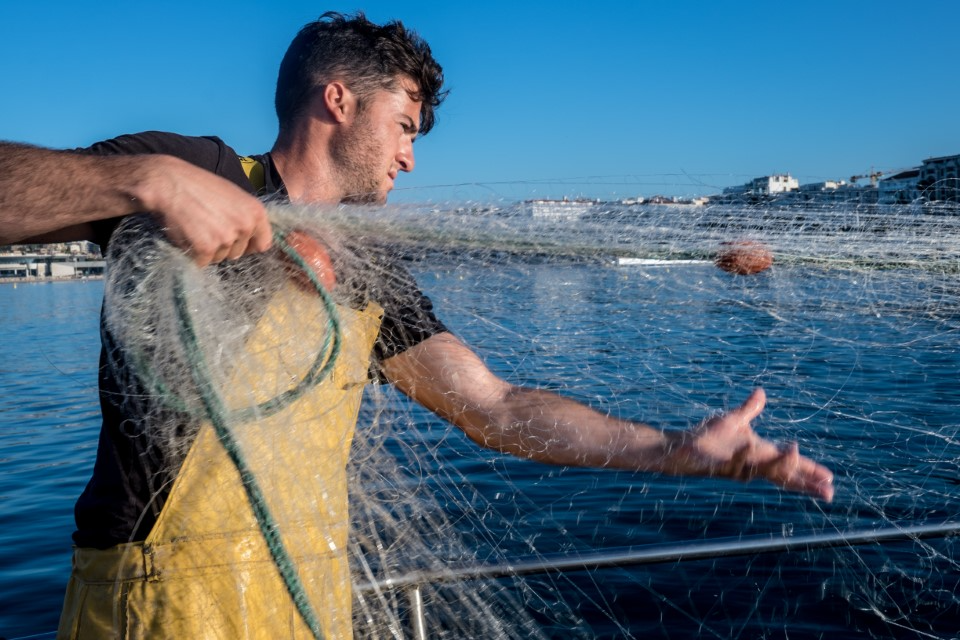
“We are not only fishers. We run a business with investments, risks and responsibilities,” said 37-year-old Miguel Angèl Mercant Sirer from Cala Ratjada, Balearic Islands, Spain. “Young people will not enter the sector if fishing cannot guarantee a decent life.” Low earning potential further reduces the appeal of small-scale fisheries (SSF) for younger generations.
Procedural and bureaucratic barriers and access to financial support
Administrative complexity remains a significant deterrent for young and new entrants. Licensing, vessel registration, reporting obligations and compliance procedures are often difficult to navigate, time-consuming and costly. Access to financial support is another major barrier, with high investment costs compounded by strict eligibility criteria.
Several SSF Forum participants noted that the cumulative burden of administrative and enforcement requirements places considerable pressure on small-scale fishers, particularly young and new entrants, and may discourage formal sector participation and long-term engagement in the profession.
Ensuring fair competition
Unregulated and unreported fishing creates unfair competition, distorts markets and undermines sustainability efforts. Recreational fishing often overlaps most closely with small-scale fisheries in terms of fishing areas and target species, making its impacts particularly visible and strongly felt by professional small-scale fishers. The sale of unreported catches without taxation or traceability weakens livelihoods and erodes trust in fisheries governance. Clear and effective frameworks for licensing, catch reporting, traceability and compliance are therefore required across all fishing activities, alongside stronger and more harmonised enforcement, to ensure fairness and protect professional SSF communities.
Digitalisation: opportunities, skills and inclusion
Digital tools, including electronic catch reporting, vessel monitoring systems and data platforms, offer opportunities to improve transparency, safety and management. However, digitalisation also presents new challenges. Young fishers increasingly require digital skills to comply with regulations and access markets, yet training and support remain uneven. Inclusive digital transitions are essential to ensure innovation supports, rather than marginalises, small-scale fishers.
Education, training and knowledge transfer
Education remains central to generational renewal in the sector. Dedicated fishing schools, vocational training programmes and local learning centres can create pathways for young people, particularly those without family backgrounds in fishing, to enter the profession.
What is at stake
Small-scale vessels remain the backbone of employment in the sector, accounting for 58 percent of total onboard employment across the Mediterranean and the Black Sea. Small-scale fisheries are not merely a sector; they are local food systems, coastal economies and custodians of marine ecosystems. When young people leave, communities lose skills, knowledge and adaptive capacity.
Generational renewal requires more than policy commitment. It demands improved access, fairer regulations, targeted finance, education, recognition of women and trust-based governance. Without these, the question shifts from why young people are leaving to who will remain.