












by Guillermo Bardera, Davide Militello, Marleen Dehasque and Waldo G. Nuez-Ortin, Adisseo
Shrimp aquaculture is one of the fastest-growing sectors in global food production, supplying high-value protein to meet increasing consumer demand. As the industry scales, concerns about its environmental footprint, particularly related to feed production and usage, have intensified. Feed accounts for a major share of farm-level greenhouse gas (GHG) emissions in shrimp farming, making feed efficiency a critical area for intervention.
Key performance indicators such as feed conversion ratio (FCR) and specific growth rate (SGR) are central to both economic and environmental sustainability. Enhancing FCR reduces the amount of feed required per unit of shrimp produced, while faster growth shortens production cycles, both of which can significantly lower energy use and emissions.
To quantify environmental impact, metric kilograms of carbon dioxide equivalent (kilograms CO₂eq) per kilogram of shrimp produced is usually used. Carbon dioxide equivalent (CO₂eq) is a standardized unit used to express the global warming potential (GWP₁₀₀) of greenhouse gases such as methane (CH₄) and nitrous oxide (N₂O), compared to carbon dioxide (CO₂). It indicates the amount of CO₂ that would have the same warming effect over a 100-year time frame, allowing emissions from different gases to be added together using a common scale.
The role of lyso-phospholipids in feed performance optimization
Phospholipids such as soy lecithin are widely used in aquafeeds for their role in emulsifying dietary fats and enhancing lipid digestion. Lyso-phospholipids (LPLs) are enzymatically modified forms of phospholipids with superior emulsification capacity, fat digestion and improved transportation through the epithelial gut lining. These properties support better nutrient absorption and energy utilization, leading to improvements in both growth rate and feed efficiency.
Aqualyso, an LPL-based feed additive, was evaluated for its potential to boost production performance while reducing feed cost by enabling partial replacement of lecithin and fish oil in shrimp feed formulations.
Life cycle assessment (LCA) based on performance outcomes with Aqualyso
To assess environmental impacts, a cradle-to-farm-gate life cycle assessment (LCA) was conducted in line with ISO 14040/44 standards. The model quantified global warming in kilograms CO₂eq per kilogram of Litopenaeus vannamei produced in commercial systems in Indonesia. The performance inputs used in the LCA were obtained from two controlled feeding trials, designed to evaluate the efficacy of Aqualyso in improving shrimp growth and FCR. These results were integrated into the LCA model to simulate commercial production scenarios, incorporating factors such as feed use, energy consumption and gas emissions.
The focus was to determine how performance improvements, specifically growth and FCR, driven by the feed additive affect the carbon footprint of shrimp production. Two intervention scenarios were compared with baseline feeds:
- Scenario 1: Reduced lecithin, improved growth, FCR unchanged
- Scenario 2: Reduced lecithin and fish oil, improved growth and FCR
Scenario 1: Growth-driven carbon footprint reduction
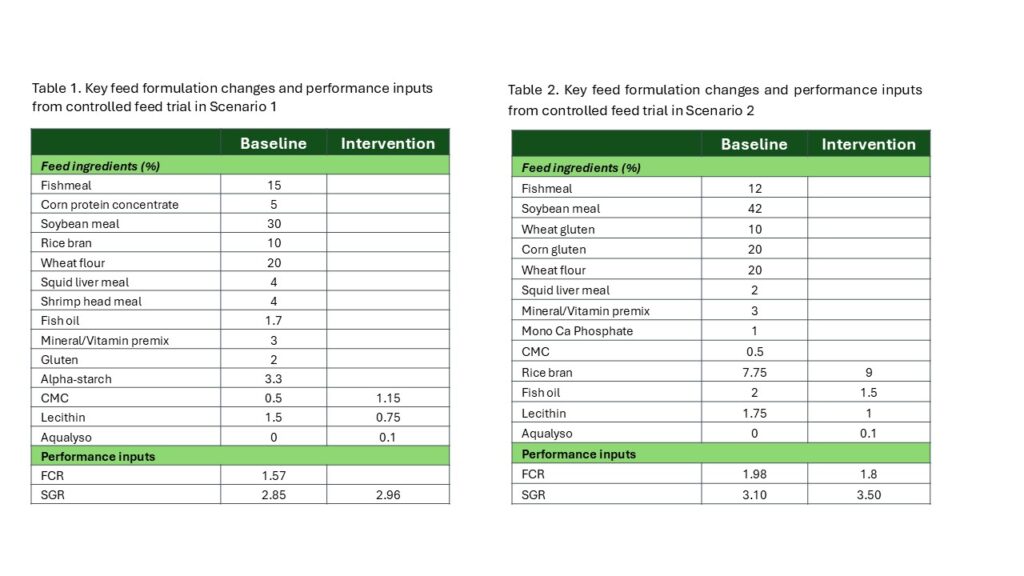
In the first scenario, a baseline feed with 1.5 percent lecithin was reformulated to 0.75 percent plus 0.1 percent Aqualyso. Data coming from the feeding trial showed a four percent improvement in shrimp growth performance, while FCR remained unchanged (Table 1).
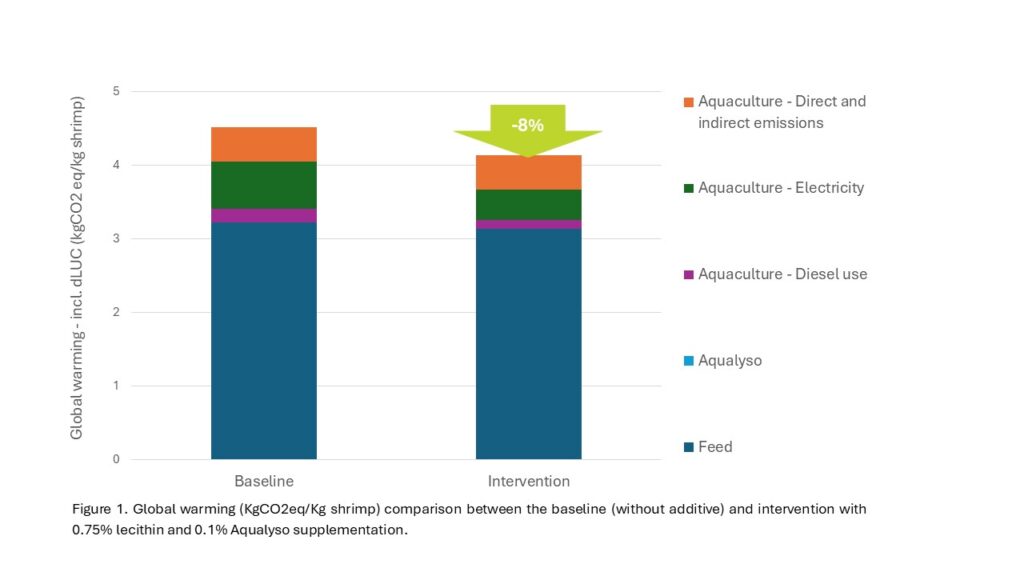
The reformulation marginally lowered the carbon footprint of the feed by two percent, while the dominant impact on environmental performance was associated with the improved growth rates. The model indicated that shrimp can potentially reach greater biomass at the end of the production cycle, resulting in reduced energy consumption (i.e. electricity and diesel) per kilogram of harvested shrimp. This change translated into an overall eight percent reduction in carbon footprint per kilogram of shrimp produced (Figure 1), indicating that enhanced growth performance was the primary sustainability driver.
Scenario 2: Growth and feed efficiency strategy in carbon footprint reduction
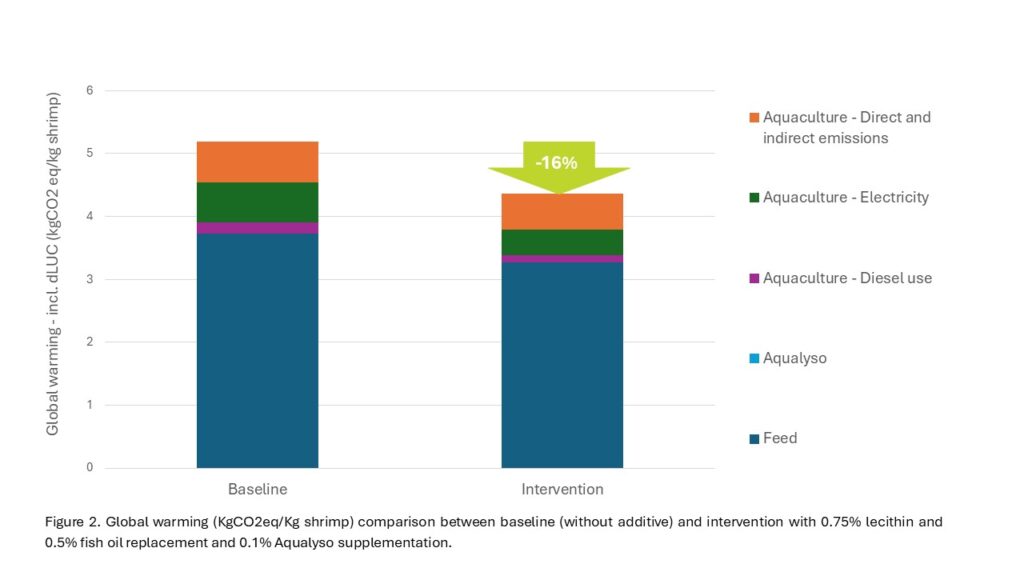
In the second scenario, the baseline formulation was optimized by reducing both soy lecithin and fish oil levels with the supplementation of 0.1 percent Aqualyso. Shrimp exhibited significant improvements in both growth rate and FCR, by 13 percent and -9 percent respectively, reflecting a higher overall efficiency of nutrient utilization (Table 2).
The additive application strategy marginally reduced the carbon footprint of feed by three percent. Improvements in performance following the supplementation were translated by the model in reduced quantity of feed fed per kilogram of shrimp produced. Improved feed efficiency leads to reduced nitrogen excretion rates, thereby lowering the emissions of nitrous oxide (N2O), a potent GHG linked to aquaculture effluents. Faster growth also contributed to a measurable drop in energy consumption per unit of shrimp produced. Collectively, these effects led to a 16 percent reduction in the overall carbon footprint (Figure 2). This scenario underscores the capacity of the LPL-based feed additive to enhance both production efficiency and environmental performance.
Maximizing output, minimizing impact
The use of Aqualyso, a lyso-phospholipid-based feed additive, offers a practical and effective solution to optimize feed cost and improve both the productivity and sustainability of shrimp farming.
The LCA model shows that improvements in growth and FCR under cost saving application strategies seem to be the primary drivers of carbon footprint reductions, ranging from 8 to16 percent depending on the application strategy and associated with reduced feed demand, lower energy use and decreased GHG emissions per kilogram of shrimp produced.
