





























by Jeppe Mortensen, Sales & Business Development, Frea Solutions, Denmark
The rapid development of recirculating aquaculture systems over the past decade has been driven largely by engineering innovation and modelling. However, many system concepts reach the market based primarily on theoretical design assumptions rather than extensive operational experience. As RAS facilities increase in scale and capital intensity, this gap between design and real-world operation becomes increasingly significant.
At Frea Solutions, a development strategy has been followed that involves building and operating systems at commercial scale before introduction to customers. The objective is to validate system performance under real farming conditions and refine design parameters based on operational feedback. This approach has proven particularly relevant for the efficient production of large trout, where system hydraulics, fish behaviour and operational control become increasingly critical at higher biomass levels and larger fish sizes.
This approach has been applied in the development of the FlexRAS grow-out module concept, designed for efficient production of large trout in the later grow-out stages. Two full-scale FlexRAS modules were constructed at the company’s farming site in Denmark, with operational experience spanning more than 18 months as of April 2026.
Fish performance and behaviour
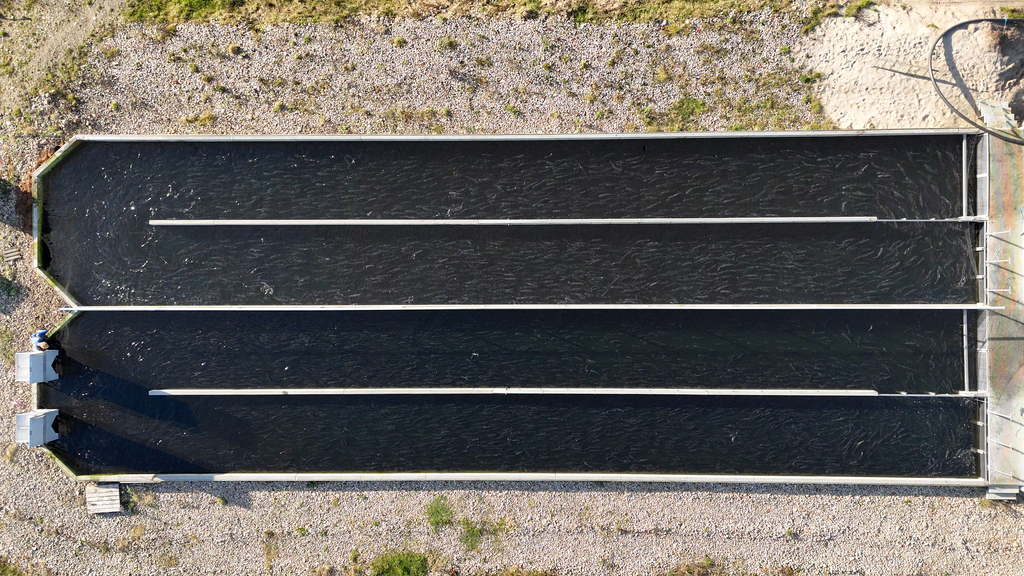
One of the notable observations from extended operation has been the biological response of fish held in the raceway-style tanks used in the FlexRAS modules. Fish have shown strong swimming behaviour and uniform distribution throughout the raceway channels, which are designed to maintain a controlled and consistent flow velocity across the entire tank length.
The hydraulic design promotes continuous swimming activity, which contributes to body shape and musculature. Fish harvested from the system have exhibited a longer and more muscular profile compared to fish produced in more static tank environments – characteristics that are commercially relevant for large trout, where product quality and physical condition are key parameters.
Customer feedback regarding fish condition and quality has been noted. Such observations highlight the importance of tank hydraulics and flow dynamics in influencing fish welfare and growth performance in RAS environments.
Oxygenation and flow optimisation
The FlexRAS modules are designed to maintain uniform flow conditions throughout the raceway, ensuring consistent water movement and even distribution of fish biomass within the tank. This hydraulic behaviour supports both biological performance and feeding efficiency, and becomes increasingly important when farming large trout, where oxygen demand and metabolic load are higher than for smaller fish.
The modules utilise oxygen platforms combined with circulation pumps to regulate flow velocity and oxygenation within the raceways, allowing operators to adjust both hydraulic conditions and oxygen input simultaneously.
Operational experience has shown that fine adjustments in oxygen platform configuration and flow control can further optimise oxygen transfer efficiency, particularly during periods of high feeding activity and increased metabolic demand.
Design flexibility and land utilisation
The FlexRAS concept allows water treatment chambers to be equipped with either moving bed biofilm reactors (MBBR) or fixed bed biofilm reactors (FBBR), depending on the biological loading and operational requirements of the system.
Operational experience has demonstrated that integrating CO₂ degassing directly above fixed-bed biofilters enables vertical integration of water treatment processes, reducing overall land footprint while maintaining treatment performance. The flexibility of the water treatment configuration allows FlexRAS modules to accommodate different raceway lengths and water volumes, enabling adaptation to varying production targets.
Fish handling and transport
Fish handling inside the FlexRAS modules has been an important focus area, particularly in large trout farming where gentle handling and efficient logistics are critical to avoid stress and maintain growth performance.
The system can use either airlifts or traditional fish pumps for internal fish transport. Long-term operational experience with airlift systems has demonstrated that they can move fish with minimal stress and limited impact on feeding behaviour. Fish typically resume feeding shortly after grading operations when airlift transport is used.
To maintain operational flexibility, the FlexRAS modules incorporate movable grids that allow operators to remove harvest-sized fish while returning smaller fish to the same tank. This approach helps maintain optimal stocking densities and feeding efficiency despite larger tank volumes.
Footprint and project economics
While biological performance is critical, economic factors such as land requirements and capital expenditure remain important when designing large-scale aquaculture facilities. This is especially relevant for large trout production, where traditional tank layouts can become land-intensive as fish size increases.
With a water depth of 2.7 metres, the FlexRAS raceways operate with a deeper water column than traditional raceways, allowing higher biomass density per unit of land area. Additionally, water treatment components such as biofilters and degassing units can be vertically integrated within the system layout, further reducing the land footprint required for water treatment infrastructure.
A comparative design exercise examining a conventional raceway grow-out concept versus a FlexRAS-based layout illustrates how structural system design can influence overall project cost and footprint. In the reference case, a conventional raceway design for large trout production required a substantial facility footprint. When FlexRAS modules were introduced for the final grow-out stage (500g to 4kg fish), the total building footprint was reduced by approximately 30 percent while maintaining the same production capacity.
Centralised technical infrastructure
The FlexRAS design includes a central technical corridor that houses blowers, electrical installations and other technical equipment. Locating these systems in a single service corridor simplifies maintenance, improves operational accessibility and reduces the need for duplicate equipment across multiple production modules.
This design also improves biosecurity by allowing technicians to access technical systems without entering production areas.
Potential application for large salmon smolt production
Originally developed for grow-out of large trout, the FlexRAS concept is also being evaluated as a potential platform for large salmon smolt production. The aquaculture industry has increasingly focused on producing larger smolt before transfer to sea cages, as this can improve survival rates and reduce time at sea. However, traditional large-scale RAS designs for salmon production can be capital intensive and technically complex.
The FlexRAS concept aims to provide an intermediate system architecture that supports large smolt production while avoiding some of the complexity associated with conventional large smolt RAS systems. The modules are based on raceway hydraulics with gravity-driven water flow and simplified mechanical infrastructure.
Indicative modelling suggests that capital expenditure for FlexRAS modules used in salmon smolt production would be lower than for production systems currently in use by the industry. Validation of system performance under commercial salmon farming conditions is planned in collaboration with salmon producers.

Summary of design characteristics
The operational experience gained from the first two FlexRAS modules demonstrates how real-world system operation can inform RAS design.
The raceway hydraulic design promotes strong swimming behaviour and uniform fish distribution, contributing to fish condition and growth performance – particularly for large trout, where continuous swimming and stable hydraulic conditions are relevant for achieving optimal size and robustness.
The modular system architecture allows facilities to be expanded gradually as production increases, enabling farmers to scale capacity without committing to full infrastructure from the outset.
The integrated design of water treatment and hydraulic infrastructure enables a more compact facility layout compared with traditional farms, which is advantageous for large trout farming where conventional designs tend to require extensive land areas.
System simplicity remains a core design principle. By reducing mechanical complexity and minimising the number of pumps, valves and moving components, the system reduces maintenance requirements and operational risk.
The experience gained through commercial operation allows continuous improvement of system components and overall production efficiency.
In an industry where technology development often moves faster than operational validation, this iterative development approach highlights the importance of combining engineering design with real-world farming experience. For RAS operators and investors, such operational insights may prove as valuable as the technology itself.