


























Sustainable Ingredients for Fish Farming
by Gianluigi Negroni and Gualberto Cappi, Cooperativa Alveo

The continuous growth in global demand for fish products has led to a constant increase in the farming of aquatic species, which require appropriate foods according to their life cycle (larvae, juvenile stages, adults, and reproductives). There is therefore a strong need for aquaculture to have feed capable of satisfying the nutritional needs of each farmed species, in its respective growth phases.
With the intensification of fishing pressure on natural fish stocks and the consequent global restrictions for more sustainable fishing, feed companies are already today, and will be even more so in the future, obliged to seek alternative solutions capable of replacing at least some the use of fish meal began, which still constitutes the main protein source for the growth of fish species in aquaculture and feed producing plants. Proteins also represent the most expensive ingredient in fish feed, which in turn accounts for over 60 percent of the costs of fish farming (feeding is in fact one of the key factors for the yield of fish farming).
Even if fish meals, due to their quality, great availability and low prices (the demands are so high that it will be difficult), will continue to be included in the feed, their role, for the reasons set out above, will tend to become more strategic, being used in smaller quantities and in a more efficient way.
It will therefore be increasingly important to study and research a sustainable basket of alternative ingredients to the aforementioned flours, to guarantee the resilience of aquaculture and other farming. In fact, aquaculture will continue to expand. A portfolio of ingredients that do not compete with human nutrition and at low costs will therefore be fundamental to meeting future feed demand, so the industrialisation and standardisation of a range of new ingredients is a basic mandatory step for the sector.
This article aims to contribute to presenting some strategic solutions for this difficult problem: to provide an ethical solution to the use of feed ingredients, to mitigate their competition with human nutrition, and to have a low or no environmental impact.
The writers have developed various formulas for pellet feed using numerous feed ingredients not in common use (of good quality and cheaper than those already used) in various countries around the world. Each country (and within each country there are sub-areas) has a specific agro-ecological situation and its own availability of these ingredients. We also have specific legislation that allows or does not allow its use. The main quantitative source of these ingredients is the agro-food industry but there are also some natural ingredients never used.
Many of the by-products and waste from the agri-food industry have become an environmental problem, as landfill disposal is currently their main destination. Landfills fill up very quickly, have logistical costs and can cause ecological problems. This also results in gas and leachate production when anaerobic decomposition occurs within landfills (in modern landfills they can be partially recovered). On the contrary, their recycling (including that of expired commercial products), in addition to avoiding filling expensive and impactful landfills and wasting energy and costs for transporting and storing some by-products of the agro-industry, can be advantageously used to create pellet feed for aquaculture, thereby using the principles of resource optimisation and lightening the environmental impact of human activities typical of the circular economy.
In this field of research and experimentation, Coop Alveo has developed numerous practical knowledge in Asia, the Caribbean, Africa, and obviously in Europe. In Europe we have very complex legislation on the use of by-products from the agro-food industry for animal farming, following some zoonoses that have created problems.


Circular economy principles
The various experiences for the use of uncommon ingredients arose from real difficulties and needs: the discontinuity of access to global markets for feed or feed ingredients, the discontinuity in global supply chains, the fluctuation of costs, and their constant increase. The above is due to the last market shock due to wars and pandemic diseases. All this placed the various national feed industries and the various end users faced with forced choices, either to modify the formulations, basing them on national ingredients of eligible cost and constant supply, or to have to close the business. Faced with this either/or, the analysis of the potential of the local agri-food sector in providing waste, co-products, and by-products, otherwise destined for landfill, usable with greater or lesser performance within different fish diets, formulated for this purpose, became the solution capable of grasping the need to have ingredients of good and stable nutritional quality, low price, easy and continuous availability.
An approach that perfectly matched the basic concepts of the circular economy, which the author will try to summarise in these short notes. (In this case, the circular economy will be interpreted concerning the production of feed for fish farming, this being a new case study, even if by-products of the fish and meat industry have been used for decades to feed fish in aquaculture).
The by-products of the agri-food industry, if correctly processed, represent an excellent choice for aqua culturists. Co-products, according to a new definition of the agro- industry contain some proteins and nutrients and fish waste in particular can be very useful if not indispensable in the formulations and subsequent production of diets for fish species. Before inclusion in diets, by-products must always be carefully processed through drying, fermentation, sterilization and other appropriate treatments. The addition of nutritional supplements, pre and probiotics can increase feed conversion rates, leading to faster growth and improved immunity in farmed fish.
Alternative protein ingredients are also needed to feed the growing population and the animals that feed it, fishmeal from pelagic fish will remain a significant ingredient while still competing with human nutrition. The waste from fish processing is considered sustainable.
The five points of sustainable and circular development (modified from Agenda 2030 Objective Italy)
– Human resources
– Environment
– Economy
– Peace
– Partnerships
Circular feed for fish farms
The feed industry can and must increase its knowledge and technical capabilities to recover nutrients, obviously inedible for humans, from other processes in the food and biofuel chains. It is a fundamental contribution of the feed sector to the economy that raises fish as part of a circular food system. First of all, the feasibility of recycling food that would be destined for destruction is assessed, with the related added value that would be lost, in addition to the well-known ecological problems that the disposal phase entails.
Historically, aquatic animals were raised on what humans did not eat, such as feed scraps, grass, or residues from food processing activities. Indeed, the very origin of the European feed industry comes from the professional recovery of wheat bran, for which there was no human food market. This ‘historic’ role in the bioeconomy confers a first circularity for the feed sector and a key responsibility in promoting sustainable food systems, continuing to innovate in the recycling of nutrients through feed for food-producing animals.
The sustainability of aquaculture foods is a fundamental orientation of the feed industry. These few lines aim to provide some suggestions to the feed industry for the formulation of diets that, by optimising the production yield of the agri-food sector, increase the sustainability of aquaculture, respecting the environment, economic principles, and social perspectives.
Significant substantial progress has been made in recent decades, but in the face of new pressing challenges, the level of applied research, legislation and social participation of consumers must be significantly increased. The choice of sustainable ingredients not in competition with human nutrition and with competitive economic prices for fish farm diets is a fundamental point for the development of the aquaculture industry from both an economic and ethical point of view. Consumers have become very sensitive to sustainability, ecology and social factors that are included in the aquaculture production chain.
The sustainability of feed for aquaculture products is perceived as the heart of the main ethical problems raised by civil society. The feed sector plays a key role in improving aquaculture production. Appropriate technical and economic solutions must be provided, for example with respect to greenhouse gas emissions, recycling of by-products and co-products, loss of nutrients, resistance to antimicrobial principles and deforestation. While these sustainability aspirations must be well considered, it should be noted that the food safety of feed stuffs will always need to be ensured as a key parameter.
Numerous international organisations believe that the great diversity of production systems, with their ability to adopt different systems depending on the economic situations and the different agro-ecological zones, should be taken into consideration, respecting the elements of sustainability of the feed ingredients used in diets of aquaculture. Positive synergies can be created thanks to the use of co-products deriving from the various processes of agro-industrial production. The state of the ‘journey towards feed sustainability’ in a specific agro-ecological area must be considered and respected by considering specific solutions for each production cycle. In a country, sustainability priorities can be significantly different depending on the agroecological zones. Feed sustainability means establishing a path for the continuous improvement of the sustainable use of byproducts and co-products, including their life cycles.
Food safety in feed
Feed food safety requirements are applied horizontally to all raw materials (diet ingredients) used whether they consist of co-products or raw materials. Production processes must control good hygiene practices, hazard analysis, critical control points (HAACP) and chemical residues, in line with Regulation (EC) No. 183/2015, Regulation (EC) no. 767/2009 and Directive 2002/32/EC.
There is still great potential for the global feed industry, hence the importance of examining which animal feed resources could be ‘extracted’ from the ‘local’ bioeconomy. The research and development of safe alternative feed ingredients – particularly those that can contribute to protein supplies is a key strategic objective for the feed industry. The new proposals can be favourably supported for the use of locally grown vegetable proteins and new alternative ingredients such as: insects – farmed and wild, marine ingredients – such as micro and macro-algae, microbial biomass, and by-products and co-products available in local agro-industrial bioeconomy. All this has the aim of encouraging the circular economy and reducing the need for importing ingredients and related logistics.
An important role can also be played by microbes, unicellular proteins, and fungi. The possibility of using these ‘intermediate organisms’ to consume the biomass represented by waste flows is being studied, but we can already speak of applied research as the technologies are already available. Biomass not considered suitable as feed for food-producing animals will subsequently be transformed by intermediate organisms and subsequently used as an ingredient in animal diets, contributing significantly to the ambition of reducing nutrient losses, in particular nitrogen. The use of intermediate organisms requires considerable applied research and industrial effort. The author’s opinion is that is more suitable for developed countries with capital availability. Obviously, any new feed ingredient must be developed and managed in a way that does not compromise the industry’s commitments to feed and food safety.
Evolution of animal nutrition
In the early days of animal nutrition science, the focus was on individual elements such as crude protein, crude fat, crude fibre, and minerals. Today, feed formulation is also based on other factors including the proportion of digestible amino acids and fats, the bioavailability of minerals and the net energy released. Food science continues to evolve, enriching knowledge of the interactions between the nutritional constituents of different ingredients in diets. There are also other considerations to keep in mind such as the neutralization of anti-nutritional factors, the effect of some micro-ingredients, the health of the intestinal microbiome, the presence of pre or probiotics natural or added to diets, the adding of specific lacking amino acids.
The concept of circular nutrition, as proposed, provides a ‘state of the art’ perspective that describes the possibility of nutrient recycling through animal nutrition. We believe that the concept of circularity can coexist with the feed conversion ratio, which is a traditional indicator of resource efficiency. In this case, we ‘only’ consider the ‘input-output’ efficiency from one kg of feed to one kg of animal product.
The circular feed approach considers the origin of the dietary ingredient and the level of competition with direct human food production. Feed conversion rate may be the most appropriate indicator to describe the efficiency of aquaculture feed ingredients. Farms that use herbivorous fish species such as grey mullet and grass carp, carp and filter-feeding fish such as tilapia have a greater capacity to absorb ‘low quality’ nutrients that are poorly edible by humans. There is also the phytoplankton – producing technology as bio floc and other easy techniques that can save a considerable amount of feed in the filter – feeding species of fish (Tilapia) and shrimp (P. vannamei) The above can and should be perceived as an advantage, if well managed, in every agro-ecological system. Each diet and its components contribute to the optimisation of the use of resources, making the most of the sources of nutrients available at a local level.
Circularity in feed production is a concept still being defined. It is not always possible to draw direct inspiration from circular economy models existing in other sectors. In plastic production, eco-design indicators such as recyclability and product lifespan are used. The concept of counteracting the linear depletion of resources through greater circularity is clear. The use of by and co-products can work in feed production and can help address the issue of competition with direct human consumption, which is a key point for public debates on the sustainability and ethicality of aquaculture.
As per definition, circular foods include non-food ingredients that are recovered as secondary raw materials from the local circular economy, minimising land use impact. Comparison for job creation using circular economy principles from agricultural by-products:
– with incineration (One workplace – Incineration)
– with the landfill – Six jobs
– with recycling (recycling – 36 jobs)
– with reuse (reuse – 296 jobs)
There are three key principles of the circular economy applicable to fish farming businesses and agribusiness: – Eliminate waste and pollution,
– Preserve (economic, biological and social) value over time
– Avoid the use of non-renewable resources
– All help to mitigate the impact of human activities on the environment.
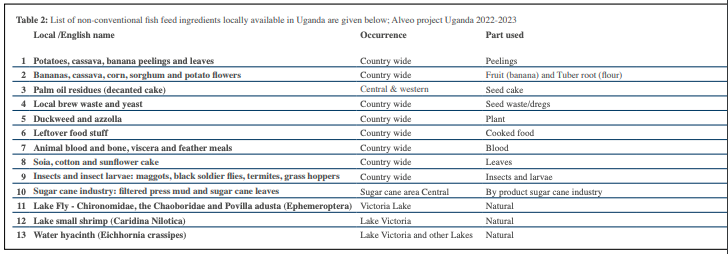
Some examples of by-products (co-products) of the agro-food industry that are used in the feed industry are given below from a recent study by the author in Jamaica.
Possibility for the practical use of feed ingredients little or not used at all for aquaculture following the principles of the circular economy in a study in a specific agroecological district. In this table, the Island of Jamaica is considered. Until 2022, all aquaculture feed components for industrial feed mills were imported into Jamaica.
The disposal of ‘donner’ from the highly developed rum industry in Jamaica is an ecological problem and different solutions are being organised to concentrate and dispose of it. But not any fish feed use was considered. The poultry and swine slaughterhouse by products are generally dumped in landfill in Jamaica.
It is important to know that the above ingredients have specific agro – ecological areas where is possible to find them. Some the above ingredients have an easy and ready use as fish feed ingredients with practical test already done. The practical results of the two projects can provide some useful comments:
• Many of the industrial co and by-products (filtered press mud, decanter cake, dunner) are used as fertiliser or dumped in rivers and lakes with a no appropriate use.
• Other slaughterhouse byproducts are often dumped in landfill with cost and ecological problem
• Water hyacinth is considered a pest and often burned but it is an interesting fish feed ingredient
• Lake fly is never used as feed ingredient despite his availability and high protein content, this also was already tested during the project
• Restaurant/hotel/other kitchen leftovers are not considered and are generally dumped in landfill


Future strategies
Based on the vision of the circular economy we present a strategy based on socio-economic, and environmental sustainability, and on transversal elements such as governance and institutional capacities, in the following points. It proposes the following four strategic objectives:
- Social development: production of quality ingredients/feed for aquaculture and development of related activities creating local employment. Each by-product/co-product must have a specific, well-controlled supply chain that creates local employment.
- Economic development: entrepreneurship development, to stimulate more economic activity, employment and income in communities. Savings in logistics and import costs with maximum import substitution of feed components. Produce quality integrated compound feed for farmed fish species at a reasonable cost, creating employment in the local industry.
- Ecological health: valorisation of local resources, conservation of natural resources and appropriate use of the co-products and by-products available from the agro-industry which become a precious resource to provide ecological resilience and do not enter the waste cycle creating ecological problems for society
- Strong institutions: develop the capacity to effectively manage the agro-industrial by-products and co-products sector and the distribution of benefits. Institutions must adequately consider their roles closely linked to available resources, in the long term with careful planning. Institutions play a key role in the feed value chain by creating a legislative network that promotes the circular economy and the use of NCF. Overall, there is a need to create incentives for circularity in available resources, to better exploit them.
Appropriate studies on the carbon footprint, on the energy costs of products and on the life cycle of finished feed ingredients in feed factories provide real answers for the feed industry. The knowledge level status permits now to produce specific applied research and development activities and practical use of the presented ingredient.
Articled published in September 2024 edition of International Aquafeed Magazine