

































by Eric De Muylder, Harriet Birikorang, Annelies Declerq and Jose De Muynck, Crevetec, Belgium
Shrimp aquaculture represents about six to eight million tonnes of worldwide production. The main challenges now are low prices but also risk of diseases and infection with Vibrio spp as one of the main causes of mortalities, whether primary or secondary pathogen gut health has been identified as an important topic for shrimp survival.
Vibrio spp is always present, but as long as the pond is healthy, shrimp will survive. When Vibrio thrives, as a result of deteriorating pond conditions, a certain quantity (quorum sensing) will attack the shrimp. Therefore, it is important to keep Vibrio levels down, in the water, and in the gut of the shrimp.

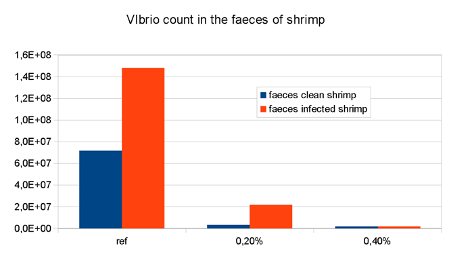
with various levels of Crustacare in the diet.
Vibrio parahaemolyticus became a major pathogen, because it produces toxins (pir a and b), which affects the hepatopancreas of the shrimp, killing them. This disease was called initially EMS (Early Mortality Syndrome) and later AHPND (Acute Hepatopancreatic Necrosis Disease). It has caused mass mortalities in Thailand and has spread all over the world.
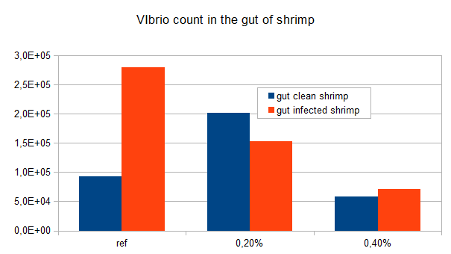
various levels of Crustacare in the diet.
Although there is no general cure against AHPND, different strategies were developed, such as genetic selection for stronger shrimp, additives such as short and medium chained fatty acids, toxin binders and probiotics. One problem with short and medium chained fatty acids for application on shrimp are the loss during the production of feeds, since most products are volatile and also water soluble. Therefore, a new product was initially developed by Clarys to improve the gut health of livestock. It was tested by CreveTec on shrimp, with promising results.
Effect on Vibrio content
Shrimp were fed with a reference diet and a diet with 0.2 and 0.4 percent Crustacare. After five days of feeding, the gut and faeces were removed and Vibrio content was analysed. This was done on clean shrimp and on shrimp which showed signs of Vibrio infection (black spots on shell and between legs).

Growth trial
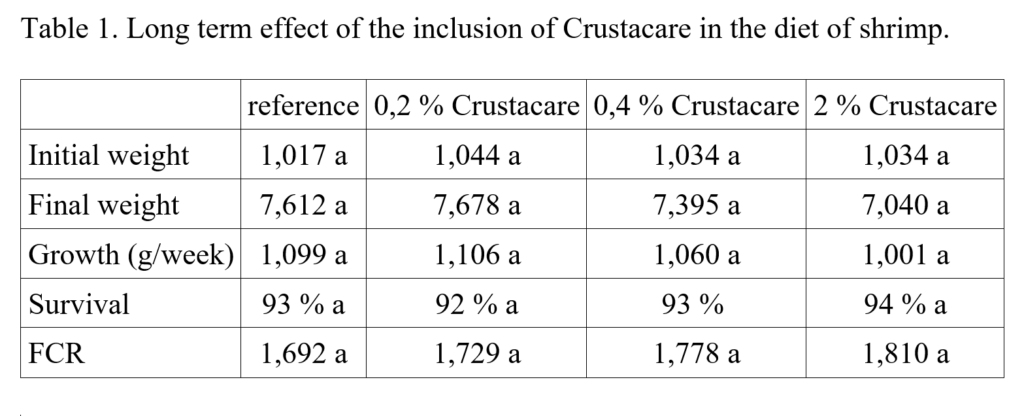
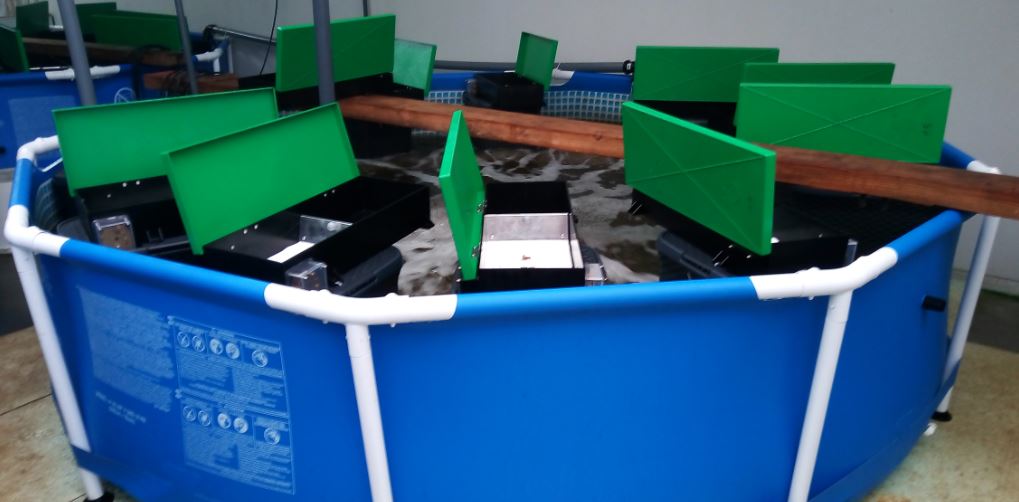
To understand the long-term effects of the inclusion of the product in the diet of shrimp, a growth trial during six weeks was performed. Growth and survival were monitored. Four diets with varying levels of the product (reference diet without, inclusion of 0.2 percent, 0.4 percent and two percent) were used with five replicates. Each basket started with 20 shrimp of around one gram.
Overall survival was very high, 92-94 percent, meaning that there was no real challenge on the shrimp. Although there seems to be a little negative effect on growth at the very high inclusion level, these differences were not statistically different. We can conclude that the inclusion of this product in the diet has no effect on growth and survival in ideal conditions and it is safe for utilisation in shrimp diets.

AHPND challenge
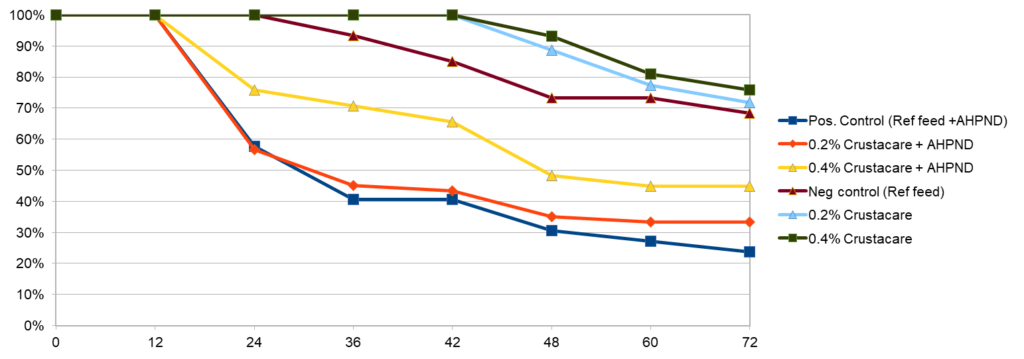
If Crustacare is able to reduce Vibrio, we wanted to check if it would also work against AHPND, since this disease is also caused by a Vibrio sp. This challenge test was performed at Ugent. 20 shrimp were put in each aquarium. There were three replicates per treatment. Inclusion rates were zero to 0.2 and 0.4 percent. Inoculation was done by adding cultivated Vibrio parahaemolyticus at a dose of 107/ml in the water. There was a negative control for each treatment without inoculation. Mortality was observed each 12 hours during three days.
When challenged with AHPND at a high level, the incorporation of Crustacare increased the survival of shrimp. The shrimp originated from CreveTec, who runs a selection program to increase resistance of shrimp. All shrimp are raised in a biofloc system, which exposes them with a mix of bacteria. Since water was not changed, during the challenge test, the shrimp suffered from deteriorating water quality. Some mortality was observed with the shrimp without infection, but even there, we can see a positive effect of the product. Another challenge test with standard shrimp was done and resulted in more than 70 percent mortality after 12 hours and more than 80 percent after 24 hours.

parahaemolyticus
Reducing Vibrio content
The inclusion of Crustacare doesn’t affect the growth or survival when shrimp are healthy.
It reduces the Vibrio content in the gut and faeces of shrimp, the optimal inclusion rate being 0.4 percent. This increases the resistance of the shrimp against a Vibrio challenge, even with AHPND. Selected shrimp, from a biofloc system, also increases the resistance against AHPND.
Published in the January 2025 issue of International Aquafeed.