

































by Eric Leclercq, Global Aquaculture R&D and Fish Application Manager, Lallemand Animal Nutrition

Mediterranean aquaculture in open-net pens is dependent upon a set of demanding management practices with fish, which are also often exposed to infectious and non-infectious deleterious factors and abrupt environmental fluctuations. These successive insults exacerbate the risk of cumulative damages and disease — often resulting in lingering poor performance without clear treatments or diagnostic protocols. In addition, optimizing growth performance and feed efficiency is crucial, particularly in the context of increasing costs of raw materials.
Functional feeds are widely used as preventive strategies to optimise farmed fish health and performance. Ultimately, this positively contributes to the volume, cost and quality of the harvest. Backed by decades of successful application in aquaculture yeast cell wall (YCW) products demonstrate some of the most sweeping benefits, particularly within the diverse landscape of functional ingredients. A new player in this category, Optiwall, shows promising results in European seabass according to a new performance trial.
Yeast cell wall to support gut health and performance
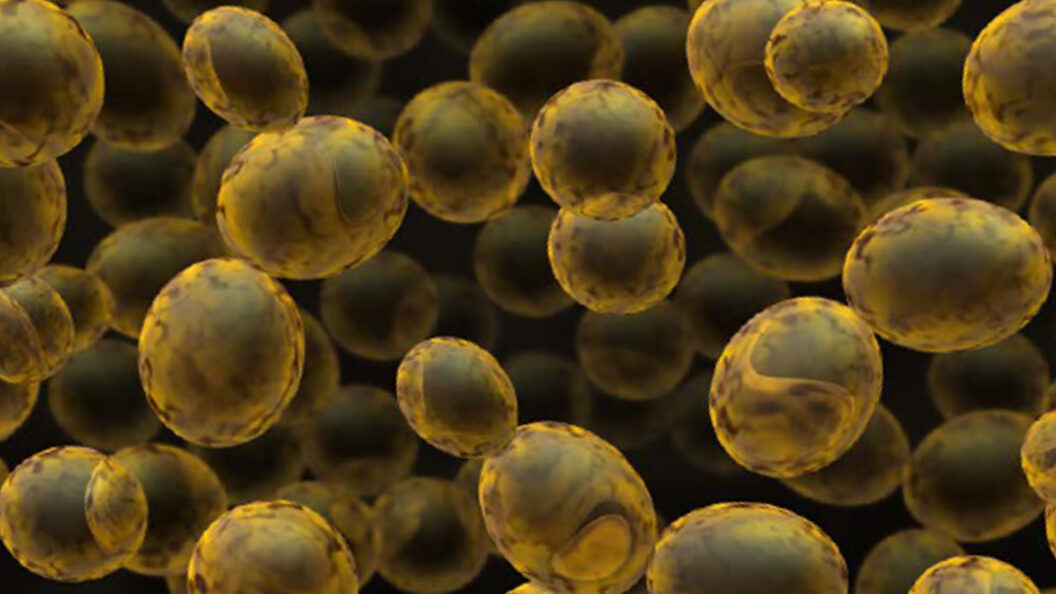
YCW contains mannan-oligosaccharides (MOS) and β-glucans, which, upon ingestion, are recognised at the gut level triggering a cascade of immune and homeostatic processes in support of gut function and integrity, fish health and performance. However, MOS and β-glucans are complex macromolecules that can widely vary in structure and properties depending on the strain and origin of the yeast product.
To reap the rewards from YCW application, it is essential to go further than the MOS and β-glucans levels and deploy a well-documented product with a consistent manufacturing process and certified origin from a specialist provider. Optiwall is a novel YCW product from Lallemand Animal Nutrition, a leading producer and provider of microbial-based solutions for animal nutrition. The product originates from a single and specific yeast strain, manufacturing plant and production process. It is down processed by Lallemand to maximize the desired functionalities for the target application. The result is an affordable, consistent and effective product to support fish health and performance.
European seabass performance trial
A two-month trial was performed in Portugal in 2023, testing different levels of OPTIWALL supplementation in juvenile European seabass (starting bodyweight 11g; 22°C; 36 ppt) in quadruplicate.
A baseline commercial diet for juvenile seabass was produced (20% fish meal; 15% land animal and 32 percent plant material; 46 percent crude protein; 16 percent crude fat; 21 MJ/kg) and supplemented with OPTIWALL (Lallemand Animal Nutrition) at a dose of 0.0, 1.5, 3.0, and 4.5 kg/T feed, which were hand-fed to visual appetite over the trial’s duration.
Fish were first reared under ideal conditions for five weeks then chronically exposed to stressors for three weeks in the form of repeat handling (1 min. netting out twice weekly) and high-density-low oxygen levels by reducing the tanks’ water level (Figure 1).

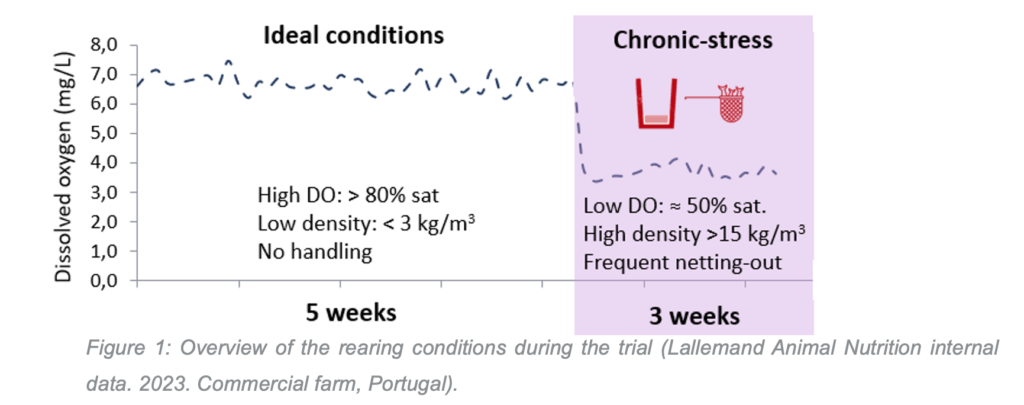
The study evaluated the diet’s effects on production performance and on the gut and skin responses over the ideal and demanding trial periods:
- Growth and performance were assessed at the end of each period
- Specific biomarkers of gut immune response and protection were evaluated (faecal levels of calprotectin and mucins)
- Gut and skin health and mucosal activity were assessed: skin mucus excretion was quantified, skin mucus quality was analysed for its anti-microbial property, and classical gut and skin histology was performed
Optiwall improves growth and feed performance
The trial showed that specific growth rates and feed conversion improved with increasing intake of Optiwall; by up to 6.7 percent and 8.3 percent respectively over the trial duration with YCW 4.5 (Figure 2).

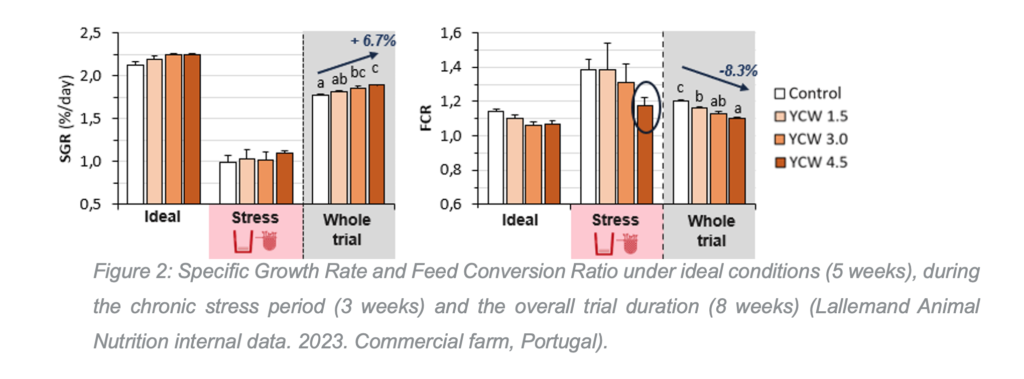
During the challenge phase, as expected, growth and FCR markedly deteriorated across all groups however, the loss of FCR was clearly mitigated in the YCW 4.5 group.
Effect on the gut barrier
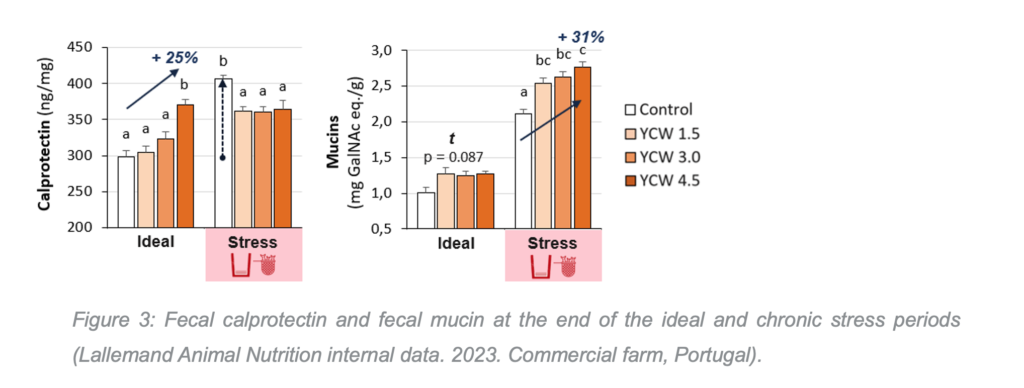
Calprotectin (CP) is secreted by white blood cells as a marker of immune activation elicited by stressors, tissue injury or microbial presence. It has beneficial properties at physiological levels (antimicrobial, oxidant scavenging and immune promotion) supporting gut barrier defence and integrity. Mucin is a constituent of secreted mucus, making it a marker of mucus excretion levels and an essential gatekeeper of mucosal protection and function.
Under the ideal phase of the trial, fecal CP increased with increasing YCW intake, indicating YCW detection and reinforcement of gut defences as supported by higher mucin-levels at the end of Phase I (Figure 3). This was verified at the end of the stress-exposure phase, when OPTIWALL was shown to potentiate increased gut mucus excretion in a dose-dependent manner, as well as lower CP-levels indicating reduced susceptibility and potential disturbance of the gut to the inflicted stressors.

Improved skin barrier
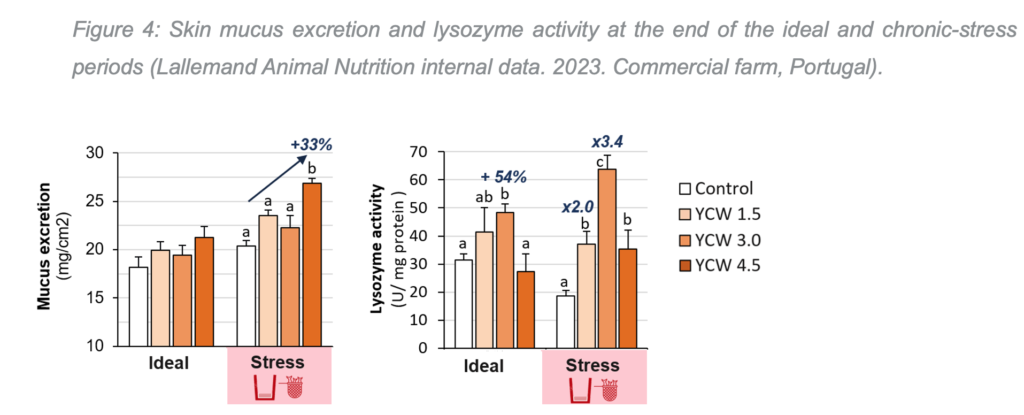
As observed in the gut, skin mucus excretion increased with OPTIWALL intake in a dose-dependent manner (Figure 4). This was particularly marked following stress exposure (+37% excretion), when skin protection is most needed. Interestingly, the antimicrobial (lysozyme) activity of the mucus was also promoted by Optiwall when exposed to stressful conditions. However, at the higher dose tested, there was an apparent dilution of the antimicrobial activity related to the higher excretion level. Interestingly, in the group without supplementation (control), exposure to stress did not promote skin mucus excretion but tended to reduce its antimicrobial activity confirming the benefits of functional feed ingredients.

The new trial confirms the potential of the novel YCW Optiwall as an effective functional supplement to support seabass health (gut and skin robustness) and performance when supplemented continuously for 8 weeks. This was particularly marked under stressful conditions when OPTIWALL supported gut and skin defense mechanisms (mucus excretion and antimicrobial properties) at a time when it was most needed. In-feed incorporation can be selected between 1.5 to 4.5 kg/T feed depending on the level of protection and performance targeted. European seabass represents, with seabream, the major farmed fish species in Turkey, and the past decade has seen more than two-fold increase in both species. Mediterranean seabass and seabream aquaculture have grown and intensified considerably in the last decades; but operations are exposed to ever-increasing biological risks and related costs. In that context, evidence-based, preventive health solutions become an essential tool to help achieve the production target and schedule with minimal reliance on medication. As a yeast-based ingredient optimised for animal health and performance, Optiwall provides broad and cost-effective benefits in support of fish robustness and farm performance.
Published in the May 2024 issue of International Aquafeed.