































by Marco G Pistrin, Founder and Managing Director, AquaOrganica SRL, Italy
Japan has farmed amberjack for the better part of a century and built it into something close to a national staple: after tuna, yellowtail is the fish the country reaches for when it wants something raw and excellent. The rest of the world spent two decades trying to follow and kept walking into the same wall. The obstacle was never the cage, the feed or the appetite of the market. It was the egg. The story of farmed Seriola beyond Japan is, at its core, the story of who learned to close the life cycle, and what it cost them to do it.
Two fish, one genus
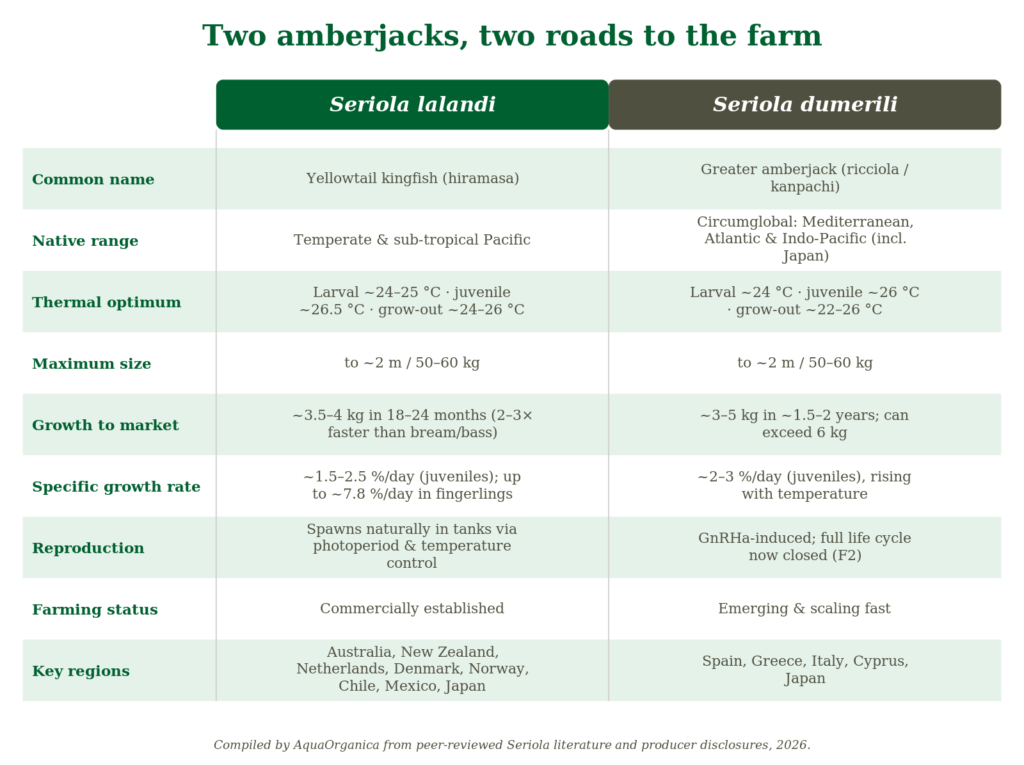
Two species carry most of the ambition. Seriola lalandi, the yellowtail kingfish sold as hiramasa and Seriola dumerili, the greater amberjack, the ricciola of the Mediterranean. On paper they read like siblings: both pelagic, both capable of reaching two metres and fifty to sixty kilograms and both prized for firm, clean, marbled flesh that commands a premium at the sashimi counter. A word of caution on names, because it catches out even the trade: hamachi is properly buri, Seriola quinqueradiata; the European farmed fish is hiramasa, S. lalandi; and what the Japanese call kanpachi is S. dumerili. Three names, three fish, one genus.
The difference that decides everything is reproductive. S. lalandi, a temperate Pacific fish, can be brought to spawn naturally in a tank on little more than disciplined control of photoperiod and temperature. S. dumerili is circumglobal, at home across the Mediterranean, the Atlantic and the Indo-Pacific and farmed in southern Japan for years as kanpachi; it grows faster and sells higher than its cousin, yet outside Japan it resisted reliable reproduction in captivity for two decades. That single divergence sent the two species down very different roads to the farm.
The Pacific did the early work
The early domestication happened in the Pacific and it deserves the credit. In Australia, Clean Seas, born out of the Stehr family tuna ambitions, absorbed punishing stock losses, walked away from southern bluefin and committed wholly to closed-cycle kingfish. Backed by the South Australian Research and Development Institute and a growth-selected breeding line drawn from wild Spencer Gulf fish from 2010, it became the largest producer of yellowtail kingfish outside Japan and the open-water reference for the species. In New Zealand, NIWA built the other pillar at the Northland Aquaculture Centre in Ruakaka, now producing roughly half a million fingerlings a year from elite, multi-generational broodstock, with fish reaching market size in around twelve months.
But easier is not easy. Even with the egg solved, kingfish punished operators on the grow-out side. The dominant threat in sea cages is parasitic: the skin flukes Benedenia seriolae and Neobenedenia girellae and the gill fluke Zeuxapta seriolae, which suppress appetite, slow growth and are routinely named the single largest barrier to cage expansion. They are also temperature-driven: warm the water and the parasite life cycle shortens and infection pressure climbs. That reality is exactly why so much of the new capacity moved indoors. In the Netherlands, The Kingfish Company Zeeland operation grows hiramasa in land-based recirculating systems on filtered Oosterschelde water and renewable power; across Denmark and Norway, Nordic Kingfish, part of Nordic Aquafarms, runs an egg-to-plate chain, from its Maximus hatchery and Sashimi Royal grow-out in Denmark to a converted land-based salmon site at Fredrikstad. Recirculation did not just modernise kingfish; it let a warm-water fish be farmed cleanly far from its native sea.
The Mediterranean examination
If kingfish was the proof of concept, greater amberjack was the real examination. The fish itself is almost ideal: it settles into captivity readily and grows at a rate that makes an accountant smile. The problem sat one level deeper. In culture, females frequently failed to complete oocyte maturation, ovulation and spawning at all. No reliable eggs, no industry.
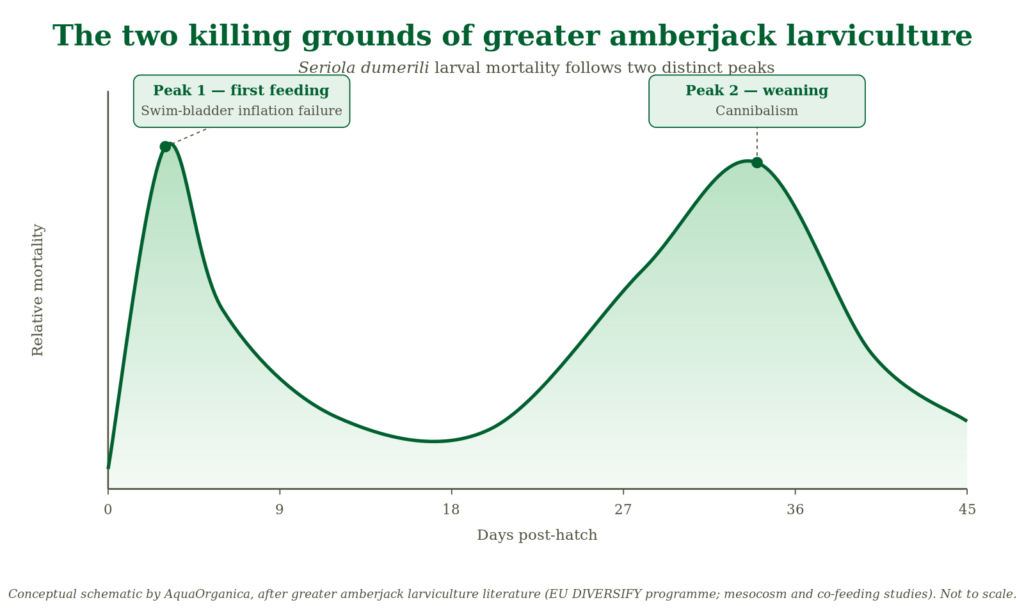
The breakthrough was Mediterranean, and it was patient work. The EU DIVERSify programme, with the Hellenic Centre for Marine Research at its core, established that controlled-release implants of gonadotropin-releasing hormone agonist (GnRHa) could govern maturation and spawning where natural conditioning could not. That unlocked the egg and opened the door to the next two killing grounds. Greater amberjack larvae die in two waves: the first at first feeding, tied to the failure of initial swim-bladder inflation, which also drives the spinal and vertebral deformities that dog the species; the second during weaning, where cannibalism does the damage. Getting through both demands meticulous co-feeding regimes, careful light and surface management, and the kind of husbandry that only comes from standing over the tanks.
This is where the Mediterranean pioneers earned their place. Among the most significant is Stavros Paraskevopoulos, founder and chief executive of StavRAS Aquatic Solutions in Cyprus, who was among the first to build and just as importantly to keep refining, working protocols for the species: broodstock selection, spawning timing, fertilisation, first feeding and some of the earliest viable second-generation (F2) fish. That last point is not a footnote. Hatchery-reared amberjack carry measurable reproductive dysregulation relative to wild fish; producing stable, repeatable F2 means breaking dependence on wild broodstock altogether. It is the difference between a fortunate spawn and a self-sustaining line.
The industry now splits cleanly in two. On land, recirculating systems sidestep the parasite burden that haunts open water. In Spain, Futuna Blue at El Puerto de Santa Maria has closed the F2 cycle and supplies juveniles to the neighbouring grow-out at Acuicultura Cadiz, a 450-tonne RAS build within the Kingfish Norway group, steered by Borge Soraas, project director at Kingfish Norway and chief executive of Acuicultura Cadiz. Nearby, Alicante Aquaculture raises dumerili on land under the Seriola Iberica label, and in Tuscany OP del Pesce Piscicoltura Orbetello has begun its first amberjack seeding. Offshore, the rival camp drives the fish into deeper, faster water. Two philosophies, one increasingly domesticated fish.
The real prize is the broodstock
Closing the cycle is the entry ticket; improving it is the prize. Once a species reproduces on command, every commercial lever, growth rate, feed conversion, survival, deformity, disease resistance, becomes a question of genetics and husbandry rather than luck. Kingfish breeders already lean on genomic tools, with SNP-based selection and genomic prediction applied to traits that include skin-fluke resistance and skeletal deformity, both heritable enough to belong in a selection index. The economics follow the biology. These fish earn premium prices and demand is widening: Japan remains the anchor market but Western appetite for high-quality raw fish, in sushi, sashimi, poke and across the restaurant trade, is pulling volume into Europe and North America, often positioned as a sustainable, traceable alternative to tuna. Hiramasa is the rarest and dearest of Japan three farmed Seriola, yet the margin is set in the hatchery and the grow-out, not at the auction. Whoever controls the broodstock controls the cost base, which is precisely why the leading lines, from the Pacific programmes to the European RAS players, are held so closely. The genetics are the asset.
A method, not just a fish
Hatchery production of kingfish is now established across New Zealand, Australia, the Netherlands, Denmark, Chile and Mexico, while the Mediterranean is fast becoming the heartland of greater amberjack farming outside Japan. Japan remains the genus true home, on the order of 130,000 tonnes a year, the bulk of it buri, with a substantial share of kampachi, but the centre of gravity for domesticating these two species has shifted decisively outward.
What the amberjack story really demonstrates is a method. A fast-growing, premium, high-demand fish was willed into domestication one bottleneck at a time: the egg, then the swim bladder, then the weaning crash, then the parasite, then the genome. Every one of those lessons transfers to the next emerging marine species the industry chooses to take on. The fish was always magnificent. What changed is that we finally learned to control it, and in learning that, the sector wrote a playbook that reaches well beyond Seriola. Crack the amberjack, and you have cracked something much larger than a single fish.