






























by Sherilyn Abarra, PhD candidate, University of Plymouth, UK

‘Give a man a fish, and you feed him for a day. Teach him how to fish, and you feed him for a lifetime.’ But will there be enough fish to catch in the Philippines in the coming decades? Aquatic food is a vital source of protein and micronutrients for the Philippines’ growing population, projected to reach 158 million within the next 20 to 30 years. However, declining fisheries production and a rising population threaten food security, with an estimated additional 1.67 million tonnes of fish (live weight) needed annually by 2050.
To address these challenges, the Department of Science and Technology (DOST) is spearheading scientific and technological initiatives through the Harmonised National Research and Development Agenda (HNRDA). The HNRDA for 2022–2028 includes the Agriculture, Aquatic, and Natural Resources (AANR) R&D agenda, which prioritises areas such as new species for aquaculture, hatchery production, fish health and disease management, and sustainable nutrition and feeding systems.
The HNRDA was developed in collaboration with government and private research institutions, the academe, industry, and other stakeholders to maximise economic and social benefits. But how do government research institutes collaborate with the academe to achieve these goals?
Government-academe collaboration
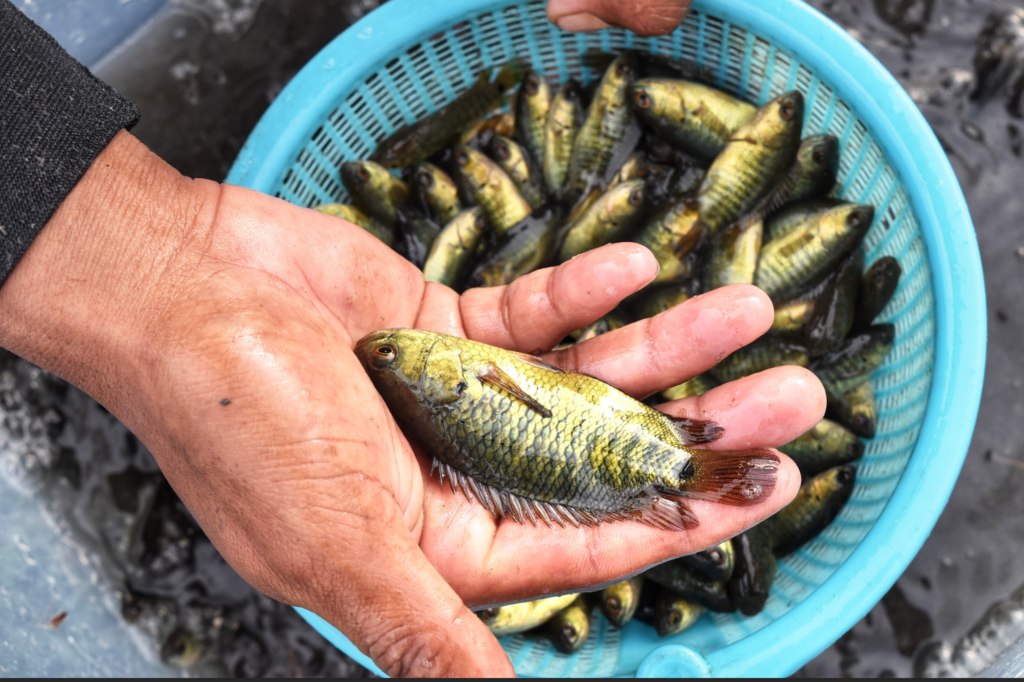
I spoke with Dr Casiano Choresca, Scientist and Centre Chief of the National Fisheries Research and Development Institute (NFRDI) Fisheries Biotechnology Centre in Muñoz, Nueva Ecija. His team runs initiatives such as ‘HatchPro,’ a hatchery production and breeding programme in partnership with state colleges and universities. For instance, in collaboration with Mindanao State University, they have improved the breeding and seed production of climbing perch (Anabas testudineus), an indigenous species with strong aquaculture potential. Dr Choresca values partnerships with the academe, as universities train the next generation of experts. He emphasised that empowering faculty researchers enhances the research culture and prepares students for roles in government research institutions. To support this, the Department of Agriculture offers a biotechnology scholarship programme to strengthen faculty expertise in fisheries and aquaculture.
The partnership between the government and the academe is mutually beneficial. A prime example is the Ateneo Aquatic and Fisheries Resources Laboratory (Aqua Lab) at Ateneo de Manila University. I recently interviewed Dr Janice Ragaza, Associate Professor and leader of Aqua Lab, about their collaboration with research institutions. Their partnerships with the Bureau of Fisheries and Aquatic Resources and the Southeast Asian Fisheries Development Centre provide students with hands-on research opportunities beyond the classroom.


These collaborations offer access to specialised resources and facilities often unavailable in universities, enriching students’ professional experience. Dr Ragaza’s research group aligns its student projects with the national R&D agenda, contributing to priority areas such as alternative aquaculture feed ingredients using local, sustainable sources and invasive fish management.
During my MSc, Dr Ragaza supervised my dissertation on processing knife fish (Chitala ornata), an invasive alien species, as a protein replacement for Nile tilapia diets. This DOST-funded project, conducted in collaboration with the National Freshwater Fisheries Technology Centre, was instrumental in shaping my research career in aquaculture nutrition.
Strengthening industry linkages
Despite these efforts, the Philippines still faces challenges in strengthening linkages between research, technology, and industry. The country ranked 64th in the 2022 Global Innovation Index for university-industry R&D collaboration. Limited investment in research and technology adoption has hindered market competitiveness. Greater emphasis on technology transfer is needed to ensure research findings reach end-users effectively.
During my PhD at the University of Plymouth, UK, under the supervision of Dr Daniel Merrifield, I have witnessed the benefits of strong academia-industry collaboration. Dr Merrifield, Programme Lead for the MSc Sustainable Aquaculture and Fisheries programme, trains graduates for careers in aquaculture through research-driven teaching.
The programme incorporates industry partnerships at local and international levels, allowing students to work on real-world challenges. His research group, the Fish Health and Nutrition Research Group, collaborates with leading aquafeed producers and feed additive companies to enhance fish nutrition and health, directly contributing to global food security.

Retaining talent
The Philippines, as one of the world’s top aquaculture producers, has the resources and infrastructure to train the next generation of fisheries scientists. However, beyond developing competent researchers, an even greater challenge lies in retaining talent. Of the 66 Filipino scientists recognised in Stanford’s 2024 ranking of the world’s top two percent scientists, only 58 are based in the Philippines, while eight work abroad. The National Academy of Science and Technology highlights ‘brain drain’ as a pressing issue. One intervention addressing this is the Scientific Career System (SCS), established under Executive Order 784, with revised implementing rules and regulations introduced in Executive Order 17 (2023).

I interviewed Dr Mudjekeewis Santos, Division Chief of the Training Division at NFRDI, and the only Career Scientist to have been conferred the title Scientist V under the SCS. He values the SCS for providing financial stability while allowing him to pursue his scientific advocacy in the Philippines, reducing the need to seek opportunities abroad. According to Dr Santos, the SCS offers a structured, merit-based career pathway with competitive financial benefits, making it an attractive option for early-career researchers in aquaculture.

Conclusion
So, will there be more fish to fish in the Philippines? Ensuring aquatic food security will require strengthening government-academe-industry collaborations, increasing investment in R&D, and supporting the nation’s skilled researchers. With the right policies and continued commitment, the Philippines can secure a sustainable future for its fisheries and aquaculture sector.
Published in the March 2025 issue of International Aquafeed & Fish Farming Technology