
































Nikos Papaioannou, CEO of Irida, was born and raised in Greece, a country with more than 15,000km of coastline and sat amongst 3000 islands. When he was in high school, he was already being introduced to the amazing world of aquaculture and learnt that tourism and shipping are not the only ways of making good use of this unique natural resource – the sea.

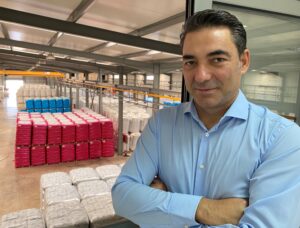
Without second thoughts he knew that my future lay in the fast-emerging aquaculture industry. He studied Animal Science at the Agricultural University of Athens followed by postgraduate work at the Institute of Aquaculture of Stirling University in Scotland.
Coming back to Greece, he was employed by KEGO SA a fast growing and pioneering company focusing on feed nutrition and fish feed manufacturing but involved and investing money and resources in more than that.
As an example, they established together with Akvaforsk Genetics Center, Norway the first family-based breeding selection program internationally, targeted specifically at bass and bream.
At KEGO, he met who proved to be the most important persons in my professional life, his three mentors Apostolis Kefalas, Sotiris Papasolomontos and Christos Gogorosis. They inspired him to learn in depth more about feed nutrition and fish feed production and perhaps more importantly, total respect for the values of business integrity, innovation, and excellence.
International Aquafeed magazine met with Mr Papaioannou recently to discuss the emerging trends ingredient trends in our industry, its role in supplying a reliable source of protein as the world’s population continues to grow and any possible constraints that it may encounter as it strives to overcome what he describes as being “a profound change in global food production.”
How long has it taken IRIDA to develop to the aquafeed production capacity that it is capable of today?
In 2008, together with Christos Gogorosis we established IRIDA S.A. and in the next years his sons Apostolis and Michalis joined us making a strong and effective management team.
Today, at IRIDA we employ more than 100 people, thus supporting the local communities surrounding our factories, while we produce and sell more than 100,000 tons of fish feed per year, serving the local market but also exporting to other Mediterranean countries and beyond.
Our state-of-the-art facilities with two factories and four distinct and separate production lines, enable us to produce with precision and at scale. Our size, coupled with our customer focus and attention to their specific needs, allow us to be agile and always competitive in what we now consider to be our home market, that is the whole of the Mediterranean.
Which are the areas that IRIDA focuses on and invests in?
The development, nutrient specification, and production of all our feeds is based on the in-depth experience and knowledge of our nutritional team strengthened by its close links to our customer base and deep understanding of their needs. We continually improve by growing our team of scientists and professionals who add know-how and value.
We continually invest in our people while also investing heavily in our manufacturing process with state-of-the-art engineering technology, that we believe differentiates us from local and global competition.
Specifically, our Research and Development and IT departments receive significant support and are key players in the investment strategy of IRIDA.
What are ‘Aquatic Biologicals’ and why has IRIDA invested in them?
We always seek to offer ‘end-to-end’ solutions to our aquaculture partners, that work well both for them and the environment. To this end, in 2021, we invested in Aquatic Biologicals, a spin-off company of the Hellenic Centre for Marine Research, becoming the majority shareholders.
Aquatic Biologicals is a Marine Biotechnology Company devoted to the prevention of fish diseases in aquaculture. Led by a team of fish researchers and animal health scientists, Aquatic Biologicals has invested heavily in the design and production of autogenous vaccines and provides diagnostic services in aquaculture.
We have initiated together a project to construct a GMP+ certified laboratory facility, the first in Greece, dedicated to the production of customized autogenous vaccines for Mediterranean fish species.
What are the future constrains in meeting the demands for aquafeed in your region?
We are facing a profound change in global food production, where we must harvest and produce more food, but do so in a more sustainable way to meet the needs of a rapidly growing world population and their expectations. The major future constrains relate to the environment and the raw material availability and sustainability.
It is obvious that our sectors’ priorities should lie in embracing fully the principles of sustainability while facing future challenges with due consideration of economic, environmental, and societal needs and demands.
IRIDA is the largest producer of aquafeeds for organic production in the Mediterranean and is certified by Naturland and Bio-Hellas. It is also in close contact with ASC and our resources are devoted to ensuring we will be ready the soonest to be certified for the new aqua-feed standards.
We understand IRIDA is using krill as a source of protein. Is this a viable alternative raw material in fish feed production, is it sustainable?
To meet the nutritional requirements of fish safely and in full, we always give high priority to the quality and sustainability of the raw materials we select and use. One of these is Antarctic Krill Meal from Aker BioMarine.
This top-quality krill meal acts as a feeding stimulant that increases feed uptake and enhances growth in marine fish species. Additionally, it has been proven to strengthen the health and improve survival rates at the larval and juvenile stage. Among all the benefits of krill inclusion in feed, one of the most important, particularly in the current market, is its low environmental impact.
Will aquaculture continue to play a significant role in meeting a growing population’s demand for protein in the future?
Aquaculture already makes a significant contribution to world food supply and security. At the global level it helps fill the gap between the rising demands for fishery products and the limited increases in capture fisheries production. Aquaculture is the fastest growing food-producing sector in the world.
Fish have a highly desirable nutrient profile providing an excellent source of high-quality animal protein that is easily digestible and of high biological value. Marine fish are one of the best converters of feed to human food.
The challenge is to secure the growth and development of the aquaculture sector in a sustainable way with deep respect for society at large and our home, planet Earth.
For more information of Irida visit HERE.
For more Irida news on our website visit HERE.