





























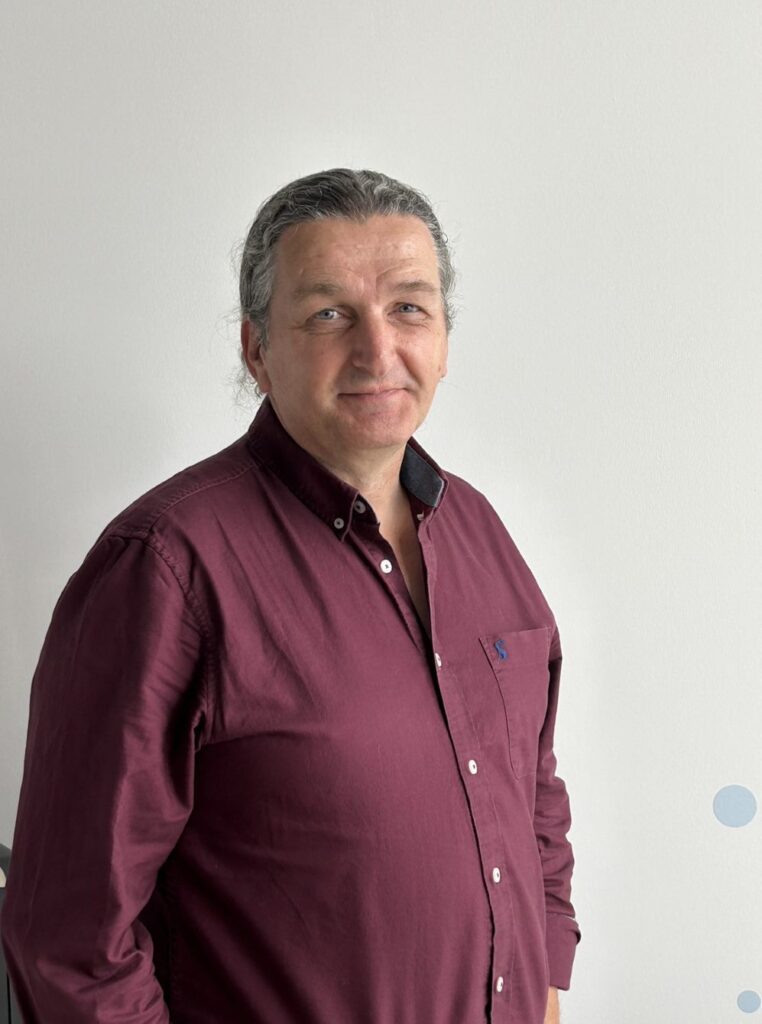
Keith Davidson was appointed Chief Technology Officer at Ace Aquatec in August this year. With a wealth of experience in leading global technology teams, including in North America, Europe and Asia, Keith now works alongside the Ace Aquatec team to further develop and expand the company’s welfare-first aquaculture technologies.
You have a rich career in the industry, what initially lead you to this field?
My career has been spread over numerous industries driven by a curiosity for all things technology. I often describe myself as a maker, applying the skills I have accumulated in electronics, electrical – even mechanical – engineering, through to most of my recent career in cloud system/software engineering. Coming into aquaculture and Ace Aquatec gives me a unique opportunity to work across all of these engineering disciplines solving problems for customers.
As the CTO of Ace Aquatec, you’ve undoubtedly encountered various challenges in the aquafeed industry. Can you share a particularly significant obstacle you’ve faced and how your personal values and leadership philosophy guided you through it?
From my perspective a major challenge in the aquaculture industry and particularly in aquafeed is being able to represent the health and status of fish while they mature towards harvest time. A large proportion of the information is collected manually, which inherently leads to an accuracy challenge, whether through error or limited manual sampling. The inaccuracy of primary inputs that determine the correct feeding programs has a direct impact on the profitability of the farms and can be impactful to the environment. These practices, although questionable from an accuracy perspective, are the way it has been done to date.
To change this, we need to make it easier and safer to collect accurate information on the condition of the fish and to collect much more data. My view is that the sophistication of our systems like our A-BIOMASS™ will transform farmers’ decision making. We just need to provide the key information that is actionable by them in a simple, understandable way. It must be incredibly simple to use and its accuracy, although high, has to constantly improve and bring a richness of insights to the farms, allowing them to make key decisions effectively. Ideally, progress towards automation in the growth to feed to harvest cycle.
My leadership approach is always based around principles and holding to them. Such as always listening to the customer, continuous improvement, innovate for good, keep it simple.
Sustainability is a key aspect of Ace Aquatec’s mission. What are your personal beliefs regarding the importance of sustainability in aquaculture, and how do they align with the company’s goals and practices?
I have a strong belief in sustainability and conservation, holding those beliefs and practices for many years, so Ace Aquatec’s mission aligns with my personal beliefs and was key in me joining the company. The application of technology for good is a very strong driver for me. When we are designing our products, processes, and practices as a company it is always at the forefront of our discussions. It is very common in Ace Aquatec for our team to challenge approaches to ensure we are holding to our mission in as many aspects as possible. I firmly believe that goals and practices have to be engrained in organisations for them to be realised fully and I believe this is the case for Ace Aquatec.
Collaboration is often essential in driving innovation. Can you share your thoughts on the importance of partnerships and knowledge-sharing within the aquafeed sector, and how these collaborations have influenced your leadership style?
Collaboration is essential in any endeavour in my opinion, we look to work with partners, even those who may seem to be competitors. Whether this is partnering in the manufacturing of our products or looking to work with others that are using data to help the industry predict/detect the health of fish. From my perspective it is essential that we keep the customers in mind which means if we don’t have a piece of the puzzle, we should work with others to integrate other pieces so that the customer can benefit.
There are areas in the overall industry where sharing global and regional knowledge/data on a constant basis could help the industry improve, protecting both business returns and the environment.
In your opinion, what are the most pressing challenges or opportunities in the aquafeed industry today?
All challenges are opportunities is my belief. In the aquafeed industry the key challenge is understanding the nutritional needs of species so that the right kind of feed can be created and delivered in a manner that reduces the impact to the environment and optimises production. To do this, it is essential that data is collected for researchers/farmers to study and identify the optimal ingredients and rate of consumption. This data needs to be as comprehensive as possible, allowing farmers to instantly access and monitor details of biomass and all the impacts – from feed and consumption to predation and other health indicators. One place to access all the data that is needed for farmers to provide care for their fish and to optimise growth cycles up to harvest.
Where do you think the industry will be in 2050?
I see an industry where there are detailed feed profiles available that are scientifically formulated to produce high quality fish. Farms and producers will have access to insights that allow them to adjust feed profiles on a daily basis, taking into account the farm’s conditions, including impactful events such as environmental changes or predator interference. These insights will inform producers of fish stock density levels, feed rates, and biomass levels, ensuring that their fish can be grown in an economically and environmentally sustainable way.