





























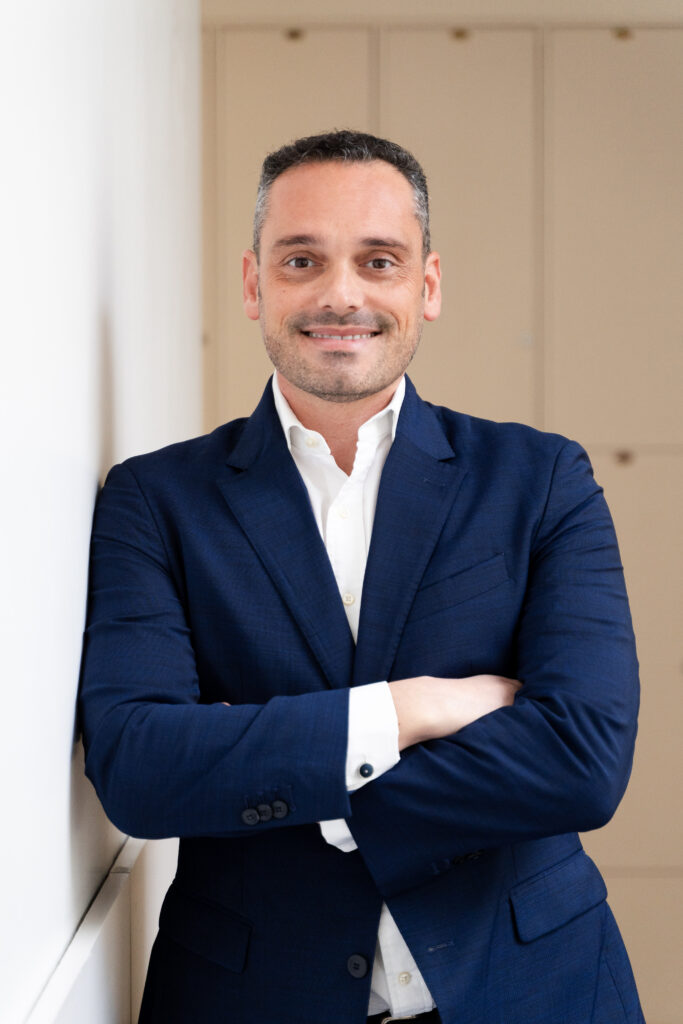
Nuno Medina is the Commercial Director of Aquasoja, part of the Soja De Portugal Group, where he leads the global expansion of the company’s aquaculture feed business across Europe, Africa, the Middle East and Asia. With more than 15 years of international experience in agri-food and aquaculture, he specialises in transforming complex value chains into stable, scalable growth platforms. His work focuses on building trust-based partnerships, advancing sustainability practices and supporting farmers with high-performance, resilient feed solutions. He is currently pursuing an Executive MBA at Porto Business School, further strengthening his focus on strategy, ESG and innovation.
What initially led you to the aquaculture sector, and what continues to motivate your work today?
I decided at a certain point in my career that I wanted to work in this industry. I came from a large Portuguese multinational in the services sector, and when I discovered the circular model of Soja De Portugal, I immediately felt aligned with its purpose. I led Savinor UTS — our ingredient production unit — for several years, and those eight years working directly with raw materials gave me a privileged technical and strategic foundation.
When I was later invited to assume the role of Commercial Director at Aquasoja, this background became a major advantage. Today, what motivates me is the possibility of connecting raw-material intelligence, sustainability and customer value to help farmers produce healthier fish with more stability and confidence.
Aquasoja has a distinctive model built on producing its own key ingredients. How does this integrated approach strengthen feed quality, stability and sustainability?
Aquasoja’s model is unique in Southern Europe: we control the production of strategic ingredients such as fish meal, fish oil and poultry meal through our sister companies within Soja De Portugal. This integration allows us to secure consistent quality, nutritional stability and traceability — three pillars that directly impact farm performance.
By reducing dependence on external suppliers, we also mitigate volatility in both pricing and formulation. This ensures customers receive stable, robust feeds even during global supply disruptions. Sustainability is reinforced by our circular-economy approach: we valorise by-products from the fish and poultry industries and convert them into high-value nutrients, significantly reducing environmental footprint. It’s a model where quality, security of supply and sustainability are fully aligned.
Ingredient volatility, ESG expectations and cost pressures are reshaping the aquafeed landscape. How is Aquasoja navigating these challenges while maintaining sustainability and high performance?
Our strategy combines three pillars. First, technical resilience: we invest in formulation flexibility and R&D to ensure performance even when ingredient markets fluctuate. Our functional additives, health-oriented diets and precision formulation tools help farmers maintain growth and FCR under diverse conditions.
Second, financial stability: thanks to our vertically integrated model and efficient operations, we can offer predictable pricing and reduce exposure to extreme volatility, which is critical for customers planning production cycles months ahead.
Third, ESG leadership: we are aligning our entire value chain with European sustainability standards, reinforcing transparency in raw materials, lowering emissions and expanding regenerative practices. For Aquasoja, sustainability is not a constraint — it is a competitive advantage and a driver of long-term profitability for farmers.
With your experience expanding business across continents, what regional trends are most influencing Aquasoja’s global strategy today?
Regions are evolving at different speeds, but a few trends are universal. In Europe, the pressure for sustainability, traceability and animal welfare is reshaping the industry. Farmers increasingly seek partners that can support compliance and provide documentation on origin and environmental impact.
In the Mediterranean, growth continues to be driven by seabass and seabream, with a strong focus on feed efficiency and robustness due to rising temperatures. In emerging markets such as the Caucasus, Central América, South Korea or Africa, the priority is technical reliability and knowledge transfer — consistent feed, stable supply and hands-on support.
Across all regions, customers value suppliers who can combine performance with predictability, and that is precisely where Aquasoja positions itself.
Looking ahead, what are Aquasoja’s key priorities for innovation, sustainability and market growth?
Our priority is to keep strengthening our technical offer while deepening our sustainability commitments. On the innovation side, we are expanding functional nutrition, health-support diets and precision feeding, supported by collaborative research with universities and farms.
Sustainability will continue to guide all decisions: circular ingredients, lower-emission manufacturing and transparent ESG reporting are at the core of our roadmap.
In terms of growth, Aquasoja will reinforce its presence in strategic Mediterranean and Atlantic markets while expanding partnerships in regions that value reliability, technical service and high-quality feed. Our ambition is clear: to be recognised as a trusted, resilient and forward-looking partner for sustainable aquaculture.