





























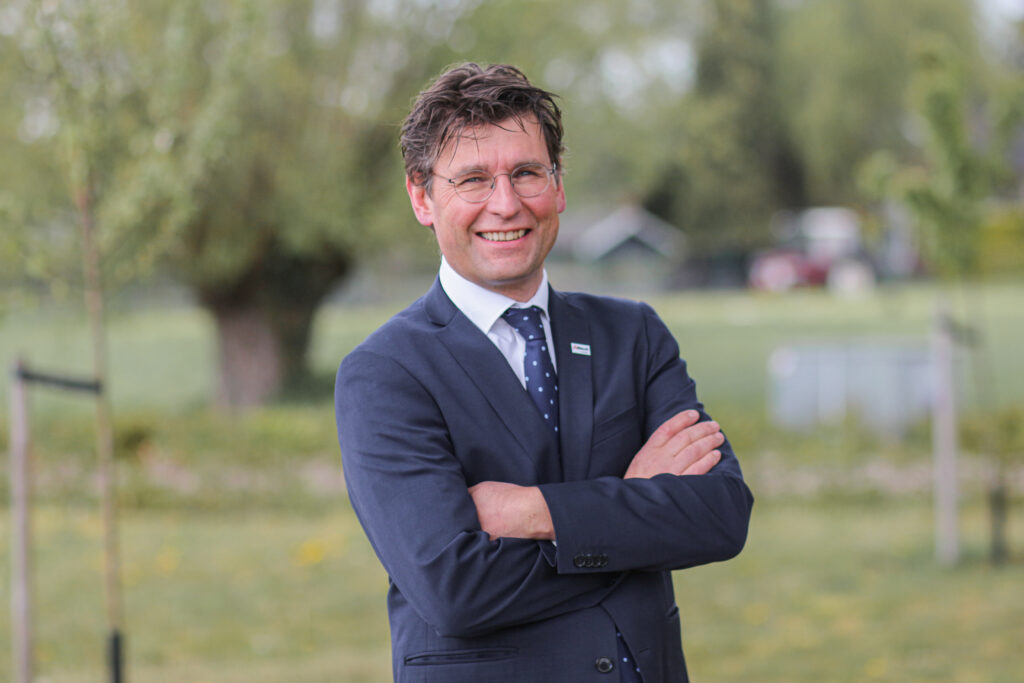
As Alltech’s global aqua lead and CEO of Alltech Coppens, Ronald Faber oversees all of Alltech’s aqua business.
Faber leads a global team of aquaculture experts focused on fish nutrition, feed production, technical support and sustainable aquafeed solutions. This team works closely together to improve aquatic feed nutrition and sustainability in aquaculture.
Faber received a master’s degree, specializing in aquaculture and fisheries, from Wageningen University, the Netherlands. He began his career in the aquaculture and veterinary industries and joined Coppens International in 1998. With more than 30 years of experience in the aquaculture industry, Faber’s journey has been marked by a commitment to innovation and sustainable practices.
You have a rich career in the industry, what initially led you to this field?
Initially I wanted to become a veterinarian, but during my studies the aqua industry really intrigued me. The industry was completely unknown at that time and there was so much to learn and discover, which is where I found my place.
Aquaculture is truly a people’s industry. It’s still a relatively small industry, so the trade shows you see a lot of old friends.
With your extensive background in aquaculture spanning over 30 years, could you share some key insights into how the industry has evolved in terms of both technological advancements and sustainable practices?
From a technology standpoint, what we have seen over the last couple of years is an increase of knowledge in the industry. It’s not only the pipes and steel, but also the data driven industry which I think we have just started to embark upon.
From a sustainability standpoint, the industry has been growing fast, especially in the last couple of years. We are not talking about replacing fishmeal and fishmeal anymore, we are already past that stage and onto the next level.
Just touching on the technological advancements, how important is the recent influx of capital into the industry?
Of course, the capital is very necessary for starting something new. There is not regular funding, and there is still some unproven technology, so we need capital from people who really want to support this industry.
With the acquisition of Coppens International by Alltech in 2016, how has this merger influenced the direction and goals of Alltech Coppens, particularly in terms of research and development?
The goal was to build a powerhouse within the aquafeed industry, of course building on the knowledge that Alltech brought in additives. Alltech is a leading company when it comes to additives, which has brought us to the next step.
Given your experience working across different regions, are there any specific regions or countries that you believe hold significant potential for growth, and what factors contribute to their promise as emerging aquaculture hubs?
Most continents have their own industry. They differ, of course, but there are two regions where I think there is growth potential for the coming years.
First, there’s North America. North America is heavily dependent on imported fish, and the industry is still relatively small. There is still room for growth, especially on the feed side. They are really lacking the technology that we have here mainly in Europe. The aquafeed industry in Mexico is quite significant already, and that’s what’s missing in the US and Canada.
But what I also like to address is Africa. West Africa, Alltech Coppens has been a pioneer in this region. We are also building on a significant investment in West Africa because we have a strong belief that’s the future market for feed and fish farmers.
Alltech Coppens emphasizes the importance of improving aquatic feed nutrition. Could you discuss some of the key strategies or advancements your team has implemented to enhance the nutritional quality of aquafeed?
Yes, I’d like to name three of them. First is our winter feeding.
What we see in the winter conditions is that fish have difficulties with digestibility, so we did a lot of research into this and developed a specified tailor-made feed for winter feeding.
The second one is net energy. We are the first in the industry to launch net energy for fish, so we cover the full cycle of production in the fish. Normally people formulate on digestible energy, but you miss a significant part this way. We have the flexibility and are leading in this area.
The third one is, of course, sustainability. It’s very important to us, we have invested in a PSE funding together with Sterling on a full LCA cycle for the value chain. We’ve seen in the past that this industry is built on innovation and research, which is true, but I think it’s also built on people. The people in the industry are passionate. They want to achieve something, build an industry because they love it. Of course, you need technology, you need your capital influx, but ultimately, I think the industry is built on people.
Couldn’t agree more. And finally, congratulations. You have been awarded silver and gold medal from EcoVadis, of all your contributions, what do you consider as most worthy of this award?
Thank you, we are extremely proud of it. What I learned from the whole process of achieving this EcoVadis silver medal and the gold medal, is that it’s not about us. It’s not about the farmers. It’s not about the supplier, but it’s the value chain. And that’s what EcoVadis does – it covers the full value chain. We have to do it together and that is the key point that the awards represent I believe.