





























by Dr Sebastien Rider, Aquaculture Scientist, dsm-firmenich, Switzerland.
Reintroducing vitamin D into aquaculture diets is primarily driven by the needs of the fish. Adequate vitamin D supports growth, health and welfare, contributing to more sustainable production. As farmed fish are also the richest natural dietary source of vitamin D for humans, this creates a paradox for aquaculture: to deliver vitamin D to consumers, fish themselves must receive sufficient and bioavailable vitamin D throughout the production cycle.
In the wild, fish acquire vitamin D through a combination of dietary prey and their skin – dermal synthesis stimulated by light exposure – although the percentages attributed to each source are still unknown. In aquaculture systems relying on feeds with a greater portion of plant-based ingredients, recirculating aquaculture systems (RAS), submerged cages and winter production, these natural inputs of light and prey are not present. The consequence of this has not only lowered vitamin D status in fish to consumers but also has measurable impacts on growth, nutrient utilization, welfare and ultimately the final product quality.
Vitamin D: Essential Nutrition
Vitamin D is not simply a dietary vitamin. In both fish and humans, although vitamin D inclusion levels in the diet are tiny, vitamin D regulates approximately 2–5 percent of the genome, telling genes when to turn on and off and influencing key physiological processes such as immune function, ion homeostasis, bone development, nutrient metabolism and growth.
However, it’s not as straightforward as supplementing the diet with vitamin D. Cholecalciferol (vitamin D₃) itself is biologically inactive and must first be converted in the liver to 25-hydroxyvitamin D₃ and then further activated at the tissue level. But once in its active form (1,25-dihydroxyvitamin D₃), it functions as a remarkable and essential regulatory hormone.
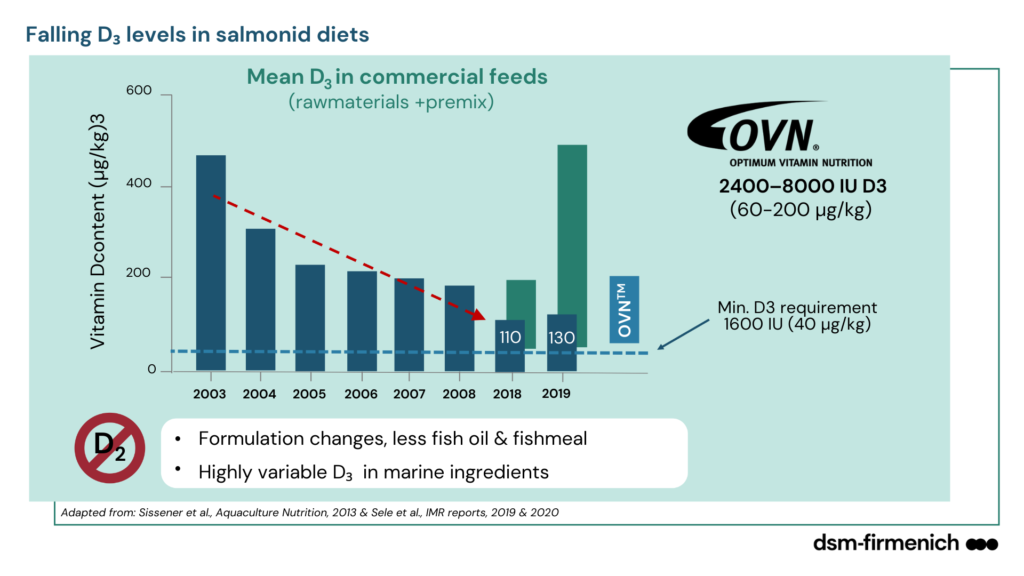
Historically, fish diets were rich in fishmeal and fish oil, naturally providing vitamin D₃. However, formulation changes over the last two decades, with a focus on plant-based diet driven by sustainability and raw material availability, have led to significantly lower and more variable vitamin D₃ levels in commercial feeds.
Figure 1 show a clear decline in vitamin D₃ content of salmonid diets from the early 2000s through 2019, coinciding with the increased use of plant-based feeds. While vitamin D₂ may be present in some ingredients, it has little biological activity in fish; vitamin D₃ is the only physiologically relevant and required form of vitamin D for fish. This nutritional gap had real (albeit unintended) biological consequences. Resultingly, specifically for salmonids, EU policy changed from limiting vitamin D₃ supplementation from 3000IU to 60,000IU. This revised level protects both the animal and the final consumer.
So, we know that vitamin D is a good thing for both fish production and the end consumer, and fish diets are being adapted to counter production environments, hindering the natural ability of fish to produce it themselves. How do producers optimise this input while working within commercial limits?
Hy-D®: The Most Bioavailable Vitamin D for Fish
Hy-D® is a pure metabolite of vitamin D3, acknowledged as the most bioavailable form of vitamin D for fish. Its presentation in the form of 25-hydroxyvitamin D₃ ensures efficient absorption and one less step in its hepatic processing, thereby enhancing its bioavailability. This represents a major step forward for the aquaculture industry, in delivering vitamin D benefits to fish and subsequently humans, unlocking both performance and quality benefits across multiple species.
The European Food Safety Authority confirmed the safety and efficacy of Hy-D®, followed by the European Commission granting authorisation for use in aquaculture at the end of 2025. This milestone advances the company’s mission to deliver safe, effective and sustainable nutritional solutions, marking a 25-year journey to bring the benefits of Hy-D® to all species in the European Union.
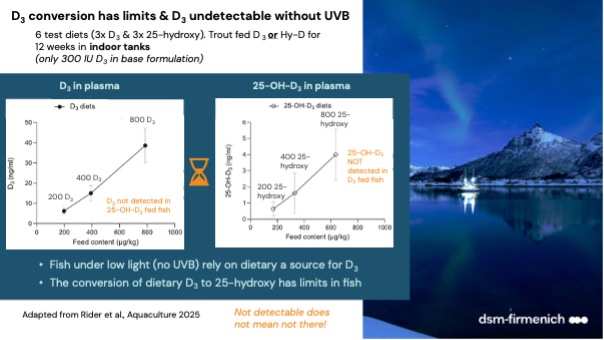
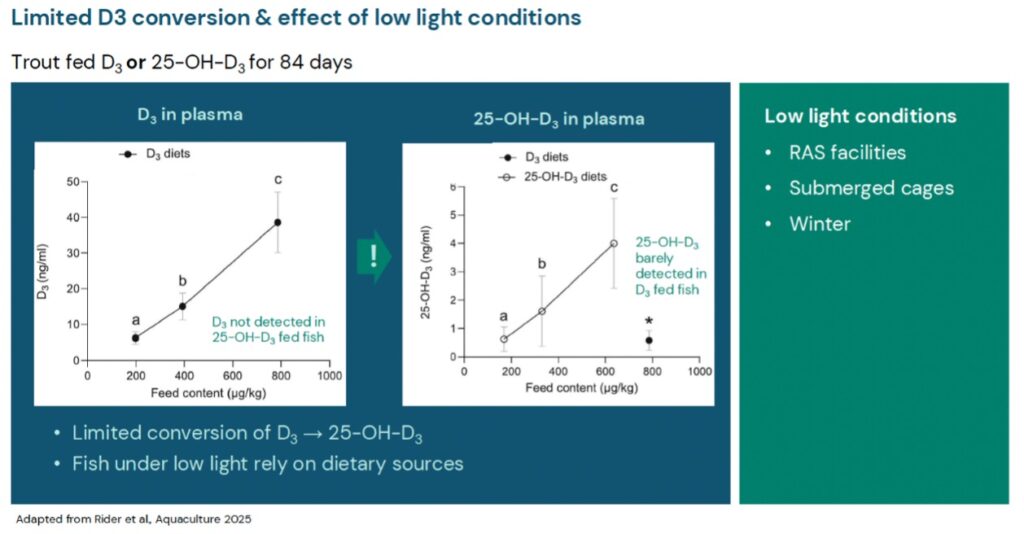
Figure 2 and figure 3 demonstrates limited conversion of dietary D₃ to circulating 25-hydroxyvitamin D₃ (25-OH-D₃), particularly under low-light conditions such as RAS facilities, submerged cages and winter production. In fish, both hydroxylation steps required to activate vitamin D occur in the liver (whereas in terrestrial animals the second conversion occurs in the kidney), creating a particular reliance on liver health for effective vitamin D metabolism. In trials where trout were fed either D₃ or 25-hydroxyvitamin D₃ for 84 days, plasma 25-OH-D₃ was barely detectable in fish feed recommended levels of D3, whereas Hy-D® supplementation resulted in measurable (and functional) metabolite levels.
This explains why simply adding more standard D₃ often fails to deliver consistent, expected responses in the field. As we know, from a fish performance standpoint, insufficient vitamin D reduces growth and compromises feed efficiency.
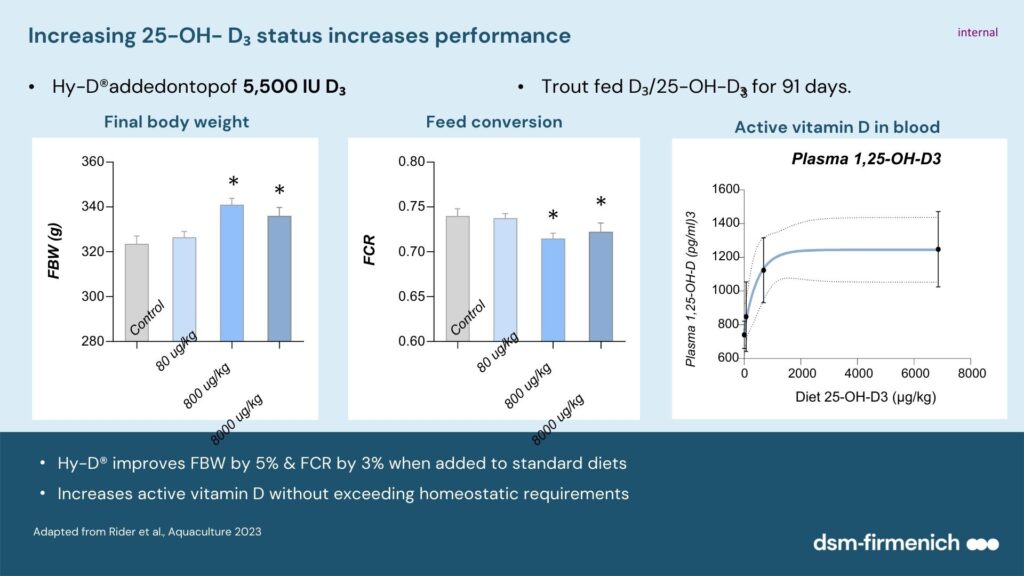
When Hy-D® was added on top of standard diets containing approximately 5500 IU D₃ which is typical in today’s commercial aquafeeds, trout showed a five percent increase in final body weight (FBW) and a three percent improvement in feed conversion ratio (FCR) over 91 days when added to standard diets, as seen in figure 4. Importantly, these benefits were achieved without exceeding regulatory vitamin D limits.
Because of Hy-D’s higher efficacy, producers can more easily comply with regulatory limits on vitamin D set for some species of fish in certain geographies. The benefits to business profitability are equally clear – the cost of vitamin supplementation is negligible when compared to the cost of reduced growth, poorer feed conversion ratio and lost biomass. Hy-D® demonstrates a ROI of 5:1.
Welfare and Wound Healing Benefits
From a welfare perspective, low vitamin D status in fish is associated with thinner skin and reduced robustness. This is particularly relevant during mechanical handling events, such as well-boat operations for sea lice treatments, where wounds and scale loss directly reduce the value of whole fish, and together with a reduced immune capacity, increase secondary infection risk.
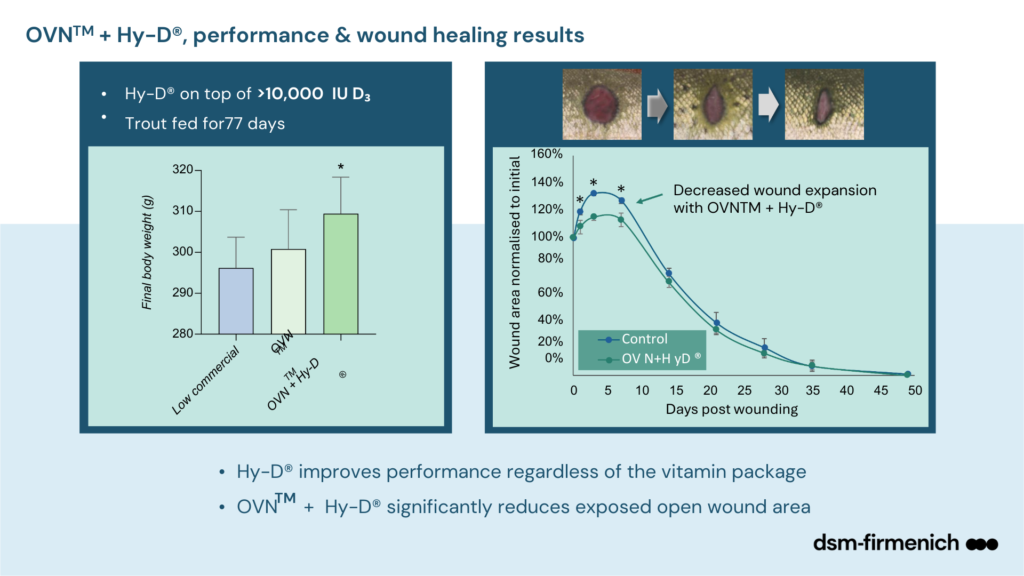
Figure 5 shows that in trout trials comparing standard vitamin packages with OVN™ plus Hy-D®, fish receiving Hy-D® showed reduced wound expansion, demonstrating enhanced tissue repair capacity, good news for fish farmers in regions like Norway where winter wounds are a challenge.
Lipid Utilization, Carcass Yield, and Fillet Quality
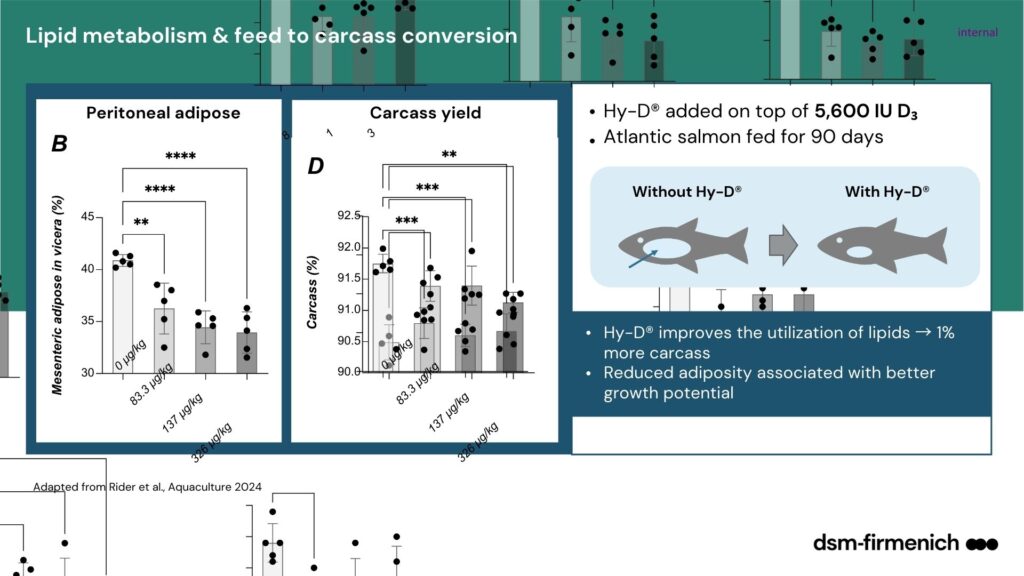
Hy-D® also has a positive effect on lipid metabolism and feed-to-carcass conversion efficiency, as seen in figure 6. In Atlantic salmon fed for 90 days, increasing dietary 25-OH-D₃ reduced mesenteric adiposity, improved visceral somatic index and increased carcass yield by approximately one percent compared to diets without Hy-D®. Field observations in Chile also suggest improvements in both bone deformity and fillet gaping – by supporting connective tissue and muscle structure, Hy-D® contributes to better texture and product consistency.
Life Stage: Deep Dive
Vitamin D requirements are not static – they vary across life stages. For example, data indicates that older, seawater fish may require approximately three times more vitamin D than early-stage freshwater fish. Fish are now spending more of their early days undercover, with smolt often transferred from freshwater at 300–500 grams rather than the historical 100 grams, spending extended periods under cover in RAS facilities with minimal UVB exposure. Under these conditions, fish rely entirely on a dietary source of vitamin D.
The Ultimate Goal: Consumer Nutrition
From a consumer’s perspective, the key benefit of oily fish lies in their naturally high vitamin D content. Yet vitamin D deficiency remains widespread, with approximately 40 percent of Europeans and 35 percent of people in the United States insufficient in circulating 25-hydroxy-D₃. Much like some farmed fish, modern humans spend increasing amounts of time indoors, limiting exposure to sunlight and reducing endogenous vitamin D synthesis.
This issue is particularly pronounced during winter in the northern hemisphere, when shorter daylight hours and adverse weather mean that dietary intake becomes the dominant source of vitamin D. At the same time, winter often places additional strain on the immune system, making oily fish such as sardine, mackerel and salmon valuable contributors to vitamin D intake. A 100 gram serving of salmon can provide between 38 – 126 percent of the adequate daily intake of vitamin D₃, although levels remain consistently higher in wild compared with farmed fish.
Optimizing vitamin D nutrition in aquafeeds therefore not only improves fish health and performance but also strengthens the nutritional value proposition of farmed fish for consumers.
Putting the 25-hydroxy D3 back in the fish
Putting the D back in diets is about delivering vitamin D in a form fish can actually use. This is why the availability of Hy-D® represents a significant step forward for fish producers worldwide providing a science-based solution to long-standing metabolic limitations. By improving growth, feed efficiency, welfare, product quality and ultimately consumer value while remaining within regulatory frameworks. As demand for aquatic protein continues to grow, precision micronutrition is no longer optional but fundamental to sustainable performance.
So, what’s next for vitamin D research? dsm-firmenich is planning trials to investigate the role of vitamin D in immunity against viral and bacterial disease, its interaction with the uptake of other micronutrients and how 25-hydroxy-D₃ supports the specific needs of key organs, including the gill and intestine. Watch this space.
And perhaps by the end of the story, it becomes clear that “putting the D back in diets” really means putting 25-hydroxy-D₃ back into the fish—where it can do its most important work.