






























by Jordi Comas, Sales Manager warm water markets at Mørenot Aquaculture, Norway

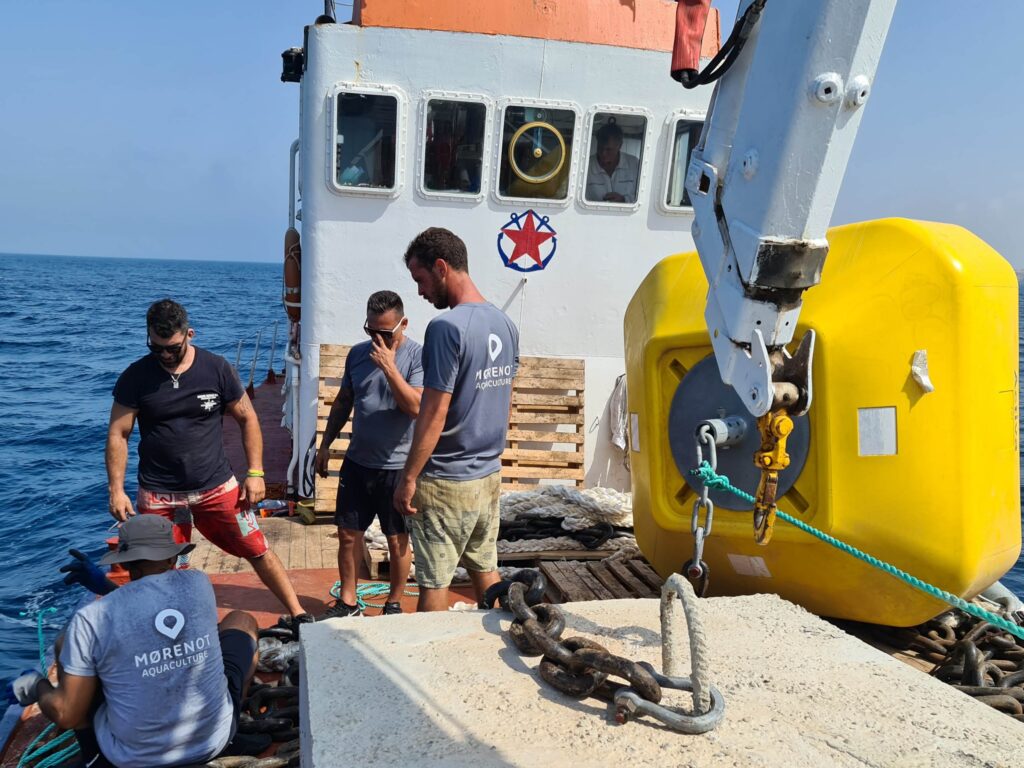
More than a century ago, Mørenot began its journey by supplying fishing gear and nets in Norway. As the aquaculture industry evolved in the country, Mørenot specialised in manufacturing aquaculture nets. While premium net production has been the company’s central activity, it has diversified into other sectors, including fisheries and the oil and gas industries. Despite this diversification, aquaculture has remained company’s core business. The company has expanded globally, establishing subsidiaries and diversifying product range. Today, it is a leading global supplier to the aquaculture industry, offering complete turn-key solutions, including equipment, services, know-how transfer, ongoing support, and training, primarily for the cage aquaculture sector.
Off-shore cage culture
Among all different production methodologies, net pens account for approximately 65 percent of marine and coastal finfish aquaculture production, and their significance is expected to grow with the industry’s expansion. Despite being a well-established production system, cage culture has faced criticism regarding farmed fish interactions with wild populations, visual impact, and water and sediment contamination. However, many of these concerns lack supporting data. When properly planned and managed, cage culture offers substantial advantages over other production systems, being lower operational costs the most relevant. Cage culture also requires less land and pumping effort while maintaining high production efficiency. Offshore operations further reduce the impact on water quality and sediments.


Systems reliability
In cage aquaculture, net pens are the strong box of the biomass. Fish farms must be strategically placed, and cages, nets, and mooring components must be designed and dimensioned to withstand weather and oceanic conditions to ensure reliability and prevent structural failures and fish escapes.
Norway’s salmon industry pioneered the development and implementation of aquaculture standards. The implementation of the Norsk Standard NS 9415, first introduced in the early 2000s and continuously revised, has significantly reduced fish escapes in Norway while increasing production threefold. This standard precisely defines the conditions and specifications for fish farms, with mooring and net analysis ensuring compliance.


Aquaculture’s growth and challenges
Aquaculture is poised for significant growth. Currently, half of the world’s seafood consumption, approximately 100 million tonnes, comes from aquaculture. Aquaculture industry expansion will be essential to meet the increasing demand for marine food driven by global population growth, projected to reach 11 billion in less than 50 years. Additionally, the depletion of fish stocks due to overfishing, which has been steadily declining over the past 20 years, underscores the need for sustainable aquaculture practices. As stated above, cage aquaculture already accounts for about two-thirds of marine finfish production and is expected to play a significant role in providing secure, sustainable, and healthy food for future generations.
The role of technology
Aquaculture is a primary sector industry and still today most of aquaculture production relies on traditional practices where technology plays a minimal role. However, the industry’s growth must be driven by the implementation of advanced digital technologies and artificial intelligence. These innovations should enhance farm reliability and robustness, improve control, efficiency, sustainability, and reduce maintenance and energy consumption, thereby lowering costs.
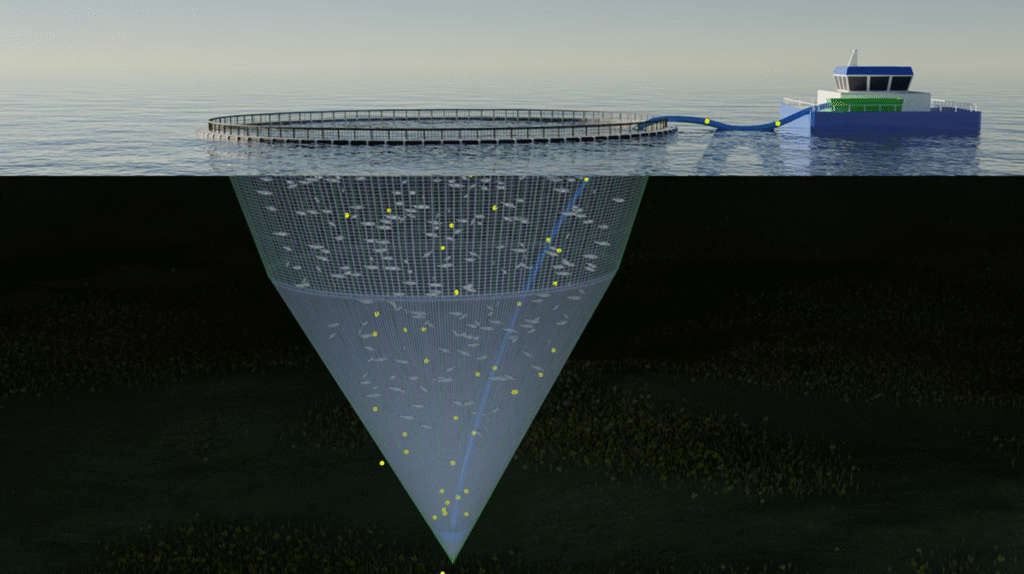
Innovation and technology implementation have been a cornerstone of Mørenot since the company was established. It was among the first companies in Norway to be certified to supply according to NS 9415. In 2010, the company launched the Flexilink®, the first steel-free grid system for offshore cages, designed to extend the lifespan of traditional grids, increase reliability, and significantly reduce maintenance costs. In 2024, they introduced the Mørenot Collect, a system that collects waste deposition in net pens, pumps it back to the surface, and upcycles it into green energy. Commercial-scale tests in Norway reported a 60 percent efficiency, with the energy generated equivalent to the annual electricity consumption of 40 households. This innovation exemplifies how transitioning to a circular economy can mitigate environmental impact.


Future technological challenges
The company is now tackling new technological challenges. Some of the most relevant are the development of full-scale, reliable, and affordable technology for submersible cages and offshore semi-closed systems. Apart from reducing visual impact, submersible cages aim to protect stock by lowering cages in the water column during storm episodes, place biomass in optimal temperature and dissolved oxygen ranges, and mitigate parasite infestations or pathological infections. Semi-closed systems, on the other hand, enable some water quality control inside net pens by pumping in high-quality water and reducing the interaction between inside and outside cage water bodies, thereby promoting fish welfare and performance.
Pioneering digital solutions
In 2010, the company anticipated the need for digital technologies in aquaculture and established Mørenot Digital to spearhead this transformation in the industry. The following year, Mørenot Digital launched Aquacom, a comprehensive database designed to integrate all digital technologies within a fish farm. Since its inception, it has evolved into an indispensable tool for fish farmers, not only enabling them to manage maintenance and operations seamlessly but helping in the integration of different systems and control tools, including feeding control software, growth models, water quality sensors, weather forecast applications, environmental modelling, mooring load cells, and biomass estimators among others.
The integration of these technologies, coupled with artificial intelligence to analyse real-time data, offers fish farmers a revolutionary perspective on decision-making. This holistic approach will enhance sustainability, efficiency, and cost, paving the way for a new era in aquaculture.

Dawn of aquaculture 4.0
Digitalisation, cutting-edge technologies, and artificial intelligence are propelling us towards Aquaculture 4.0. This advancement is set to be crucial for the production of marine-origin food in the coming decades. At Mørenot, we firmly believe that cage aquaculture will play a pivotal role in the industry’s growth, ensuring the secure and sustainable production of marine food to meet future demands. Aquaculture 4.0 is not just a vision; it’s the future of sustainable food production.
Published in the April 2025 issue of International Aquafeed & Fish Farming Technology