

































by Joana Yi Hui de Sousa Pinto Liew, MSc Sustainable Aquaculture and Fisheries, University of Plymouth, UK
As global demand for seafood continues to rise, questions of sustainability are becoming increasingly important to consider. Eco-labels offer consumers more sustainable choices, but how much do consumers know and care about these labels? A survey in Plymouth, UK, explored these questions by assessing consumer awareness of the term sustainability, willingness to pay (WTP) for eco-labels, preference for wild versus farmed fish and knowledge of seafood harvesting techniques.

Survey methodology
A survey was conducted online (49 percent) and face-to-face (51 percent) using a self-administered questionnaire open to residents in Plymouth who were above 18 years old and consumed seafood. The questionnaire assessed consumer understanding of the term sustainability, WTP for eco-labels, perceptions of wild versus farmed fish, and awareness of seafood harvesting techniques. Demographic information was also obtained, such as age, gender, occupation, monthly income and additional details.
Thematic analysis was used on open-ended responses on sustainability. Inductive analysis was applied to explore consumer views on eco-labels, reasons for not choosing to purchase eco-labelled seafood products, and views on seafood harvesting techniques. A generalised linear model with a significance level of p<0.05 was used to analyse how age, gender, employment, monthly income, education and weekly grocery expenditure influenced WTP for eco-labelled products. A Kruskal-Wallis test was used to examine the relationship between the aforementioned independent variables, and to determine if age, employment, monthly income and education influenced consumer perceptions of wild and farmed fish statements.
Demographic information
In total, there were 140 participants consisting of 56 percent females and 44 percent male respondents, with 18-24 years old being the highest represented age group (36 percent) and 45-54 years old being the least represented group (seven percent). Most respondents were employed full-time (42 percent) or were students (31 percent), and 47 percent of respondents held a degree or equivalent. Monthly income varied, with over 30 percent of respondents earning more than UK£2,000 per month while 26 percent of respondents were students with no monthly income. Most respondents reported a weekly food expenditure of UK£30-UK£50 (35 percent), followed by UK£50-UK£70 (23 percent). Over 80 percent shopped for one to two people, and 64 percent of respondents lived one to two miles from the sea.


Willingness to pay for eco-labels
Eco-labels such as Marine Stewardship Council (MSC), Aquaculture Stewardship Council (ASC) and Friend of the Sea (FOS) provide consumers with guidance on sustainable and ethically sourced options. While prior research shows that consumers are willing to pay a premium of up to 10 percent for eco-labelled seafood, many studies vary their methodologies and express price premiums using percentages rather than actual monetary values. This inconsistency raises the question about whether survey respondents really understand the implications of their stated WTP.
In the present study, respondents earning over UK£2000 per month were willing to pay an estimated UK£4.20 or more for two pieces of eco-labelled salmon weighing 240g (vs current cost of UK£3.89; i.e. an approx. eight percent premium). This aligns with the general trend that people with higher disposable income are more open to paying a premium for sustainable products, likely because they are not constrained by the amount of disposable income available. A general linear model revealed that weekly grocery expenditure negatively influenced WTP, with those who spend between UK£50-UK£70 a week on groceries limiting their WTP to about UK£4 or less for the same eco-labelled product (a premium of three percent or less).
Consumers within the 18-24 year old category expressed the most scepticism towards eco-labels, with many referencing the documentary ‘Seaspiracy’. Although such documentaries highlight the need for environmental and social responsibility, their accuracy must be critically scrutinised, as they may deter consumers from supporting meaningful solutions. Indeed, ‘Seaspiracy’ has retracted some of the claims it originally presented.
Consumer mistrust may also stem from the possible over proliferation of eco-labels in the market, which may be overwhelming and confusing to consumers. While eco-labels highlight environmental and social attributes of products, the abundance of labels, each with varying information and colourful logos, may confuse consumers.
Understanding sustainability
Although a popular buzzword today, the term sustainability originates from 18th century forestry practices; in 1987 the term evolved into a policy concept through the World Commission on Environment (WCED) report Our Common Future, defining it as development that satisfies present needs without compromising the needs of future generations. Research suggests a growing understanding of the term due to a rise in media coverage and early integration into educational initiatives, but with so many definitions of sustainability, the term remains widely misunderstood.
In the present study, most respondents (35 percent) referenced the Brundtland Report definition, and resource stewardship, responsible harvesting, along with an emphasis on environmental aspects were also mentioned. This awareness likely stems from the fact that many respondents were students or graduates with a background in biological or environmental sciences, making them more aware of this term.
Recent initiatives that focus heavily on the protection of the environment, such as the creation of the UK’s first National Marine Park at Plymouth Sound in 2019, may also be increasing the local awareness for the term, albeit emphasising environmental aspects. This focus on environmental dimensions in consumers’ responses, overshadows other sustainability dimensions such as traceability, choosing local products, ethics and preserving cultural practices, leading to their lower prominence, which could explain why many consumers prioritised nature-related themes.

Wild versus farmed fish
It is often reported that consumers generally favour wild over farmed fish, perceiving it as tastier, fresher and higher quality compared to farmed fish, despite research demonstrating that consumers often cannot differentiate between the two. This perception is shaped by multiple sociodemographic factors. Higher education and income tend to correlate with more favourable views towards farmed fish. In contrast, older respondents (55 years or older) view wild fish as more sustainable and tastier than farmed fish. Gender differences in perception, however, are less clear, as most research point towards a lack of a significant relationship.
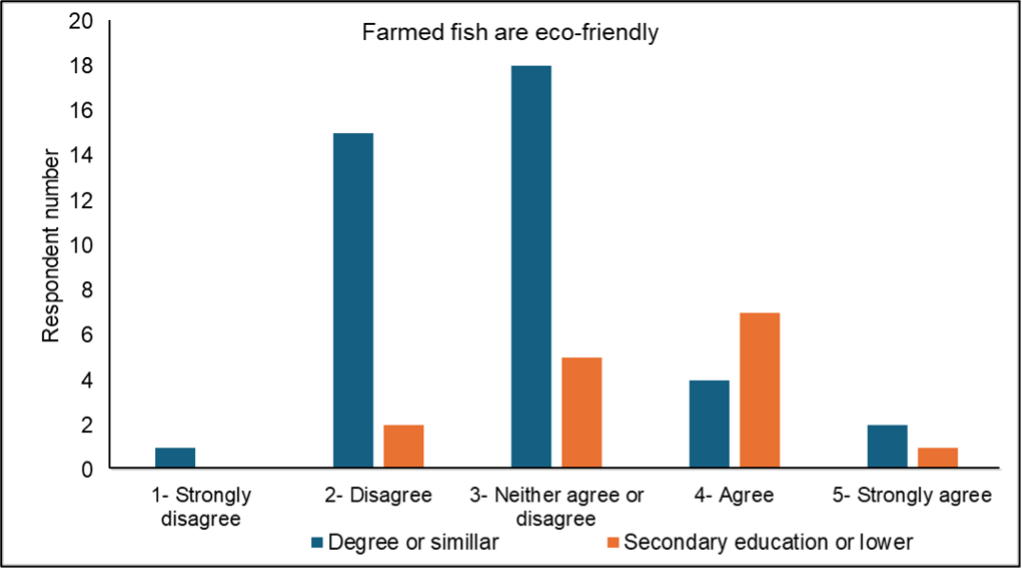
According to the findings of the current survey, consumers generally favoured wild over farmed fish, associating it with higher quality, safety, eco-friendliness and better animal welfare. Respondents with higher education were likely to disagree with the statement ‘Farmed fish are eco-friendly’ (Figure 1), suggesting highly educated individuals were less likely to hold simplistic beliefs and will tend to critically assess before forming opinions, rather than accept information at face value.
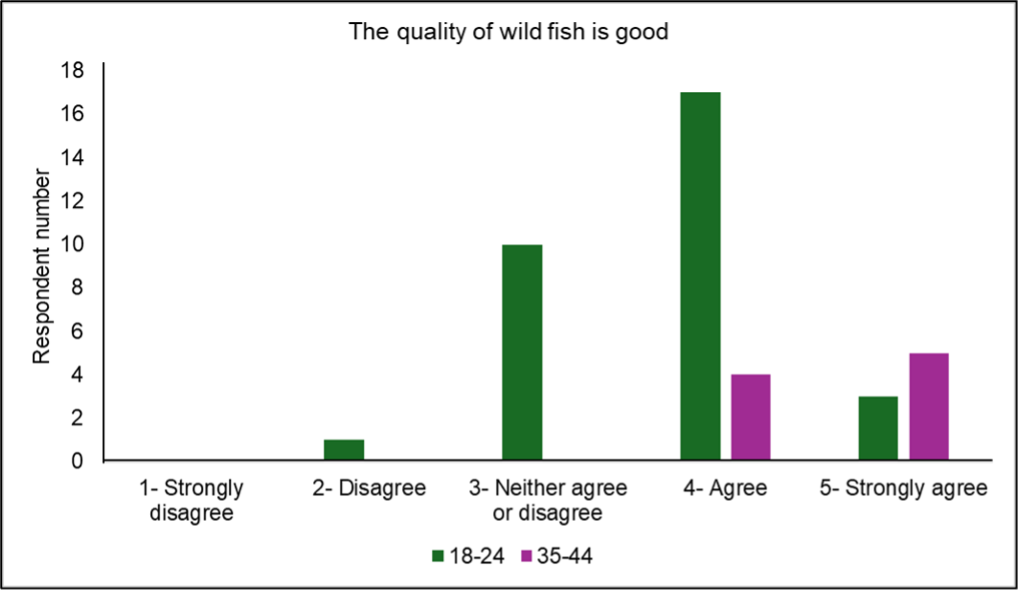
A notable difference emerged between the age groups 18-24 years and 34-44 years, whereby the older age group expressed stronger agreement towards the statement ‘The quality of wild fish is good’ compared to younger individuals. Older individuals often perceive wild fish to be more natural, healthier and of better quality compared to farmed fish. Conversely, they often link farmed fish with industrial processes akin to agricultural farming, raising concerns about chemical and antibiotic use. This may explain the stronger preference for wild fish among older respondents.

Techniques and sociodemographic impact
There is a general paucity of research on consumer awareness of seafood harvesting techniques, but the study of Karnad et al. (2021) is an interesting example of one of the few in-depth studies. Their findings concluded that more than 60 percent of consumers successfully identified at least one type of fishing gear. Proximity to the sea and higher education were linked with increased awareness of these techniques, and education provides greater access to ecological knowledge, enhancing their understanding of fishing methods. Interestingly, younger respondents demonstrated greater familiarity towards traditional fishing methods compared to older respondents.
Age and employment affected consumer seafood consumption frequency. Older (65 years or over) and retired respondents ate seafood more regularly than those aged 25-34 years, likely due to the health benefits of seafood. The high omega-3, vitamin and mineral content is highly prioritised by older consumers.
Summary
Understanding the impact of consumer purchasing decisions is crucial for promoting sustainable seafood choices. Increasing educational campaigns is key to enhancing consumers WTP for sustainably sourced seafood, and affordability must be ensured for those with larger families or lower incomes. By raising awareness of the benefits of eco-labels, this will help reduce scepticism, helping support long-term environmental and social goals. Awareness of seafood harvesting remains limited, highlighting the need for greater education to allow consumers to understand what each technique entails and the subsequent ecological impact. Ultimately, these insights need to be implemented swiftly, and informed decisions will be the key to protecting marine ecosystems for generations to come.
Published in the December 2024 issue of International Aquafeed.