













Dr. Giovanni M. Cusimano1
1AquaBioTech Group, Malta
To determine the performance and feed utilisation of hybrid catfish (Clarias gariepinus ♀ x Heterobranchus longifilis ♂) fed a novel yeast additive made from cultured Candida utilis, a nine-week growth trial was conducted. Preliminary results of this trial indicate that C. utilis could represent a suitable replacement of plant-based ingredients in hybrid catfish diet.
A growing demand for catfish
The FAO (2022) has identified catfish as an important and expanding sub-sector for aquaculture with production growing exponentially over the past several years, reaching 7.6 percent of the global inland aquaculture production in 2020. Although taxonomists recognise >3,000 species of catfish, only some of these contribute to the global harvest. The genus Clarias has been widely introduced to many countries beyond its native range, including Brazil, Cuba, Bangladesh, China, Philippines, The Netherlands, and Hungary (who lead the European production with over 3000 tons/year). Although the use of the pure strain is widespread, the hybridisation process has drawn attention to improved production traits such as growth, feed utilisation, and disease resistance.
In the interest of more efficient production systems, improved sustainability, and reduced adverse environmental impacts there needs to be a reduction in the dependency on traditional raw materials (fishmeal and soybean meal) in aquafeed. Extensive research on microbial products, particularly yeast, is showing immense potential as a sustainable protein source for food or feed (Jones et al., 2020; Øverland & Skrede, 2016). Yeast is able to convert low-value non-food waste biomass from forestry and agriculture into high protein feed with limited dependence on arable land and water.
The aim of this study was, therefore, to evaluate growth and feed utilisation performances when including single cell proteins at varying proportions in hybrid catfish feed.
Yeast additives as a feed solution
The experiment compared a control diet (42 percent protein, 12 percent lipid) consisting primarily of 80 percent land-based ingredients (wheat, soybean meal, wheat gluten) and 17 percent animal-based ingredients (feather meal, fishmeal, fish oil, poultry oil) with two experimental diets where C. utilis was included at 10 and 20 percent respectively. A total of 140 specimens were randomly assigned to three replicate groups and stocked in 0.65 m3 culture tanks within a full Recirculation Aquaculture System (RAS). The results of the trial showed a similar growth trend among the treatments with no significant differences recorded.
The three tested diets were formulated to be isonitrogenous (42 percent crude protein) and isolipidic (12 percent crude fat) and manufactured by Research Diet Services BV. The inclusion level of primary protein sources is showed in Table 1.

Juvenile hybrid catfish (Clarias gariepinus ♀ x Heterobranchus longifilis ♂) were obtained in June 2022 from Győri Előre Halászati Termelőszövetkezet (Hungary) at a size of 0.4g and fed with a commercial diet until they reached the target size for the trial.
Fish of 77.7±0.25 g were randomly divided at an initial stocking density of 140 individuals per replicate (17kg m-3) and fed three times a day just below satiation for nine weeks. A bulk weight of all fish was performed after four weeks and at the end of the trial. Growth performances (FCR, SGR, PER, SFR) between the diets was then evaluated. Additional data collection of bio-morphometrics (K, fillet yield, VSI, SSI, HSI) and body colour intensity (L*, a* and b* coordinate) using Minolta Chroma-Meters CR-400 cat. 1878-209 was also performed.
The proof is in the pellets
Growth performance, bio-morphometric indexes and body colour intensity were analysed by one-way analysis of variance (ANOVA), using Jamovi software version 2.2.5 (The Jamovi Project, 2020), followed by post-hoc comparison by Tukey ́s test for significance. The level of significance was set at p<0.05.
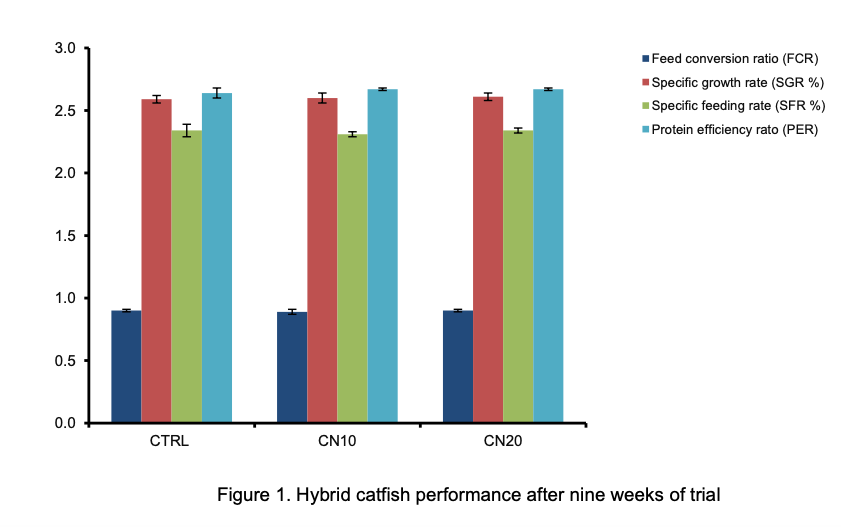
The experimental diets used during the trial were well accepted by the fish and no signs of low palatability were recorded. End of trial growth performance biometric and morphometric indexes and body colour intensity are shown in Table 2 and Figure 1. The experimental diets gave similar growth results (p>0.05) and there is no evidence that candida meal inclusion reduces growth performance. In fact, 20 percent inclusion of candida meal showed slightly higher growth compared to control and 10 percent inclusion. The overall survival rate was >98 percent indicating an absence of negative effect of the treatments. Finally, the biometric and morphometric indexes revealed no significant difference among the treatments, while the body colour intensity showed a significant higher value of a* (red/green coordinate) of the 20 percent inclusion compared to the control diet.

A diversification of options
The aquafeed manufacture industry is still dominated by fishmeal and plant-based products but can now rely on a wider range of ingredients.
This experiment demonstrates the opportunity to provide a novel, more sustainable alternative for the industry that can relieve the environmental pressures on marine and land- based stocks. C. utilis has important nutritional value, possessing a high protein content (55 percent) and an interesting amino acid profile, including lysine (4.5 percent), threonine (3.0 percent), histidine (2.0 percent), and arginine (4.9 percent), as well as B-complex vitamins. Though non- significant, these results indicate that reduction of plant-based ingredients of about 14 percent and 28 percent, produced similar or slightly improved growth rates compared to the control diet. The palatability of the tested yeast-based diets was in contrast with previous research conducted on fingerlings of African catfish, where an inclusion of 30 percent yeast showed low palatability and reduced feed intake (Elesho et al., 2021; Solomon et al., 2017). Although the results are promising, further investigation is required to evaluate the interaction among the ingredients in formulated diets, the relative effect on digestibility and the gut impact in hybrid catfish.
What’s next for sustainable circular feeds?
The use of C. utilis and yeast in general as novel protein source has been widely investigated in valuable farmed species such as salmonids (Øverland et al., 2013; Refstie et al., 2010; Tukmechi et al., 2014), marine and freshwater fish (He et al., 2011; Li P, 2003/ 2004; Ortuno et al., 2002; Rodriguez et al., 2003; Tewary et al., 2011; Welker et al., 2012) showing an enhancement of growth performance, immune responses, and/or protection against bacterial infection. The growing interest of catfish farming worldwide and the development of related technology, make it a valuable candidate for further investigation.
These preliminary results will be integrated with further results of liver and gut histology, gut microbiome, and acute challenge test (ACT) using confinement stress. This multidisciplinary holistic approach will provide valuable information about physiology, feed utilization and stress tolerance of hybrid catfish fed with different inclusions of C. utilis.
Further investigation is needed to define the optimal inclusion of candida meal, the replacement of plant-based ingredients, as well as a market analysis on production costs of such ingredients at industrial scale to ensure the sustainability of yeast production as part of aquafeed, not only for catfish but for many high-value farmed species.
ABTG~Document~Date
Acknowledgements
This research was carried out as part of “Intelligent Fish feeding through Integration of Enabling technologies and Circular principles – iFishIENCi Innovation Action Project”. iFishIENCi is funded by the European Union’s Horizon 2020 Research and Innovation Programme under grant agreement No 818036
References are available upon request
