


























by Bragi Smith, Sales Director, Saeplast and iTUB Europe, Iceland
Atlantic salmon is one of the world’s most efficient animal proteins, but once the fish leaves the farm, an important part of the value chain still depends on a largely linear model. Whole, head-on gutted salmon is commonly packed in expanded polystyrene boxes, transported to a processing plant where the fish is processed. Once this transport has been completed the box is discarded.
That model has worked for decades, and EPS remains useful for routes where return logistics are impractical, particularly some airfreight and low-volume lanes. But on regular, high-volume routes between salmon producers and value-added processing plants, the industry now has a credible alternative.
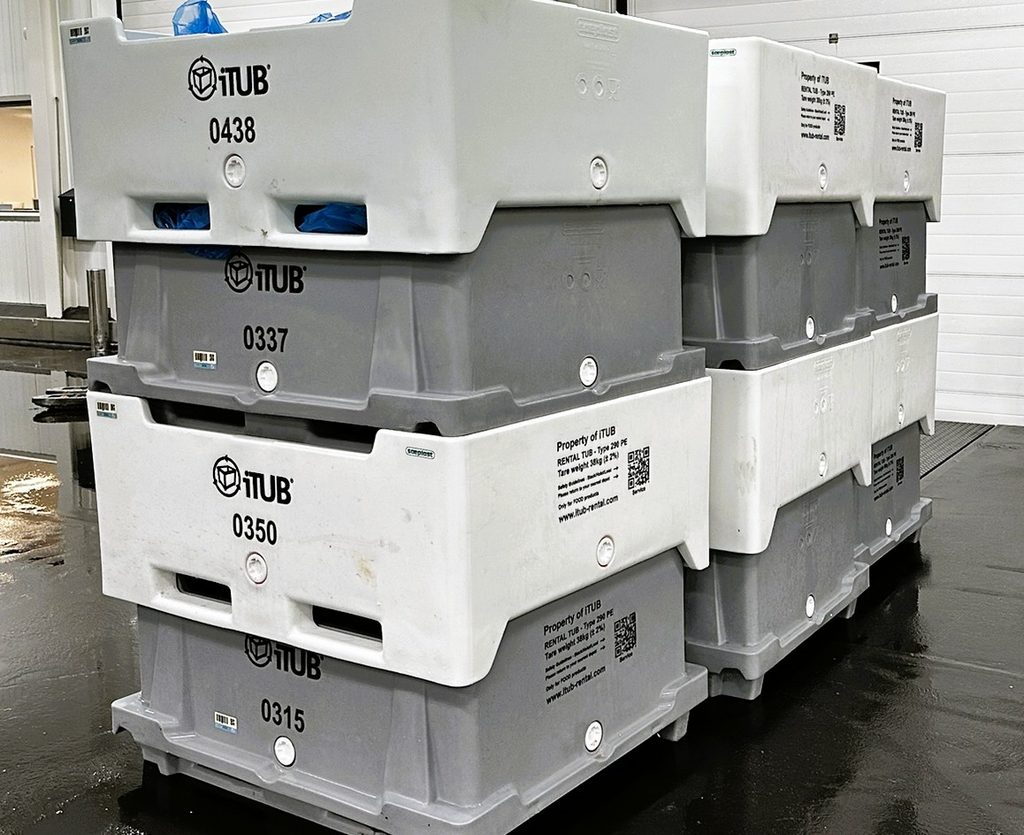
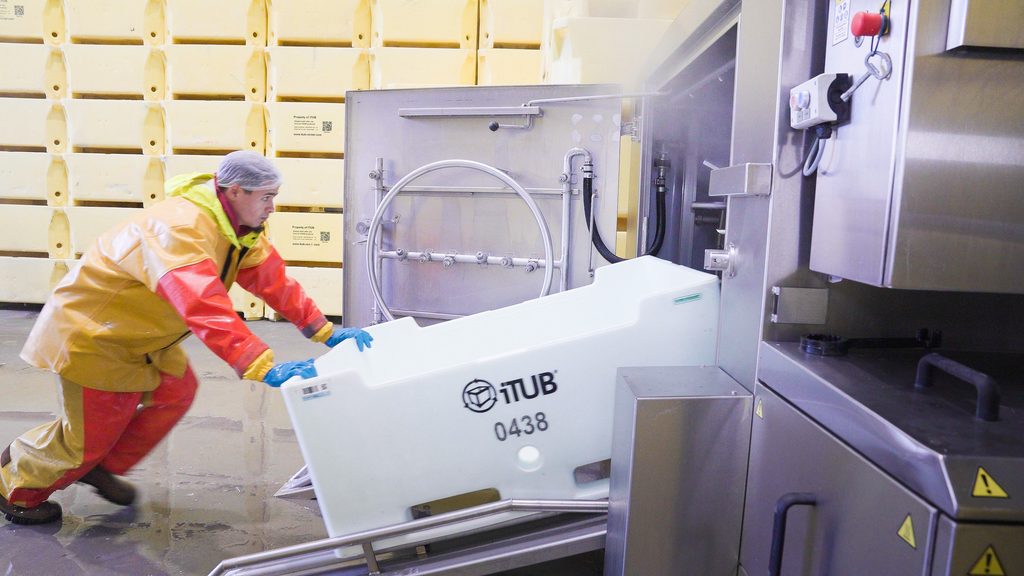
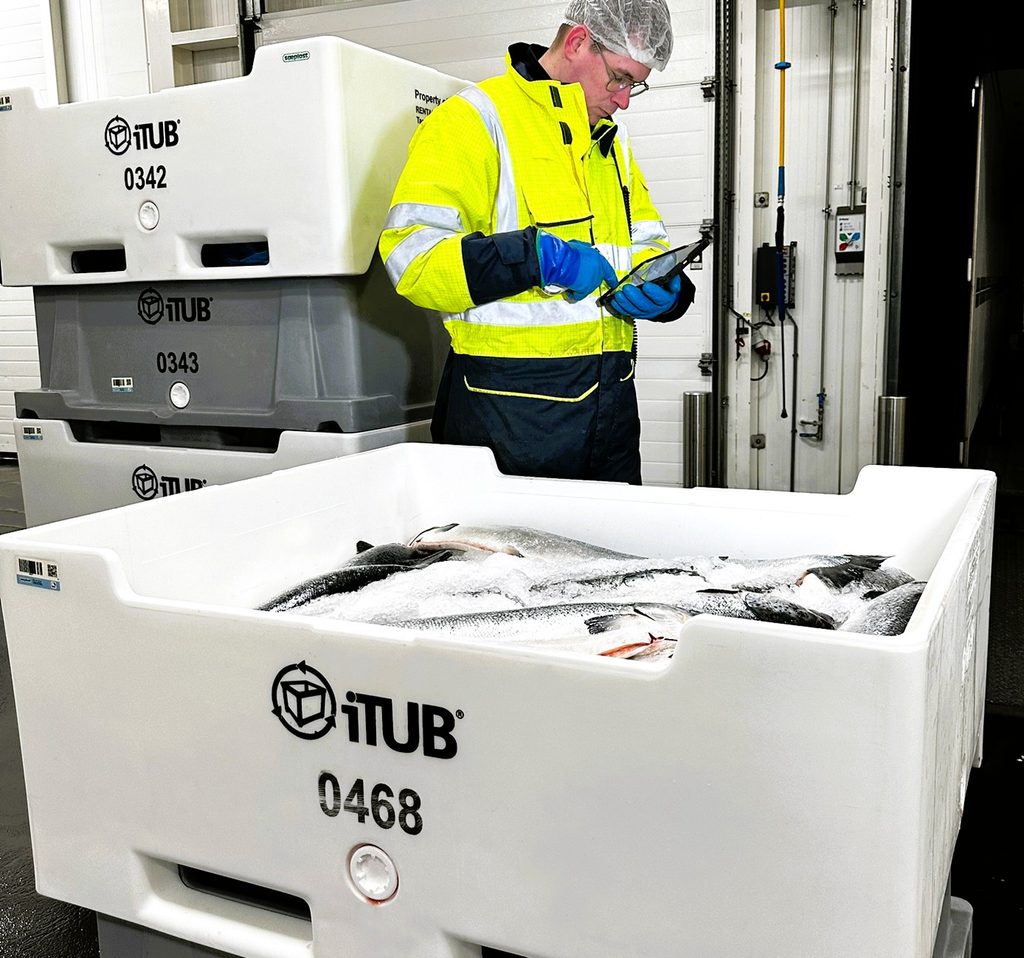
The Salmon Solution is not simply another tub. It is a managed transport system built around reusable, insulated polyethylene tubs manufactured by Sæplast and operated in a circular rental pool by iTUB. Clean and disinfected tubs are delivered to a salmon producer. The tubs are filled with HOG salmon, transported to the buyer, emptied, collected, inspected, repaired where necessary, professionally washed and disinfected, and returned to circulation. Digital tracking gives the operator visibility over location, utilisation and turnaround.
This distinction matters. Reuse does not succeed because a package is theoretically reusable. It succeeds only when the collection, return, washing, inspection, repair and redistribution system works reliably. Saeplast brings more than four decades of experience in insulated seafood tubs, while iTUB has operated reusable tub pooling since 2010. Together, the companies can provide both the physical product and the operational infrastructure required to keep it moving.
Why the timing has changed
The European Union’s Packaging and Packaging Waste Regulation, or PPWR, changes the direction of travel for packaging. The regulation entered into force on 11 February 2025 and generally applies from 12 August 2026. It covers the full life cycle of packaging and places greater emphasis on waste prevention, reuse, recyclability and lower dependence on virgin raw materials. From 2030, economic operators must ensure that at least 40 percent of several categories of transport and sales packaging are reusable, including many boxes, trays and plastic crates.
PPWR is not a blanket ban on EPS, and companies should not treat any single packaging change as automatic compliance. What it does do is make the old ‘produce, use once and discard’ model harder to defend. It also raises the importance of real reuse systems: packaging must be capable of repeated use, safe emptying, cleaning, refilling and circulation within an organized system.
The business case comes first
Environmental performance matters, but aquaculture companies are also under intense pressure to control cost. A sustainable system that creates more work, adds freight or weakens product quality will not scale. Reuse has to make financial sense.
A Twin Tub typically carries around 200 kilograms of salmon, approximately the same amount of fish as ten conventional EPS boxes. That immediately reduces the number of individual handling units. At the producer, fewer packages can mean faster filling and loading. At the processor, it means fewer units to unload and far less single-use packaging to compact, store and dispose of.
The tubs are also nestable. When empty, one half of a Twin Tub is turned and placed inside the other, reducing the return volume by up to 60 percent. This is critical because the business and environmental case for reuse depends on efficient backhaul rather than transporting empty air.
Payload is another major factor. In one modelled 40-foot standard container example, 621 EPS boxes carried approximately 13.35 tonnes of salmon. The same container configuration held 91 Twin Tubs carrying approximately 18.2 tonnes. That is about 36 percent more saleable fish in the same transport unit.
The exact saving will differ by route, legal payload limits, fish size, ice ratio, container type, washing location and return logistics. Not that every lane will save the same amount. It is that suitable closed-loop routes can deliver meaningful savings in packaging, handling and freight, with packaging savings commonly modelled at around 20–30 percent and total logistics benefits potentially higher.
Lower emissions through repeated use
The environmental case follows the same logic. A reusable tub has a larger manufacturing footprint than one lightweight EPS box, but it carries much more fish and is used repeatedly over a working life that can reach 12–15 years. The relevant comparison is therefore not one tub against one box. It is the full service delivered over many transport cycles.
A peer-reviewed life-cycle assessment led by the University of Iceland compared single-use and multi-use systems for transporting 1000 tonnes of fresh fish from Iceland to Europe. The EPS system produced approximately 141 tonnes of carbon-dioxide equivalent, while the reusable alternatives ranged from roughly four to 46 tonnes in the first year, depending on the system. The study found that the multi-use systems had lower overall environmental impacts even during their first year of use.
A separate Scottish assessment compared several fish-packaging systems. Over 50 transport cycles, it estimated total environmental costs of EU€320 for EPS and EU€99 for a reusable HDPE container. The reusable container achieved the lowest total impact in that repeated-use scenario.
Taken together, the Icelandic and Scottish studies support reductions of roughly 70–80 percent on well-designed routes. They also make an important point: reuse is not automatically low-carbon. The number of rotations, payload, washing method, damage rate and distance to the cleaning and redistribution point all matter. A tub that circulates frequently through an efficient regional network performs very differently from one that travels long distances empty or sits unused.
That is why the Salmon Solution is built as a pooling and logistics model rather than a product sale. Higher utilization and shorter, planned return loops improve both the economics and the life-cycle result.
Evidence from a real supply chain
The concept has been tested between Arctic Fish in Bolungarvík, Iceland, and Adri & Zoon in the Netherlands. Comparative shipments used EPS boxes and Twin Tubs, including tubs with conventional ice, little or no ice and slurry ice. The work examined temperature control, fish quality, drip loss and fillet yield.
The trials found no negative effect on product quality or yield from transporting salmon in Twin Tubs. In later industrial-scale testing, fish arriving in the tubs delivered the same or higher average fillet yield under the tested conditions. The producer also gained operational flexibility by running tubs and EPS boxes in parallel rather than forcing an immediate, all-or-nothing conversion.
The Salmon Solution is designed to work alongside existing packaging. Producers can start with one customer, one route or one harvest period, compare the results and expand where the business case is strongest. This reduces risk and allows the whole chain: producer, carrier, buyer, washing partner and tub pool operator to prove the loop before scaling.
An Icelandic solution with wider relevance
Iceland is a natural place to develop this model. The country has built export industries around maintaining fish quality over long distances, and Saeplast’s first insulated seafood tubs were developed in Dalvík in 1984. The Salmon Solution combines manufacturing heritage with iTUB’s European pooling, service and tracking network.
For Icelandic aquaculture, the value is practical. Reusable transport can help producers reduce dependence on continuous deliveries of single-use boxes, improve utilization of sea containers, protect temperature and quality, and offer European buyers a lower-waste supply route. It can also help producers and processors prepare a regulatory environment in which proof of reuse, circularity and material efficiency will carry increasing commercial weight.
The same logic applies beyond Iceland. Norway, Scotland, the Faroe Islands, Chile and North America all have salmon or aquaculture routes where a repeatable loop between producer and processor could support reusable packaging. The strongest opportunities will be routed with reliable volumes, predictable receivers, efficient backhaul and access to professional washing and disinfection.
The right solution for the right time
The aquaculture industry does not need sustainability claims that survive only in a presentation. It needs systems that protect the fish, reduce costs and keep working every day.
The Salmon Solution brings those requirements together. Reusable tubs can replace thousands of single-use packages over their life. Better payload and lower ice ratios can reduce freight cost per kilogram. Professional pooling removes much of the burden of ownership and return management. Lower and more stable temperatures protect quality and shelf life. Life-cycle assessments show that, on the right routes, the emissions benefit can reach around 80 percent.
PPWR is accelerating the conversation, but regulation is not the only reason to act. The stronger reason is that reusability, logistics efficiency, product quality and cost reduction are beginning to point in the same direction.
The future of salmon transport will not be decided by whether one package is described as green. It will be decided by which complete system moves the most high-quality fish, with the least waste, at the lowest credible total cost.
For references, contact editorial@perendale.co.uk