


























Researchers at the Massachusetts Institute of Technology (MIT) and the US Department of Agriculture (USDA) have developed a new approach to fish vaccination using water-resistant, food-grade silk microneedles. The devices deliver vaccines underwater and can reach young trout that are still too small for conventional needle injection to work well.

Detailed in a new paper in ACS Nano, the microneedles lightly penetrate fish skin before decomposing. The team showed the system can carry a range of payloads, such as bacterial vaccines.
“To feed the world we need more fish, which are a major source of protein and nutrition. Aquaculture is a very effective way of producing a large amount of fish. Our approach could give farmers a more precise tool to maintain fish health. Farmers are really concerned about the health care of these fish, so providing them with better tools is really important,” said Benedetto Marelli, a professor in MIT’s Department of Civil and Environmental Engineering.
Protecting trout early in life
As with vaccines for land animals, fish vaccines work best when given early in life, before any exposure to disease. That means the fish being vaccinated are small, which makes handling difficult. The researchers believe their approach could offer a better way to vaccinate small fish, and they tested it in rainbow trout.
Gregory Wiens, a researcher at the USDA’s National Center for Cool and Cold Water Aquaculture, described the gap the technology targets.
“In trout aquaculture, one of the biggest challenges we face is preventing disease early in a fish’s life, because traditional needle-based vaccination just doesn’t work well until the fish reach about 30 grams, which leaves the smallest juveniles unprotected during a critical growth period,” Wiens said. “What our research shows is food-grade, silk fibroin microneedles can deliver vaccines underwater to fish as small as 1 to 2 grams. We designed these single-use microneedles to pierce wet skin, stay attached while the fish swim, and release either bacterin or DNA vaccines in a controlled way.”
Bacterin is a vaccine made from killed bacteria.
Limits of current vaccination methods
Vaccinating a fish is far harder than vaccinating a cow. Fish raised in pools or ponds are an increasingly important food source worldwide, and in 2022 farmed aquatic animals outweighed wild-caught ones in global production for the first time, according to the UN Food and Agriculture Organization (FAO). Aquaculture holds enormous potential to address food insecurity, reduce energy consumption and decarbonise global food systems, but disease outbreaks can cause substantial losses.
“The world’s population is going to grow by almost 2 billion people by 2050,” Marelli said. “Fish provide access to essential nutrition. They are high in protein and healthy fat, which are difficult to make, so the world is trying to produce more fish. But there are many challenges associated with fisheries.”
Producers use a mix of automated and manual vaccination strategies, each with drawbacks. Treatments added to feed might not reach every animal. Immersing stock in treated water demands far larger quantities of product and still falls short of full effectiveness. Metal needles are the most effective option, but the process involves sedating the fish and lifting them onto a conveyor belt, where workers must hurry to inject them and return them to the water to minimise harm.
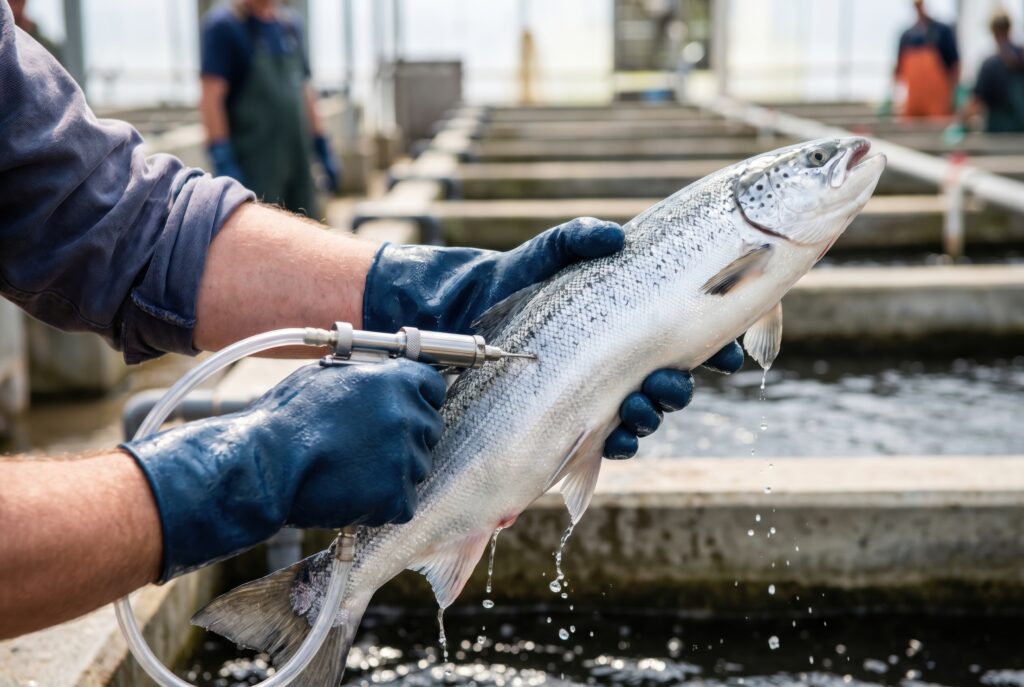
“Workers inject fish one by one,” explained Meng Li, an MIT postdoc, biomedical engineer and first author on the paper. “It’s high intensity, there’s a risk of cross contamination of blood-borne diseases, and workers may accidentally jab themselves because they are working so quickly. So it’s labor intensive, costly, stressful for fish, and dangerous for workers.”
Shellac coating keeps the silk intact
Marelli’s laboratory has spent years developing silk microneedles to deliver nutrients to plants. The silk has been classified as safe for human consumption in food coatings, and it degrades in the body or the environment over time.
Marelli first learned of the difficulties in vaccinating fish at a conference in Southeast Asia, where aquaculture is an especially important part of the aquatic food supply. His team won support from MIT’s Abdul Latif Jameel Water and Food Systems Lab (J-WAFS) to adapt the silk platform for underwater use. Early designs dissolved quickly in water, releasing the vaccine at once and failing to penetrate fish skin.
Li began work on the project in 2022, and Marelli credits her with finding a way around silk’s tendency to soften when wet. The system adds a thin layer of shellac, an insect-secreted resin used in food coatings and pills, which forms a moisture barrier that stays intact before the fish are injected.
“The material choice is critical because we’re dealing with food, even though we expect the microneedle to fall out of the fish or to be degraded in their body,” Li said. “Our criteria were safety for fish and humans alike.”
Adjustable release and dry storage
The researchers showed the microneedles can store a range of vaccines. They also built versions that lasted longer in water, or that diffused vaccines more quickly.
“In some cases, you may want the vaccine released within 15 minutes, but in others, the release can last 10 or even 24 hours,” Li said. “That could be better for other therapeutic uses beyond vaccines.”
Shelf life was tested as well. Half of the structure of the DNA plasmids, the small circular DNA molecules carrying a vaccine’s genetic code, survived four weeks of dry storage.
“That stability is important, particularly for the last mile of delivery, because aquaculture is mostly done in rural areas,” Marelli said. “This allows farmers to not need to rely on the infrastructure to maintain the cold chain.”
Further work needed before farm use
The researchers say more development is needed before the device can be used seamlessly at scale on fish farms, but they regard the paper as an important first step.

“We have all the components to believe this technology could be developed further,” Marelli said. “There are so many challenges with aquaculture and fish vaccination right now. We need to support farmers to operate safely, improve working conditions, protect their business, make vaccination more accessible, and improve the living conditions of farmed fish and ultimately the quality of the food we eat. This new technology could be a much more effective and safer approach.”
A USDA fellowship awarded to Li in 2024 brought funding and links with collaborators at the agency and beyond. The US Geological Survey, for example, gave the team access to a DNA vaccine for rainbow trout. The work was supported in part by J-WAFS and the USDA.
Marelli and Li were joined on the paper by Jad Raad MEng ‘24; Yunteng Cao PhD ‘22, now a postdoc at Yale University; Yue Hu, a former MIT postdoc; Colleen Wolfe MEng ‘23; Doyoon Kim, a former MIT postdoc; MIT postdoc Bradley Frank; and Wiens.