




























Promoting the health of fish and shrimp in field conditions
by I-Tung Chen, Martin Guerin; Gilberto Hernández, Maria Mercè Isern-Subich & Waldo G. Nuez-Ortín, Adisseo SAS, France

Aquaculture is facing substantial challenges from infectious diseases, which can have varying impacts, from asymptomatic cases to severe mortality. Even infected animals without visible symptoms can spread diseases in cultured ponds, leading to reduced growth and higher production costs. Pathogens often go undetected and can lead to outbreaks when multiple factors come together. Traditionally, antimicrobial agents like disinfectants and antibiotics were commonly used to control pathogen outbreaks. However, the overuse of chemical treatments has resulted in the emergence of antibiotic-resistant bacteria. As a result, the trend of stricter regulations is now in place, and the use of antibiotics is declining. Instead, health-promoting strategies such as improved pond management and nutritional approaches to reduce pathogen load are gaining traction and proving to be effective in preventing disease and improving farm efficiency.
Incorporating organic acids into the diet has demonstrated significant potential in enhancing disease resistance and growth in aquatic animals. The combination of different acids effectively disrupts bacterial cell walls and modifies cytoplasmic pH, hindering the growth of both gram-positive and gram-negative bacteria (Batovska et al., 2009; Defoirdt et al., 2009). By inhibiting pathogenic bacteria and promoting beneficial gut microbial populations, organic acids play a crucial role in maintaining a healthy gut environment, reducing disease pressures, and improving overall health. Research shows that organic acids can elevate growth rates, enhance feed conversion efficiency, and bolster immune responses in aquatic species (Ng et al., 2009; Nuez-Ortín et al., 2020). Through the enhancement of gut health and optimal nutrient utilization, organic acids represent a valuable tool for achieving enhanced growth performance and disease resilience.
Enhancing the health and growth of fish and shrimp in farming conditions
Bacti-nil® Aqua is a blend of organic acids specially formulated for delivering antimicrobial properties in aquatic animals. Extensive research conducted under controlled infection conditions has demonstrated its effectiveness in combatting diseases such as Francisellosis and Streptococcosis in tilapia and vibriosis in shrimp. (da Silva et al., 2023; Morales-Covarrubias et al., 2022; Eissa et al., 2022). This product has been proven to suppress pathogenic bacteria in high-density farming environments. Moreover, the additive is designed to uphold a healthy gut microbiota by selectively inhibiting harmful bacteria while encouraging the growth of beneficial ones. This enhanced balance significantly contributes to overall health and growth performance in aquatic animals. Additionally, incorporating Bacti-nil® Aqua into aquaculture practices can reduce the dependency on antibiotics, thereby minimizing the risk of antibiotic resistance.
Two studies were conducted to validate the efficacy of Bacti-nil® Aqua: one on tilapia in Thailand and another on white leg shrimp in Mexico.
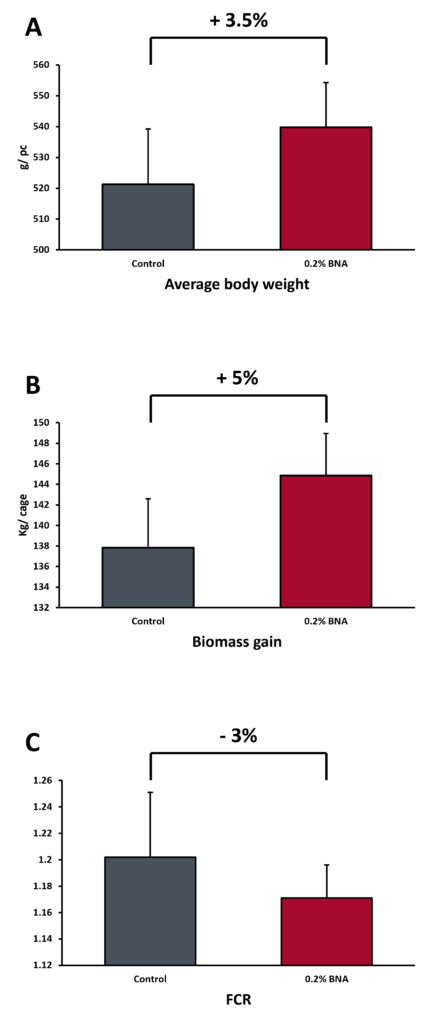
12 weeks of feeding.
The effects of growth and profitability under optimal farm trial conditions
The first study examined the impact of Bacti-nil® Aqua on the health and feeding performance of tilapia in a farm trial in central Thailand. The study compared a control feed with a treatment feed containing 0.2 percent Bacti-nil® Aqua. Both feeds were formulated with 32 percent crude protein and 4 percent fat. The tilapia was housed in cages in a reservoir pond, with four replicates for each treatment, with 300 red tilapia fingerlings per cage. The starting weight of the fish was 56.5g, and the study lasted 12 weeks with twice-daily feedings.
A health assessment at the beginning of the trial ensured that the fish were healthy and pathogen-free. Regular sampling every four weeks involved weighing and counting the fish to monitor feeding, mortality, and behaviour. After 12 weeks, all fish in both the control and Bacti-nil® Aqua groups remained healthy with no signs of infection. The survival rate exceeded 99 percent, attributed to optimal water temperatures and consequently a low risk of Streptococcus.
Despite the optimal conditions, Bacti-nil® Aqua improved growth performance, resulting in a 3.5 percent increase in body weight, a 5 percent gain in total biomass, and a 3 percent reduction in FCR (Figure 1). These findings align with a recent study, showing that tilapia supplemented with Bacti-nil® Aqua for 21 days exhibited a healthier gut microbiota, with reduced harmful bacteria like Vibrio spp. and increased beneficial probiotics like Cetobacterium and Bacillus spp., known for supporting fish health and growth.
The investment in feed cost was offset by the gain in biomass and economic returns, with an ROI indicating that each USD dollar invested yielded an additional USD 3.5. This trial demonstrated that a preventive dose of 0.2 percent Bacti-nil® Aqua in feed could positively impact farm profitability, even under optimal production conditions.
Improvement in the performance of extensive shrimp feed
The second study was conducted on a farm in southern-central Mexico during the summer season and aimed to enhance the efficiency of an extensive feed to match the quality of a semi-extensive feed within a semi-extensive culture system. The study tested three types of feeds: a semi-extensive feed (positive control), an extensive feed (negative control), and an extensive feed supplemented with 0.2 percent Bacti-nil® Aqua. Despite having the same protein and fat levels (35 percent and 6 percent) as the semi-extensive feed, the extensive feed had higher low-quality protein sources and less fish meal, resulting in a lower production cost.
Healthy juvenile shrimp, around 3g each, were placed in submerged cages (3 x 3 x 1 m) at a density of 25 shrimp per square meter. They were fed twice daily, and the amount was adjusted based on tray consumption and weekly biometric measurements. The results showed high survival rates of around 90 percent, which were attributed to optimal environmental conditions.

differences (p<0.05) compared to the control feeds.
The results confirmed that adding 0.2 % Bacti-nil® Aqua improved the performance quality of the extensive feed. Compared to the unsupplemented extensive feed, the additive significantly increased survival by 6% and improved biomass gain and FCR by 7.8% and 8%, respectively (Figure 2). The performance of the additive-supplemented extensive feed was similar to that of the semi-extensive feed, resulting in an ROI of 18.1 in relation to the unsupplemented extensive feed. This suggests that the supplementation strategy can positively impact the profitability of semi-extensive farms by enhancing the efficiency of extensive shrimp feed.
Conclusion
Bacti-nil® Aqua, an organic acid-based additive, has proven effective in preventing bacterial infections in aquaculture. Animals that receive Bacti-nil® Aqua in less challenged conditions exhibit improved survival and growth rates, likely due to better pathogen control and increased energy utilization for growth-promoting mechanisms. These findings confirm the effectiveness of the health additive in ensuring the success and profitability of functional feeds in aquaculture. As the industry moves towards sustainable and efficient farming practices, the use of Bacti-nil® Aqua can potentially result in significant economic benefits for farmers.
Published in the August 2024 issue of International Aquafeed.