
































by Enric Gisbert, Head of Aquaculture Programme, IRTA, Spain and Federico Melenchón Ramírez, Product Manager Functional Health Ingredients, Unibio, Denmark
Fishmeal is still the reference protein in marine fish feed, valued for its nutritional composition, its digestibility and excellent palatability. But it is also finite and it is becoming increasingly important for feed manufacturers to play around it. Global output has fallen steeply in recent months and industry forecasters expect demand to outpace supply well before the end of the decade. Furthermore, climate change is affecting fisheries’ productivity and extreme events such as El Niño weather patterns continue to disrupt fishmeal supplies. For anyone formulating diets for high-value marine species, that pressure has made credible fishmeal replacers a commercial necessity.
Single-cell proteins are among the most convincing candidates. Bacterial meals grown on methane in particular offer an amino acid profile close to fishmeal, useful bioactive compounds and a production route that does not compete with human food or arable land. For Methylococcus capsulatus-based single-cell protein, most research to date has concentrated on cold-water carnivores such as salmon and trout. From an industrial point of view, species-specific benchmarking of this meal remains necessary, since knowledge derived from one species may not transfer to others. For Mediterranean warm-water species such as gilthead sea bream, the literature is considerably thinner and that gap is what this study set out to fill.
What the trial tested
The tested ingredient was Uniprotein®, a bacterial single-cell protein produced by Unibio A/S through methane fermentation using a methanotrophic consortium built around Methylococcus capsulatus.
Five extruded diets were manufactured to be isoproteic (47 percent), isolipidic (21 percent) and isoenergetic (19.1 MJ per kg). A control diet carried the full fishmeal blend, a mix of Fishmeal 60 (~28 percent of total fishmeal) and Super Prime fishmeal (~72 percent), totaling 180 g per kg of feed. Across the other four diets, that blend was replaced in steps of 25, 50, 75 and 100 percent. At the halfway mark, 50 percent replacement corresponded to a dietary inclusion of about 8.5 percent single-cell protein.
Gilthead sea bream juveniles, starting at an average of 3.8 g, were reared for 96 days in a recirculation system at around 25°C, with four tanks per diet. Alongside growth and feed data, the team measured nutrient digestibility, fillet composition, digestive enzyme activity, oxidative stress markers, liver and gut histology, and intestinal microbiota. A separate challenge with the pathogen Vibrio harveyi was conducted to test whether fishmeal replacement by bacterial single-cell protein affected disease resistance.
Growth holds to the halfway point
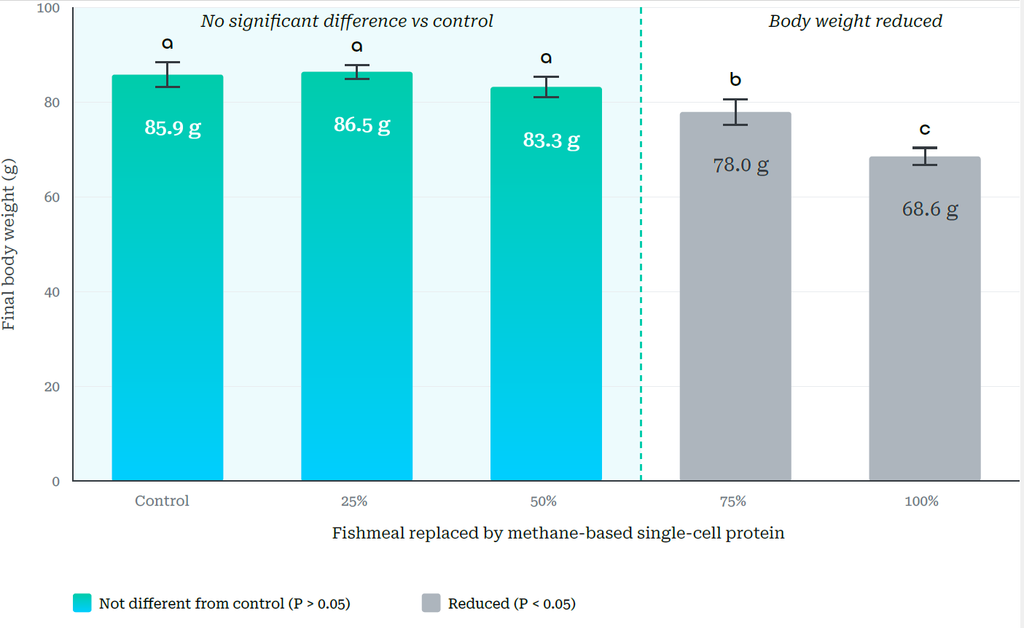
The clearest result was the growth response. Fish on the control, 25 percent, and 50 percent diets finished the trial at comparable body weights, with no statistical difference between them and specific growth rate followed the same pattern. This confirms that single-cell protein from Methylococcus capsulatus can replace up to 50 percent of a good-quality fishmeal blend in diets formulated with low fishmeal levels (18 percent).
Reductions in somatic growth were not associated with changes in feed utilisation, as all experimental groups showed similar feed conversion ratios and were instead attributed to a reduction in feed intake at the highest levels of fishmeal replacement.
A central problem with replacing fishmeal at high levels lies in its fat content, not its protein. Fishmeal is rich in fish oil, meaning it contains phospholipids and high proportions of long-chain polyunsaturated omega-3 fatty acids, which are almost absent in land-based ingredients. It is infrequent to find a study in which fishmeal was replaced at high levels by land-based protein sources (single-cell, insect or vegetable meals) without a linear decline in fatty acids such as EPA and DHA.
In marine species this is even more pronounced, because their endogenous synthesis of these fatty acids is especially limited: adapted to a natural environment rich in omega-3 from microalgae, they produce very little themselves. Small reductions are generally well tolerated, as shown by steady growth and by welfare indicators such as the antioxidant response, but this remains one of the main physiological barriers to replacing fishmeal. One way around it is to supplement the diet with EPA and DHA, for example from microalgae oil.
This is also an interesting discovery when looking into future possibilities, because an improvement in the palatability of the diet could allow an even higher amount of fishmeal replacement.
Digestibility and fish health stayed on the control baseline
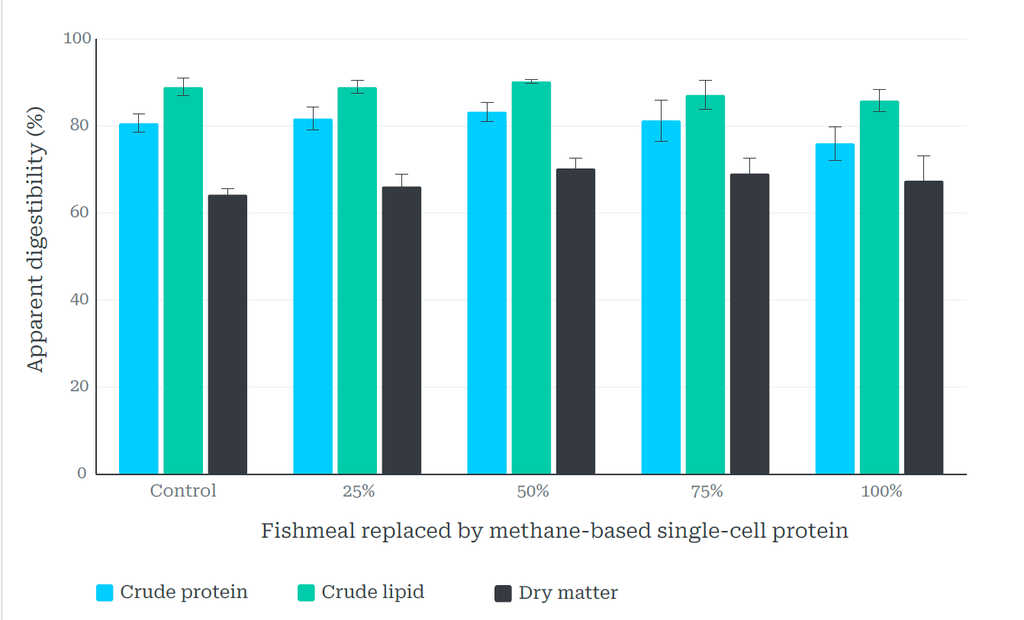
In diets up to and including 75 percent replacement, protein digestibility followed the control closely, ranging from 81 to 83 percent against 80.7 percent for the full fishmeal diet. Only at full replacement did it show a downward trend to 76 percent, and even then, the difference was not statistically significant. Lipid and dry matter digestibility, as well as the digestibility of individual amino acids, did not differ across diets.
Measuring digestive enzymes is crucial when testing a new feed ingredient because it reveals how effectively the animal can digest, absorb, and convert the feed into energy. In the current study, digestive enzyme activities, spanning gastric, pancreatic, and intestinal brush-border enzymes, were unchanged. Liver and intestinal tissue looked normal under the microscope, with no signs of inflammation, no immune-cell infiltration, and no structural changes in the hepatic parenchyma or intestinal mucosa. Oxidative stress markers in liver and gut were stable. Fillet protein and amino acid content remained constant.
The gut microbiota moved in a useful direction
If health markers mostly held steady, the gut microbiota was where the ingredient made an active, positive contribution. Phylogenetic bacterial diversity rose with inclusion, with a shift in the types of bacteria present rather than a change in total bacterial abundance or evenness.
Most striking was the change in the abundance of two contrasting genera. Photobacterium, part of the Vibrionaceae family and a genus that includes common fish pathogens, decreased as single-cell protein levels in diets increased. At the same time Candidatus Arthromitus, a segmented filamentous bacterium linked to immune development and mucosal maturation rose sharply, reaching around 18 times its control abundance in the higher-inclusion diets. Two further genera associated with gut health, Corynebacterium and the short-chain-fatty-acid producer Cutibacterium, also increased.
The net effect was a community with more of the taxa associated with a healthy, well-defended gut and fewer of those linked to opportunistic infection. For an ingredient being asked to replace fishmeal, improving the microbial baseline rather than merely preserving it is a meaningful point in its favour.
Disease resistance mirrored the growth story
A Vibrio harveyi challenge reinforced the halfway-point finding. Survival held across the control, 25, 50 and 75 percent diets, with the 75 percent group at 52.9 percent against 45.2 percent for the control. Only full fishmeal replacement reduced survival in a statistically significant manner.
The pattern lines up with the fatty acid data. Robustness was maintained wherever long chain omega-3 polyunsaturated fatty acids remained adequate, and it fell where those fatty acids ran short. Disease resistance, in other words, was probably limited by a lack of essential fatty acids but the discussion should remain open to other components that are abundant in fishmeal.

What feed formulators can gain from it
At up to 50 percent replacement of the fishmeal blend (equivalent to 8.5 percent dietary inclusion), gilthead sea bream grew, converted feed, digested nutrients, maintained tissue integrity and resisted disease no differently from fish on a full-fishmeal diet, while carrying a gut microbiota that had shifted in a beneficial direction. Above that level, palatability and a shortfall in omega-3 PUFA began to cost growth and robustness; both are limitations that can be addressed through diet design rather than through the ingredient itself.
Read as a whole, the trial supports a clear and confident practical conclusion. In a commercial diet formulated for gilthead sea bream, bacterial single-cell protein can replace up to half the fishmeal while maintaining good performance across the traits that matter to producers. To push inclusion further, the trial also shows where the attention needs to go: keeping essential fatty acid levels intact so that the protein swap can maintain a productive and healthy performance. Replacing fishmeal with innovative ingredients such as bacterial single-cell protein helps safeguard aquaculture against supply constraints, creating a more resilient, reliable, and future-ready industry.