





























by Bert Rodgers, Student, University of Plymouth, The UK
In the UK we have learned to see farmed landscapes as the ‘countryside’. The patchwork of green fields and accompanying livestock barns are postcard-ready vistas, familiar to us and part of a national identity. The thought of putting a fish pen or mussel line on a postcard, however, is probably a laughable idea to most. However, both images depict vital food production systems and should be judged on evidence-led portrayals, not on the false perceptions that pervade from the public observer. Such double standards must be addressed for consumers to gain a fair representation of production systems.
In a review of media samples from aquaculture-producing countries (Budhathoki et al., 2024), the UK was the only country in which negative articles exceeded positive ones (45 percent -ive, 33 percent +ive and 20 percent neutral from 2015 to 2023). UK aquaculture representation was focused on risk prevention with key negative themes of environmental impacts, sea lice, escapees and animal welfare concerns. Reflecting this increased scrutiny, the Global Salmon Initiative adopted a commitment to achieve 100 percent ASC certification across all member farms. Alongside accreditation, there have been reductions in antibiotic use, improved transparency, lower FIFO and FCR, as well as sustained economic growth for rural and coastal communities. However, the messaging that appears to be most relevant to producers is what consumers see on packaging – eco-friendly labels. But are these sufficiently communicating the positive messages of aquaculture?
This matters because consumers are having to navigate a crowded and confused market of sustainability labels, certifications and green claims. Altintzoglou et al. (2025) found that European consumer awareness of aquaculture production systems remains low, even when their attitudes are positive. Their study identified three consumers groups; trusting, unimpressed and uninformed. The uninformed group was the largest, making them the obvious targets for improved communication. However, they are understandably uninformed and I would advocate for continuing meaningful communication with those more likely to engage – namely the ‘foodies’ and ‘adventurous responsible’ groups as cited by Stancu et al. (2022). With improved understanding, hopefully the personal social connections made through these groups influence the uninformed that are not captured by conventional marketing.
With intense scrutiny comes opportunity. Public concern surrounding salmon farming has forced the industry into a level of monitoring that is not seen in other forms of farming. In Scotland, aquaculture data exists on a publicly accessible portal including information on environmental monitoring, escapees, emissions, biomass, treatments, leases, permit conditions and movement restrictions. This does not mean every farm performs excellently but rather provides the framework for a more transparent consumer relationship. Despite this progress, reducing mortality remains a key challenge for the industry.
In the UK, food security has long been treated as a matter of foremost importance and, since World War II, a measure of national resilience. In a recently destabilised global food landscape, this sentiment is still pertinent. National self-sufficiency has fallen from over 80 percent in the 1980s to 65 percent in 2024 (DEFRA, 2025). A growing population and lack of terrestrial space means the solution to improving self-sufficiency lies in offshore and inshore aquaculture. Currently the UK imports 90 percent of seafood consumed (DEFRA, 2024) and Scottish salmon is the UK’s top food export (Salmon Scotland, 2026). UK land is already heavily farmed – agriculture constitutes 69 percent of UK land area, making farmed landscapes the dominant landscape in the UK.
A 2012 survey by the University of Cambridge (n = 1736) found widespread affection for agriculture despite a surprising level of ignorance about the sector. Public estimate of land farmed nationally was 35 percent. Large numbers of people believed that farming is important for the economy, estimating farming constitutes 24 percent of GDP when at the time it was closer to 1.5 percent. Surprisingly, 75 percent of respondents said farming played an important role in protecting the environment. The author, a research assistant in rural affairs, states “most people’s hearts are in the right place even if they have some misconceptions about it.” If true, aquaculture should aim to win the hearts of the public because it seems to be where most people do their thinking.
As someone who is passionate about efficient, transparent use of resources to better protect the environment, I find it highly frustrating that cultural familiarity often outweighs environmental evidence. As well as industrial farming resulting in a monoculture of grasses, UK farmland birds have declined by 62 percent since 1970 (JNCC, 2025), UK pollinator distribution indicators were 23 percent lower in 2024 than in 1980 (JNCC, 2026). In 2024, diffuse pollution from agriculture impacted 40 percent of water bodies in England. Farming activities caused 74 serious pollution incidents, including 67 serious incidents to water.
Furthermore, of the targeted inspections at non-permitted farms, inspectors found non-compliance with environmental regulations in 51 percent of cases (EA, 2025). Comparable environmental performance in aquaculture would likely attract significant regulatory attention because impacts are generally easier to attribute to individual sites. As agricultural pollution is dispersed across catchments, soils and atmospheres, it makes it hard to scrutinise a specific farm. Terrestrial farmers are better protected because they commonly own the land they farm and therefore have associated rights. Agriculture carries the legacy of historical production priorities, whereas aquaculture has developed in an age of environmentalism. Historical practices and traditions are hard to correct whereas, because of present scrutiny, environmental protection has become traditional in aquaculture. This is a message that should be conveyed to the public, alongside the vast economic opportunities that aquaculture presents.
Equal scrutiny should exist for terrestrial farming systems and comparisons should be made using equal metrics including land use, feed conversion ratio, GHG emissions, welfare and mortality, economic value etc. Trust will be won by showing the evidence of benefits within aquaculture, explaining its system and asking to be judged by the same standards as land-based farming. The introduction of a public portal, with appropriate support available, that makes it mandatory for farmers to prove they are protecting the environment, would be a positive step forward. If the UK accepts farmed fields as part of the national landscape with its attached environmental baggage, hopefully, the public will learn to accept well-regulated aquaculture.
Aquaculture can contribute towards domestic supply significantly more than current public acceptance allows; a more balanced food production network may even positively contribute to terrestrial biodiversity gain by alleviating intensification. Low awareness and understanding are partly a product of negative coverage; I believe it responsible to point out this double standard and to advocate for fair representation for all food production systems. None are perfect, some are simply treated more generously than others. Progress aquaculture communication from green claims, be bold and build aquaculture teachings into everyday culture through youth societies, community shellfish projects, underwater live feeds, bio secure open days and seafood cooking in schools.
Aquaculture is a necessary part of a secure and sustainable food future in the UK and globally. If the above practices were adopted, perhaps one day the public may view a seascape of salmon farms and mussel lines in the same light as this green and pleasant land.
For references, contact editorial@perendale.co.uk
-ends-
Panel:
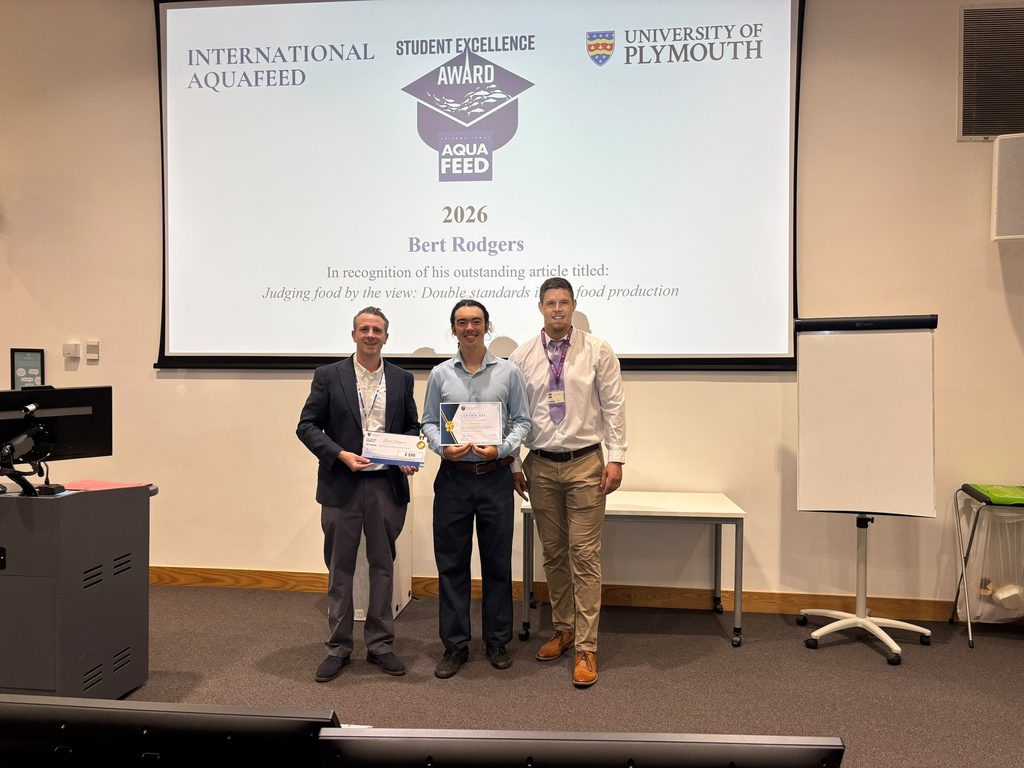
This article won the inaugural IAF Student Excellence Award, recognising exceptional originality, critical thinking and scientific communication in advancing sustainable aquaculture. The award is presented by International Aquafeed in collaboration with the University of Plymouth
Author profile:
Bert Rodgers is an MSc Sustainable Aquaculture and Fisheries student at the University of Plymouth with a passion for sustainable food production and environmental stewardship. After working with Dartmoor National Park and Devon Wildlife Trust, he turned to aquaculture to explore how responsible seafood production can support both food security and healthy ecosystems. Bert is about to begin placements with Landcatch and Tritonia Scientific in Scotland, where he will gain experience in salmon husbandry and marine environmental consultancy. He hopes to build a career that combines innovation, sustainability and practical solutions for the future of aquaculture. To learn more about Bert’s journey into aquaculture and future aspirations, visit the website version of the article [LINK]
Photo caption:
FIAF2608_IAF-Award_2_1185_PS – (Left to right) Prof Daniel Merrifield, Bert Rodger, Dr Mark Rawling