































by Pedro Gómez Requeni, Senior Scientist, Biomar, Denmark, and Joana Silva, Head of Salmon Product Marketing, Biomar, Norway
As aquaculture evolves, so does the role of nutrition. Micronutrients like vitamin D3, once considered essential primarily for bone health, are now recognised for their broader biological functions. In Rainbow Trout, improving vitamin D3 uptake through feed will enhance fillet nutritional value without affecting fish performance, offering new opportunities for functional seafood innovation.
Biomar’s research and development team investigated a novel supplementation strategy using bioactive vitamin D3 metabolites. The results point to a more efficient way to deliver this essential nutrient while maintaining growth, welfare and product quality.
Why vitamin D3 matters now
Vitamin D3 regulates calcium and phosphorus metabolism but also plays a role in immune function, muscle physiology and stress response. These functions are particularly relevant in high-intensity production environments such as recirculating aquaculture systems (RAS), where fish are exposed to tightly controlled conditions and potentially higher stress levels.
In such environments, precise and effective nutrient delivery becomes even more important. Micronutrients must not only meet basic physiological needs but also support resilience and welfare under production pressures.
At the same time, the industry’s shift toward plant-based ingredients has reduced the natural occurrence of vitamin D3 in commercial diets. Synthetic supplementation has become more common, and in 2019, the EU raised the legal inclusion limit from 3000 to 60,000 International Units (IU) per kilogram. This created a new scope for nutritional innovation. But higher inclusion doesn’t always mean better results.
When synthetic cholecalciferol is added at high levels, retention in edible tissue may plateau. That’s where other vitamin D3 metabolites come in. By providing the nutrient in its already-converted forms, these compounds may bypass metabolic bottlenecks and increase vitamin D3 deposition efficiency.
A comparative trial: cholecalciferol vs other metabolites
To test this hypothesis, Biomar conducted a 61-day trial at its Aquaculture Technology Centre in Hirtshals, Denmark.
Study design:
- Species: Freshwater Rainbow Trout (initial weight: 206g)
- System: RAS environment
- Diets:
- 10 feeds with graded levels of synthetic vitamin D3 (8100–77,400 IU/kg)
- Two feeds with synthetic vitamin D3 (40,000 IU/kg)
- An ‘intermediate’ vitamin D metabolite at 0.004 percent
- An ‘active’ vitamin D metabolite at 0.08 percent
- Format: 4.5 mm floating pellets
- Monitored: Growth performance, vitamin D3 retention, pigmentation and whole-body mineral content
The study compared traditional cholecalciferol against these bioactive forms, looking at how effectively cholecalciferol was retained in the body and fillet, as well as any effects on growth or product quality.
Key results and insights
1. Growth performance
All fish, regardless of diet, showed comparable growth, feed intake, specific growth rate (SGR) and feed conversion ratio (FCR). No adverse effects were observed from high vitamin D3 levels or from the use of the ‘active’ or ‘intermediate’ vitamin D metabolites.
This consistency is important. In commercial production, any changes to feed formulation must maintain performance benchmarks. The results suggest that using vitamin D3 metabolites does not come at the cost of growth or feed efficiency.
2. Tissue deposition
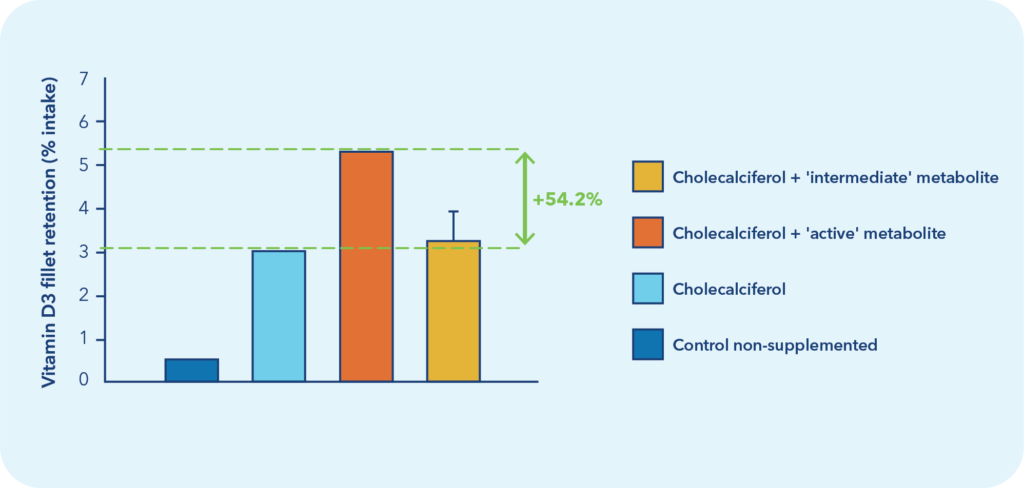
Fillet and whole-body vitamin D3 content increased with higher dietary cholecalciferol levels. But fish fed the combination of cholecalciferol and the ‘active’ vitamin D metabolite showed significantly better vitamin D3 deposition.
Fillet vitamin D3 content was 21 percent higher than in fish receiving only cholecalciferol, and overall retention was 54.2 percent greater. By including the ‘active’ vitamin D metabolite, these likely by-passes conversion in the liver and kidneys, enabling more direct uptake and use by tissues and sparing the bioconversion of vitamin D3.
Including the ‘intermediate’ vitamin D metabolite also improved vitamin D3 deposition, particularly in whole-body samples. It may support storage of vitamin D3 in organs such as the liver, while the ‘active’ vitamin D metabolite promotes deposition in muscle, where it contributes most directly to consumer nutrition.
These findings highlight a more efficient way to enrich farmed fish with vitamin D3, especially when the goal is to improve fillet value rather than simply meet metabolic requirements.
3. Fillet pigmentation
Fillet colour was assessed evaluating Minolta a* values. Redness increased slightly with higher dietary D3 and remained within acceptable commercial standards. Neither the ‘active’ or ‘intermediate’ vitamin D metabolites impaired pigmentation.
This result is significant for quality-conscious markets. It shows that functional feed strategies using metabolites can support nutritional enrichment without sacrificing product appearance or marketability.
4. Mineral interactions
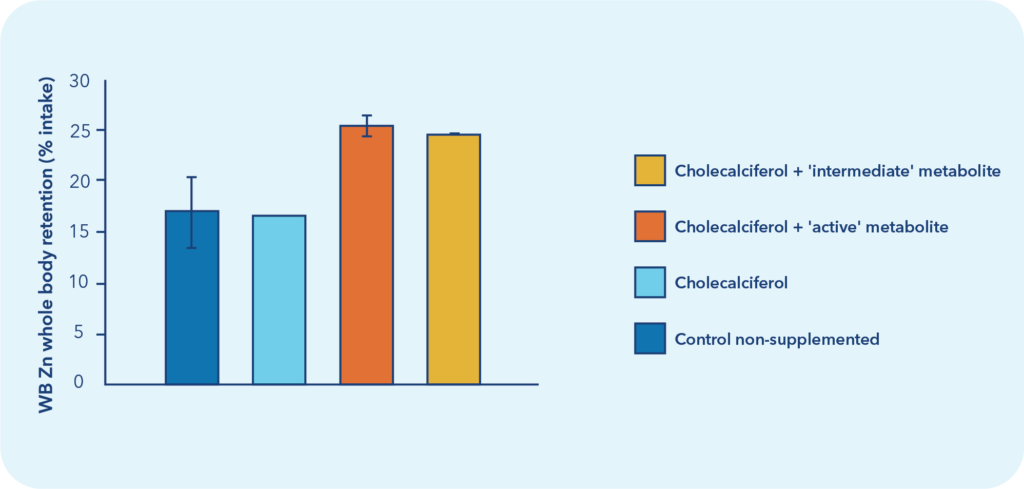
The trial also showed that vitamin D3 metabolites affected retention of minerals and trace elements. Fish fed combinations of cholecalciferol and ‘active’ ‘intermediate’ metabolites improved whole-body zinc and iron retention, compared to those fed only cholecalciferol.
A mild negative correlation was observed between dietary zinc and fillet vitamin D3 retention (as a percent of intake), hinting at potential higher utilisation of dietary vitamin D3 when zinc is readily available. While these interactions require further study, they open the door to more integrated micronutrient formulation strategies, potentially improving multiple nutritional outcomes at once.
Consumer impacts
Vitamin D deficiency, particularly in the dark winter periods, is problematic, especially in regions like Northern Europe and North America. In Denmark, more than 57 percent of the population’s vitamin D intake comes from fish, with salmonids being the top contributors. Enhancing the vitamin D3 content of farmed fish could help bridge nutritional gaps, support functional food claims and deliver added value to health-conscious consumers.
By increasing deposition in edible tissue, producers can use lower dietary inputs while achieving the same nutritional output. For feed formulators and producers, the ability to enrich seafood nutritionally, meeting regulatory limits, is a strong case for considering metabolite-based solutions.
Smarter approach to micronutrition
This trial confirms the potential of vitamin D3 metabolites, especially ‘active’ vitamin D metabolites, to improve tissue deposition in Rainbow Trout without affecting growth or pigmentation. By delivering the nutrient in a more bioavailable form, these compounds allow for precise, efficient nutrient strategies that align with both biological and market needs.
As aquaculture moves toward more sustainable, performance-driven systems, functional feed components like these will play a key role. By targeting nutritional outcomes more accurately, feed producers can increase vitamin D3 retention and enhance product quality, which contributes to a more efficient and responsible aquaculture sector.