





























by Gary Myers, Senior Technical Officer, AquaMaof, The UK; Dr John Taylor, Salmon R&D Specialist, AquaMaof, The UK and Neder Snir, Chief Technical Officer, AquaMaof, Republic of Cyprus
After a decade of bold projections and recent well-publicised setbacks, recirculating aquaculture systems (RAS) for Atlantic salmon and other finfish are entering a more grounded phase. Capital is more selective, buyers more technical and conversations with prospective developers more substantive than they were three years ago. Inbound interest has not slowed, it has matured. This is reflected in the questions being asked with a prudent approach to risk management.
Developers no longer ask whether RAS can work at an industrial scale; that has been demonstrated. They focus on design decisions, operating disciplines and partnerships that determine whether a specific project will succeed at a specific site with a specific species and bio-plan. These are engineering and operational questions, with answers grounded in more than a decade of accumulated field data.
RAS is not a single design, it is a concept. The unifying principle is controlled reuse of water to manage temperature, water chemistry, biosecurity and waste, while reducing land and freshwater consumption relative to flow-through or open-net pen production. Design choices vary widely as do the outcomes.
At AquaMaof, we have focused on fully enclosed, indoor RAS facilities designed around the physiological requirements of each target species. Simplicity is the goal of every serious engineer; it is also, in practice, what is left after the complexity has been worked through and discarded. At AquaMaof, this shows up as a single pumping step, gravity-driven processes, critical redundancies and treatment components sized against realistic mass-balance assumptions rather than catalogue defaults. The operational protocols that surround the technology are at least as important as the system design.
Engineering for the fish and the people running the facility
Three key water-treatment functions define a RAS: gas exchange, solid waste capture and dissolved waste conversion.
Our approach to combined nitrification and CO₂ removal is the CIFT (controlled intermittent flow trickling filter), tailored to any scale of ammonia load capacity. Low pressure (<300 Pa) fans strip 100 percent of the CO₂ added by the fish and bacteria biomass in each flow cycle, while the trickle media oxidises ammonia to nitrate with no additional oxygen supply. Because the CIFT clears the CO₂ in a single pass, hydraulic retention time in the fish tank is dramatically extended while sustaining the target CO₂ concentration. As a result, total circulation flow is significantly reduced, lowering both CapEx and OpEx across all flow-rate sized treatment steps and components.
Solid waste is handled in two stages. The circular fish tank itself acts as the first clarifier: natural rotational flow concentrates faeces and uneaten feed at a central drain trap, which is backwashed frequently. Just above the tank floor, circulated water gravity-feeds to a tube settler, a configuration borrowed from potable water treatment, that captures fine particles across the basin, avoiding the shear and particle fragmentation typical of drum filters. All demonstrated in fish performance.
Oxygenation is split between two units. The Ozone Dissolver (OZD) unit can treat 100 percent of module circulation flow with oxygen or ozone. The Oxygen Dissolving System (ODS) trims oxygen supply tank by tank, using a low pressure of 50 cm H₂O to achieve 2–4 bar(g) at the injection zone, resulting in OpEx that outperforms oxygen cones, LHOs or surface aerators.
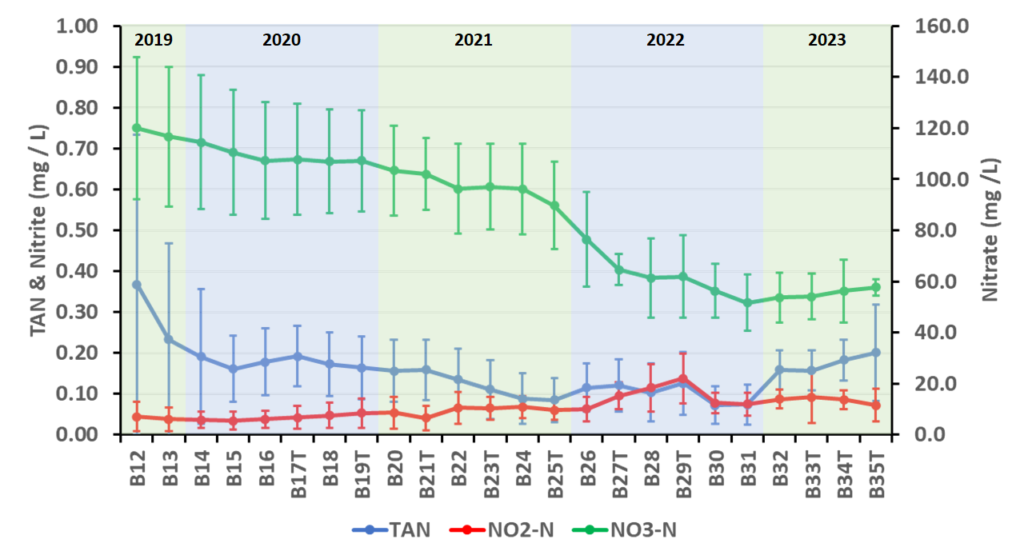
Water volume distribution matters: roughly 50 percent of the total system volume sits in the production tanks and 50 percent in the treatment system. That balance buffers against water quality and temperature fluctuations. Across our operating sites, TAN and NO₂-N concentrations remain remarkably stable through normal production cycles. Further, by consistently operating at very low NO2-N levels, we can choose very low salinity levels as minimal chloride is required to neutralise any potential sub-chronic NO2-N toxicity.
Equally important is designing for the people who will run the facility for the next twenty years. Our design discipline starts from the premise that maintenance should be minimised where possible and made as accessible as possible everywhere else. Component layout, access routes, instrumentation positioning and serviceability are treated as primary design criteria. Every operating project and every technical session with customer operating team’s lessons feeding back into our design. A valve that should sit thirty centimetres lower, a sensor that should be reachable without a ladder, these become permanent improvements in the next facility.
Where regulatory or operational economics require, an endogenous denitrification system (DNS) is added. The DNS converts NO₃ → N2 and TKN → NH₃ + NH4 → NO₃ → N₂. A final mechanical and biochemical polishing steps return denitrified water back into circulation and alkalinity is largely recovered.
What scaling actually requires
The harder lessons in RAS come from scale-up, not from the unit processes themselves. Designing a 50 kg feed/day research system is a different exercise from designing a commercial facility producing 20,000 kg fish/day and the mass-balance assumptions that hold at one scale do not automatically hold at the other.
Terjesen et al. (2013), at a NOFIMA research facility, found that the original TAN production assumption produced a 34 percent overdesign but the realised nitrification rate was 0.08–0.15 g TAN/m²/day, well below the design expectation. While commercial facilities are designed at rates of 0.25 to 0.40 g TAN/m²/day. Whether those facilities will consistently hit both water quality and production targets is a question the next years will answer.
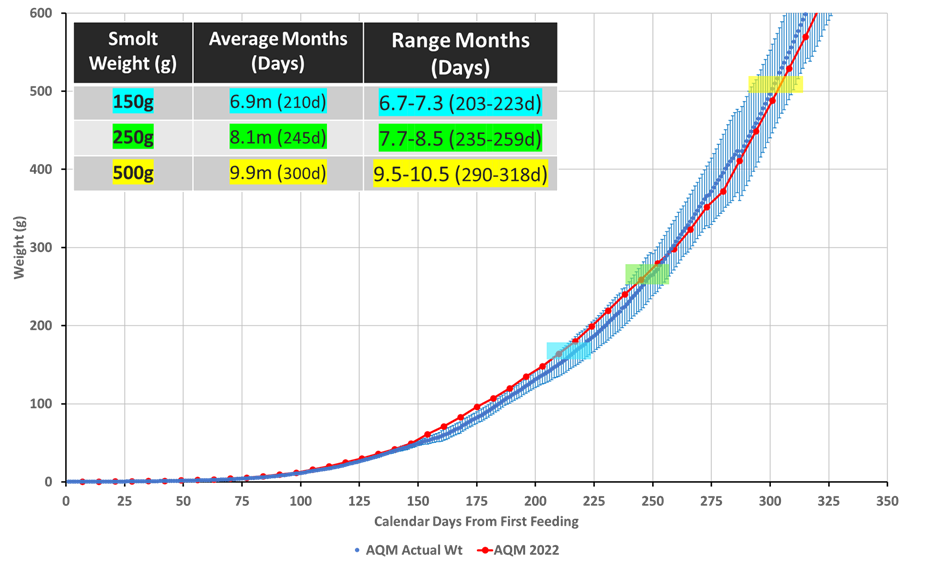
Carbon dioxide drives both capital cost and biological performance. Mota et al. (2019) reported best post-smolt growth from 71 to 400 g at CO₂ concentrations of 5 and 12 mg/L. Our R&D in the same growth window has produced post-smolts above 650 g. NOFIMA studies on tank rotational velocity reported growth to about 200 g compared to AquaMaof’s 900 g for the same growth time, a performance difference we attribute to integrated management of CO₂, flow velocity, oxygen, water chemistry, photoperiod and feeding regime rather than to any single variable.
Cooling is often underestimated for cold-water RAS. Lower target temperatures (10–14 °C) and the need to produce fish in warmer climates close to strategic markets result in greater demand for cooling capacity. As a result, low electric input and high-efficiency water treatment solutions become a major advantage, since nearly all electrical energy input into RAS machinery decays into heat which must be extracted. This produces a compounding efficiency effect: every kilowatt saved internally results in less heat requiring extraction through additional kilowatts at the chillers.
Another often under-estimated heat source in low liquid discharge RAS is all feed energy not in retained in fish growth or discharged sludge. This is a significant contributor to total heat load.
Solving the biology, not just the plumbing
Technical literature has historically treated land-based Atlantic salmon as a saltwater problem moved indoors. While industry scepticism was high, AquaMaof has grown salmon to market size at salinities of 1-2 ppt at commercial scale. It is now demonstrably viable and the implications for site selection, regulatory permitting and operating cost are substantial.
One challenge that scepticism focused on was nephrocalcinosis, a renal mineral deposition syndrome that has plagued salmon RAS production. We have developed water chemistry and feed management protocols that control the condition reliably from eggs through harvest. This was not a hardware solution; it was an operational protocol refined across multiple production cycles.
Nutrition management is the other half of the biological picture and one often given less rigour than the engineering. Optimal fish performance depends on matching feed nutrient composition to the changing physiological demands of the fish across each growth stage. Our practice is to analyse whole-fish nutrient composition alongside feed composition for each feed size, so that nutrient balance can be verified and adjusted against actual fish demand rather than assumed from feed-mill specifications alone.
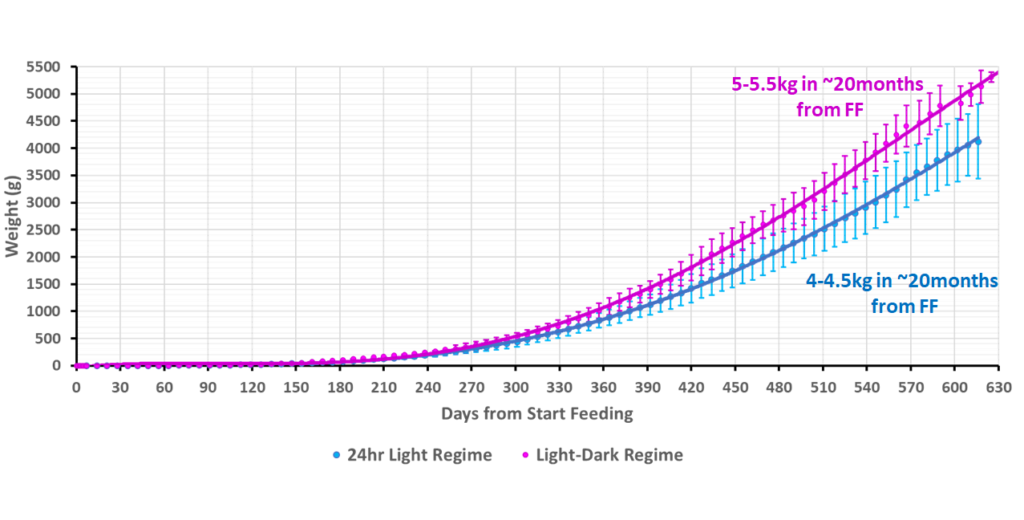
Several other management areas are moving quickly across the industry. Meal-based feeding and photoperiod manipulation, including night photoperiod in grow-out, can produce measurable performance gains. Microbiome management is shifting from observation to active protocol. Off-flavour control, historically handled in separate purging facilities, is increasingly being addressed within the production loop through geosmin and 2-MIB management strategies. Smoltification photoperiod, sometimes treated as optional in freshwater RAS, remains a natural physiological process whose proper management reduces size variation and lifts average harvest weight.
Partnership as operating model
AquaMaof has never been a pure technology vendor. From the earliest projects, our model has involved deep operational engagement, designing the facility, commissioning it, and remaining present through the ramp-up and steady-state production that follows. What is changing is the formalisation and weight of that engagement.
We are increasingly prioritising projects and partners where we can take a strategic role in the business itself, including projects we initiate and co-investments with other partners. A RAS facility delivers its design performance only when operated to the standard the technology assumes.
Successful land-based projects share characteristics: solid process and mass-balance design, realistic performance assumptions, good energy planning, experienced operating teams and sustained technical partnership with the technology provider. The unsuccessful ones, almost without exception, missed two or more of these key characteristics.
Looking ahead, continued genetic improvement, refined RAS management and accumulating industry operating data point toward 5 kg harvest weight within 16 months from first feeding as a reasonable commercial target. None of that requires fundamentally new technology, it requires disciplined execution of what is already working, in partnership with an operational approach that treats the facility as a long-term biological asset rather than a plug-and-play assembly line.
That is the message; the market is no longer asking RAS to prove it can replace the sea. It is asking which partners can be trusted to establish, build and run something that will perform, year after year, against the numbers in the model.