

































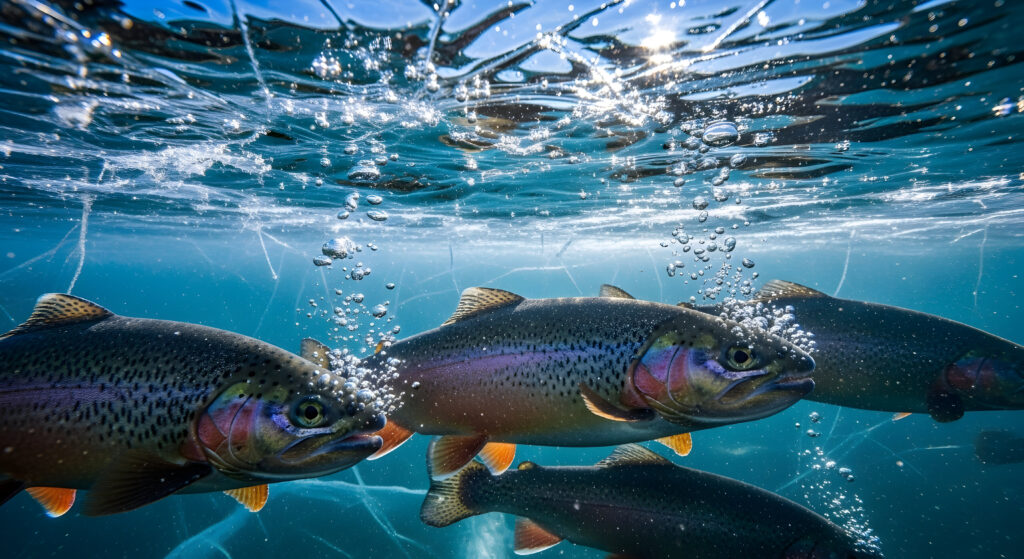
Trout farming beneath the surface can sharply reduce the need for sea lice treatments, according to a study by Norway’s Institute of Marine Research (IMR). At a commercial farm operated by Hofseth Aqua, the number of treatments fell to about a quarter of the level recorded for the farm’s previous batch of trout, raised in conventional open-water pens at the same site in 2023.
The report, published on 19 November 2026 and funded by the Norwegian Seafood Research Fund (FHF), tested whether air-dome cage technology already common in Atlantic salmon production also suits rainbow trout. The dome holds a pocket of air deep underwater. This lets fish refill their swim bladders (the gas-filled organ that controls buoyancy) without rising into the upper water layers where sea lice larvae gather. More than 430 such cages were in use in Norway in 2025 and 2026, according to the report, mostly with salmon.
Hofseth Aqua became the first farmer to grow rainbow trout this way at commercial scale. At its Bugane site in Storfjorden, five dome cages held the 2025 crop. The first lice treatment came about seven months after stocking, against two months for the 2023 crop. Each cage needed two treatments on average, compared with 7.5 before, a 73 percent reduction. Deaths linked to treatment handling fell from 4.3 percent to 0.8 percent of stocked fish, and cumulative mortality averaged 7 percent against 10 percent.
Feed data will interest producers. The deeper-set fish ate normally, with a daily feeding rate of 1.03 percent of biomass against 1.00 percent for the 2023 crop. Economic feed conversion ratio was identical at 1.41. Feed was withheld on 26 days per cage on average across the production cycle, against 63 days for the 2023 fish. The trout reached an average harvest weight of 4.76kg after 309 days in sea cages, close to the 4.84kg that the 2023 fish reached after 390 days. Superior-grade fish made up 91.0 percent of net harvest biomass, up from 80.2 percent.
The study’s authors caution that the comparison is not like for like. The 2025 trout were transferred to sea cages at about 480g each, almost twice the 253g of the 2023 fish. Lighting also differed, with continuous artificial light in the dome cages and natural daylight in the surface pens. So did lice counting, which was automated by camera in the dome cages and done manually in the surface pens.
Trade-offs in the research cages
A parallel trial at IMR’s Matre sea site in Masfjorden, using 36,000 trout in six cages, showed a trade-off. Fish held in deeper, cooler water through spring and summer accumulated about 250 fewer degree-days, a measure of warmth that drives growth. They finished 20 percent lighter, at 3.8kg against 4.6kg. They also developed fewer spinal problems, with abdominal lordosis (spinal curvature) in about 2 percent of fish compared with 15 percent in surface cages. Welfare scores and mortality were comparable between the two groups.
Lice counts stayed low in that trial, but adult female salmon lice were 2.5 times more numerous on the deeper fish. The researchers link this to time spent just below the halocline, the boundary between brackish surface water and saltwater, where larvae tend to concentrate. At the commercial farm, adult Caligus, a different sea louse species, averaged 0.54 per fish. The 2023 crop had recorded only eight in total.
Air supply risks and open questions
A week-long stress test also showed why dome maintenance matters. With the air removed, trout crowded beneath the dome roof and rubbed their snouts against it in search of air, causing moderate wear. Afterwards, more than half of the trout sampled showed the mildest grade of snout damage, against fewer than 2 percent of the fish sampled before the test. The fish recovered once air was restored on day seven, and the authors advise keeping domes filled at all times.
The findings come from two settings: a mid-sized experiment at IMR’s Matre research site and one commercial farm. The commercial results cover a single batch of fish, compared with one earlier batch at the same site. The researchers say further cycles are needed to show how consistently the lice-reducing effect holds.