


























by Emmanuel Pruvost, Business Development Manager Salmon, Adisseo, France
As I write this article in September 2026, Peru has officially closed the first anchovy fishing season of the year after a series of restrictions imposed because of historically low biomass levels. Catches reached less than 25 percent of the initially planned quota of 1.91 million tonnes. Looking ahead, prospects for 2027 remain uncertain. The question is no longer whether aquaculture will be affected by El Niño, but whether the industry will face a moderate event or a ‘Godzilla’ El Niño of exceptional magnitude.
The El Niño Southern Oscillation (ENSO) is a recurring climate phenomenon occurring every two to seven years and typically lasting 12 to 18 months. During El Niño events, warmer surface waters in the eastern Pacific weaken the nutrient-rich upwelling system along the coasts of Peru and Chile. This upwelling supports one of the most productive marine ecosystems on Earth and sustains the vast anchovy populations that form the foundation of the global fishmeal and fish oil industry.
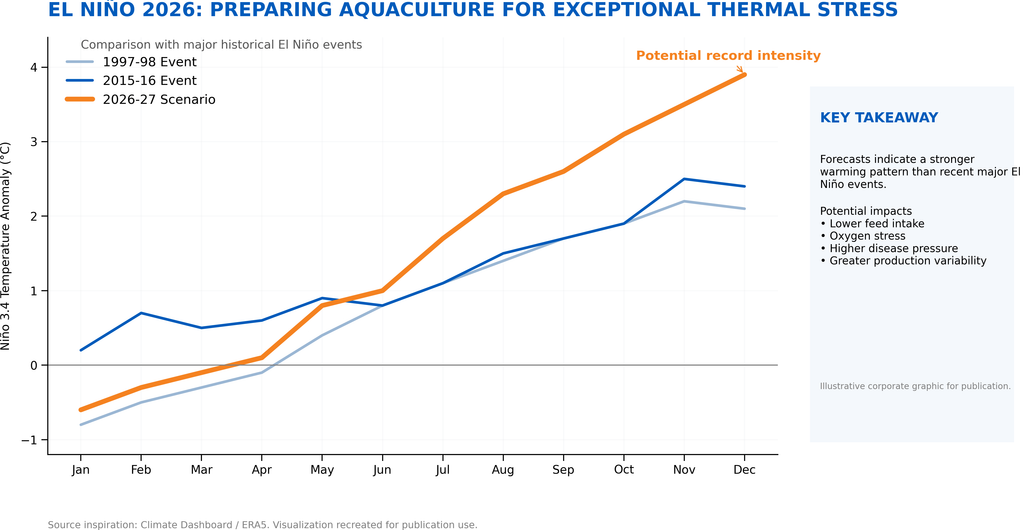
However, El Niño goes far beyond fisheries. Through its influence on atmospheric circulation and weather patterns, it affects rainfall, temperature, storms, agriculture, and aquatic ecosystems around the globe. While ENSO is a natural climate cycle, growing evidence suggests that climate change may increase the frequency and severity of extreme events. Ocean temperatures commonly rise by 1 to 2°C during El Niño episodes, but forecasts for the 2026-2027 event suggest anomalies of up to 3°C in parts of the eastern Pacific. Such changes have significant implications for aquaculture worldwide.

Impact on aquafeed raw materials
The most immediate impact of a strong El Niño is the disruption of marine ingredient supply. As anchovy biomass declines and quotas are reduced, fishmeal and fish oil availability tightens rapidly. Prices increase, creating pressure throughout the aquaculture value chain.
Feed manufacturers are therefore forced to expand the use of alternative ingredients such as algal oils, insect meals, microbial proteins and rendered land animal proteins. While adoption is advancing globally, regional differences remain significant. Chilean salmon producers have already integrated substantial levels of poultry and porcine proteins into their feed formulations, whereas uptake in Europe remains more limited because of retailer specifications and consumer expectations.
At the same time, restrictions on other forage fisheries, including herring, mackerel, sprat and blue whiting, further increase pressure on marine ingredient markets. This situation makes formulation flexibility more important than ever. As a result, for shrimp feed producers in Ecuador and Asia, optimising the nutritional value of every ingredient becomes a strategic priority.
El Niño may also influence terrestrial feed ingredients. Changes in rainfall and temperature patterns can affect crop yields and increase the risk of fungal contamination and mycotoxin development in plant-based raw materials. Consequently, feed manufacturers must navigate challenges on both marine and terrestrial ingredient fronts.
Impact on farm production in Chile and Tasmania
Among salmon-producing countries, Chile is particularly vulnerable to El Niño-related changes. The southern salmon farming regions typically operate in cool waters ranging between 4°C and 14°C. However, prolonged warming can push environmental conditions beyond the optimal range for Atlantic salmon.
Higher temperatures increase metabolic demands while reducing dissolved oxygen availability. This combination places fish under physiological stress, reducing growth performance and increasing susceptibility to disease.
Warm conditions also favor harmful algal blooms (HABs), known locally as marea roja or red tides. These blooms can dramatically reduce oxygen levels and release toxins capable of damaging fish gills. In severe cases, they can trigger large-scale mortality events and substantial economic losses.
Temperature increase may also accelerate the life cycle of caligus and contribute to the prevalence of bacterial diseases such as Salmon Rickettsial Syndrome. At the same time, thermal stress weakens immune function, making fish less able to cope with pathogen challenges.
The result is often slower growth, poorer feed efficiency, increased treatment costs and extended production cycles. Together, these factors place significant pressure on the profitability and sustainability of salmon farming operations.
Tasmania faces similar concerns. Rising seawater temperatures have increased attention on oxygen management, fish welfare, and disease prevention. As climate variability intensifies, salmon producers across the Southern Hemisphere must continue investing in monitoring systems, farm management practices, and nutritional strategies that improve resilience.

Impacts in Brazil and Ecuador
Across Latin America, El Niño affects aquaculture in different ways depending on geography and farming systems.
In Ecuador, moderate warming can initially benefit shrimp production. Temperatures within the optimal range stimulate metabolism and growth, allowing shrimp to reach market size more quickly. However, when warming becomes excessive, these benefits rapidly disappear.
Heavy rainfall can cause flooding of shrimp ponds and major fluctuations in salinity. Sudden changes in water quality create stress, weaken immune defenses and increase vulnerability to disease outbreaks. Environmental instability may also favour the emergence of harmful algal blooms and bacterial infections.
Under these conditions, shrimp producers often experience reductions in survival, feed efficiency and overall productivity. Higher temperatures also increase nutritional requirements, forcing feed manufacturers to adjust formulations to support performance under heat stress.
Nutritional strategies that improve digestibility, nutrient absorption and feed efficiency become increasingly valuable during El Niño periods, helping producers maintain growth while minimising feed costs.
In Brazil, the effects vary by region. Droughts may reduce water availability and compromise water quality, while excessive rainfall can damage infrastructure and disrupt operations. Tilapia, native freshwater species, and shrimp farming systems may all be affected. Consequently, adaptive management, biosecurity reinforcement, and nutritional optimisation are becoming key components of climate resilience strategies.
Impacts in Asia
Asia represents more than 90 percent of global aquaculture production and is therefore highly exposed to El Niño-related disruptions.
Across the region, altered rainfall patterns, droughts, floods and elevated temperatures affect both freshwater and marine production systems. Higher temperatures increase animal metabolism and nutritional requirements while simultaneously reducing dissolved oxygen concentrations, creating additional physiological stress.
In shrimp farming, elevated temperatures can increase growth rates initially, but prolonged heat stress often leads to poorer feed efficiency, reduced robustness and greater disease susceptibility. Fluctuating salinity and deteriorating water quality add further challenges.
Freshwater production systems face similar risks. Extended drought periods can reduce water availability and concentrate pollutants, while flooding can damage infrastructure, facilitate fish escapes and increase pathogen introduction.
Disease outbreaks often become more frequent during such periods of environmental instability. Bacterial, viral and parasitic challenges can significantly reduce survival and profitability in species such as shrimp, tilapia, pangasius, and carp.
As a result, producers throughout Asia are increasingly focusing on water management, biosecurity and nutrition as pillars of long-term resilience.
Adapting to a new climate reality
The most significant impact of El Niño on aquaculture may ultimately be the pressure it places on feed ingredient supply and cost. Yet the consequences extend far beyond nutrition alone. Higher temperatures, reduced oxygen availability, salinity fluctuations, disease pressure and increasing environmental variability are becoming recurring realities for producers around the world which affect animal robustness and increase the sensitivity to disease outbreaks.
What is perhaps most concerning is that these events appear to be increasing in both frequency and intensity. While ENSO remains a natural phenomenon, evidence suggests that climate change may amplify its effects, making adaptation increasingly important for the aquaculture sector.
At Adisseo, we have developed nutritional and health additive solutions that have supported the aquaculture industry for several decades. Feed additives that improve nutrient digestibility and utilisation can help reduce dependency on costly marine ingredients while maintaining animal performance. One such solution is Aqualyso, Adisseo’s lysophospholipid-based digestive enhancer designed for aquaculture species. By improving digestion, absorption and nutrient utilisation, Aqualyso allows nutritionists to increase the inclusion of alternative raw materials without compromising growth or feed conversion. When fishmeal and fish oil prices rise sharply, improving feed efficiency can significantly reduce formulation costs and improve profitability.
During El Niño events, the importance of preventive health additive strategies will be key to boost animal robustness under fluctuating and more extreme environmental conditions. Adisseo offers a range of health promoting additives with well documented modes-of-action including anti-inflammatory action, oxidative stress prevention, immune-modulation, acceleration of wound healing, enhancing robustness and resistance to pathogens. Maximising return on investment from additive strategies will result from the optimisation of the dosage and application of these preventive tools under field conditions.
By improving digestion and nutrient utilisation, supporting antioxidant capacity, promoting gut health and strengthening natural defense mechanisms, Adisseo’s solutions help producers maintain growth, feed efficiency and survival under challenging environmental conditions. This proactive approach enables farmers to better withstand climate-related stress and reduce production losses before disease problems emerge.
The aquaculture industry cannot control the arrival of the next El Niño. What it can control is how prepared it will be when it arrives.
For more information: https://www.adisseo.com/species/aquaculture