





























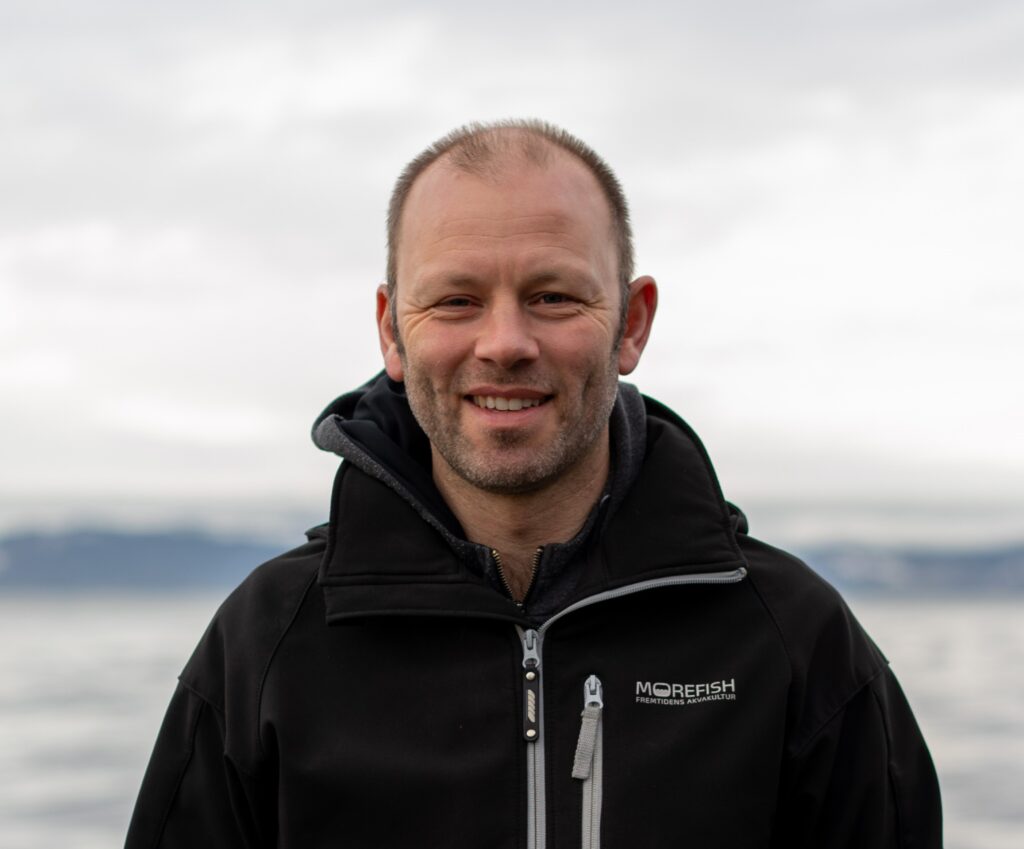
Svein Martinsen holds a master’s in aquaculture and a master’s in technology management from NTNU, Trondheim. Svein grew up at Smøla, an island west of Trondheim and south of Frøya – two societies built around fisheries and fish farming. After graduation, Svein engaged in a land-based halibut farm project, based on raceways. In 2002 he switched to Biomar and followed the first commercialisation period of cod farming, which ended in 2009. Prior to that, Svein had moved on to SINTEF Ocean for the role of Scientist, in the area of land-based farming. This was in the early years of modern RAS technology. A project with a closed floating cage, which eventually ended up as the company Fiizk, led Svein out in the industry again, joining Nekton AS at Smøla. With two RAS farms and cage farming operations, many risks were identified, solutions discussed, and all of this formed the platform of Morefish, formed in 2014. Now, Svein is the main owner and CEO of Morefish.
You have a rich career in the industry, what initially led you to this field?
I have been working in this industry since 1999, after finishing my studies at NTNU. My entry into the aquaculture industry was basically triggered by my uncle – Ivar Kvammen. He was a salmon farmer at Smøla, one of the largest aquaculture municipalities in Norway. My original choice of study was freshwater ecology, but my uncle convinced me to join the aquaculture industry, and to quote him, “probably will generate money in the long term”. And he was right! Right after my master’s degree, I embarked on a land-based halibut farm project. That didn’t go well, we farmed and sold 250t of halibut before the money ran out and farm was closed. So, yes – aquaculture generates money – but definitely not all species! Nowadays, halibut farming looks very promising, and biology, technology and market are much more aligned and ready for growth.
The aquaculture industry faces many challenges from sustainability to fish welfare. How do Morefish tackle and balance these issues?
I think modern aquaculture is on the verge of having to execute the technological shift. There are so many good indicators; closed cages have no sea lice, RAS and Flow through farms on land are able to scale up (14.000t harvested from land-based in 2024), sludge can be partly collected and reused for different purposes, whilst artificial intelligence is entering the industry and changing perspectives and intelligence, creating knowledge about how the fish physiology reacts to the environment and handling. We can go on and on. This means we are able to control the biological processes to a larger extent, improving welfare, sustainability and market acceptance. The key factor is whether this technology gives you higher or lower EBIT.
Can you give your perspective on the need for education and training for RAS in the aquaculture industry?
RAS emerges as the number one technology priority in the largest aquaculture nations. In Norway, close to 1000 people works with RAS today. Considering fish farming as a solely rural activities, there are challenges recruiting personnel with special competence. The need for formal competence is significant, remember that the RAS farms capex is often more than EU€100M and the value of the fish produced is enormous. You have to know what you are doing! And there are still things we don’t know about RAS operations, knowledge that is produced through R&D, industrial production, failures and discoveries, in which all needs to be implemented into the industry.
When we develop our training seminars, the experience from the industry is our main focus – what went wrong, why did it go wrong, and how did we solve it. This needs to be dynamic, as the industry moves fast. Creating schoolbooks is good, but after a year some of the content might not age well.
Can you tell us a bit about the research and development you’re currently involved in or looking to get involved in?
Morefish participate in quite different projects, all within the scope of fish welfare, sustainability and big data. We are doing some circular projects where discharge from farms is converted to value streams and in the future, some of this knowledge will be solutions. We also work with combining real time water quality with physiological insights of the fish, through blood analysis. This is the missing link; how does the environment in a land-based fish farm affect the fish and its potential for growth in the sea cage or grow out on land? We use AI to investigate these contexts, and the new knowledge will be implemented into new design changes. We do also work with projects with bioremediation of discharged compounds like nitrogen and phosphate – to produce low trophic organisms for feed production.
Sustainability is a big topic these days, what do you think the industry should be doing to meet the sustainable goals in fish farming?
This is very difficult topic, and one should be careful to issue bold statements, as profitability too often seems to trump animal welfare. In my opinion, the industry has great potential of performing better but needs incentives to do so. When industries deliver high profits, it’s generally very hard to impose significant changes, that also affects the profitability negatively. In Norway, some suggested that one open cage licence could be exchanged with three closed cage licences. These are the type of incentives that will increase sustainability.
Looking Ahead, what do you foresee as the most significant opportunity and challenge for the aquafeed industry, particularly concerning sustainability and land-based fish farming?
The dependency of global trade raw materials is the feed industries biggest bottleneck. When I started my career in Biomar in 2002, the global competition of fish oil and fishmeal took off – and implementation of vegetable raw materials were given full speed. We sold 1kg cod feed for EU€0.5/kg. Imagine that!
To ensure sustainability and mitigate the risk of global trade competition, feed raw materials could originate from novel sources, like low trophic organisms, wood, bacteria’s and sources that now are regulatory inhibited like blood meal. Digestibility of feed is also a factor that will be important in the new land-based farming industry. Increasing the digestibility will create less pollution in the farms, mitigating the risk for failures. And in addition, I would like to say that reduction of spill feed has great potential! Implementing new technology (camera, big data, closed systems) will reduce the amount of spill feed, creating better sustainability.
Published in the March 2025 issue of International Aquafeed & Fish Farming Technology